
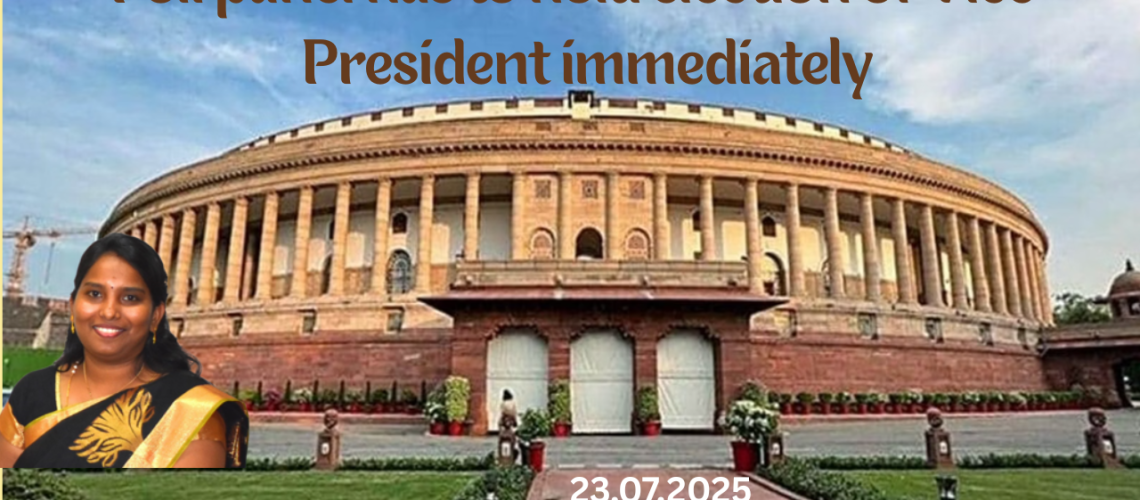
NEWS:Poll panel has to hold election of Vice-President immediately
GS-2 polity and governance
Vice-President Jagdeep Dhankhar’s resignation due to health reasons has created a mid-term constitutional vacancy, requiring the Election Commission to conduct a fresh election immediately, as per constitutional provisions
- The Vice-President’s post cannot be left vacant under the Constitution.
- No succession mechanism exists apart from conducting a fresh election.
- Deputy Chairman of Rajya Sabha will officiate proceedings until a new Vice-President takes charge.
- Election Commission is mandated to immediately notify and conduct the election.
- The electoral college includes all elected and nominated members of both Houses of Parliament.
- Voting follows proportional representation using the Single Transferable Vote (STV).
- Each MP’s vote carries equal value.
- Election of the Vice President of India
- The Vice-President, like the president, is elected not directly by the people but indirectly.
- He is elected by the members of an electoral college consisting of the members of both houses of Parliament. Thus, this electoral college is different from the electoral college for the election of the President in the following two respects:
- It consists of both elected and nominated members of the Parliament (in the case of the President, only elected members).
- It does not include the members of the state legislative assemblies (in the case of the President, the elected members of the state legislative assemblies are included).
- Vice-President’s election, like that of the President’s election, is held in accordance with the system of proportional representation by means of the single transferable vote, and the voting is by secret ballot.
- All doubts and disputes concerning the election of the Vice-President are inquired into and decided by the Supreme Court, whose decision is final
- Term and Vacancy
- Term: The Vice-President holds office for a term of five years from the date on which he enters his office. However, he can resign from his office anytime by addressing the resignation letter to the President.
- The Vice-President can hold office beyond his term of five years until his successor assumes charge. He is also eligible for reelection to that office. He may be elected for any number of terms.
NEWS:How different constitutional drafts imagined India
GS-2 polity and governance
Before the adoption of the 1950 Constitution, multiple drafts (1895–1948) were proposed by various ideologues reflecting contrasting visions of sovereignty, governance, rights, economy, and identity. These efforts offer deep insight into the evolution of constitutional thought in pre-independent India.
- Five major constitutional drafts proposed between 1895 and 1948 shaped India’s constitutional discourse.
- Ideologies ranged from liberalism, Gandhism, Hindu nationalism, to radical socialism.
- M.N. Roy’s draft (1944) uniquely emphasised participatory democracy, economic rights, and citizens’ committees.
- The Gandhian Constitution (1946) focused on village self-rule and trusteeship, rejecting industrial capitalism.
- The Socialist Party draft (1948) advocated nationalisation, class-based legislature, and economic democracy.
- The Hindusthan Free State draft (1944) reflected cultural nationalism, but surprisingly upheld secular guarantees.
- Elements from these drafts influenced the final 1950 Constitution, though none were adopted in full.
1. The Constitution of India Bill (1895):
- Attributed to early nationalists.
- Proposed representative government, civil liberties, separation of powers, and rule of law.
- Heavily inspired by British constitutional liberalism, focused on Dominion status, not full independence.
2. M.N. Roy’s Draft (1944):
- Rooted in radical humanism and participatory democracy.
- Introduced right to revolt, enforceable socio-economic rights, and citizens’ committees.
- Emphasised federalism, linguistic states, and transparency.
- Prioritised political education and rejected parliamentary sovereignty.
- Strong precursor to both Fundamental Rights and Directive Principles.
NEWS:SC cautions ED against being used to fight political battles
GS-2 governance
Bench dismisses appeal against a HC decision to set aside charges against the Karnataka Chief Minister’s wife in MUDA case; HC had raised doubts about the ED’s haste in initiating proceedings
- The High Court had raised doubts about the ED’s haste in initiating proceedings on the basis of alleged illegality in allotment of sites to various persons by MUDA, including Ms. Parvathi.
the Directorate of Enforcement (ED)
- The Directorate of Enforcement (ED) is a multi-disciplinary organization mandated with investigation of offences of money laundering and violations of foreign exchange laws.
- It functions under the Department of Revenue of the Ministry of Finance.
- As a premier financial investigation agency of the Government of India, the Enforcement Directorate functions in strict compliance with the Constitution and Laws of India.
- Where does the Genesis of ED Lie?
- The origin of this Directorate goes back to 1st May, 1956, when an ‘Enforcement Unit’ was formed in the Department of Economic Affairs for handling Exchange Control Laws violations under Foreign Exchange Regulation Act (FERA), 1947.
- It was headquartered in Delhi, headed by a Legal Service Officer as the Director of Enforcement.
- It had two branches – at Bombay and Calcutta.
- In the year 1957, this Unit was renamed as ‘Enforcement Directorate’, and another branch was opened at Madras (now Chennai).
- In 1960, the administrative control of the Directorate was transferred from the Department of Economic Affairs to the Department of Revenue.
- With the passage of time, FERA 1947 was repealed and replaced by FERA, 1973.
- With the onset of the process of economic liberalisation, FERA, 1973, which was a regulatory law, was repealed and in its place, a new law viz. the Foreign Exchange Management Act, 1999 (FEMA) came into operation w.e.f. 1st June 2000.
- Further, in tune with the International Anti Money Laundering regime, the Prevention of Money Laundering Act, 2002 (PMLA) was enacted and ED was entrusted with its enforcement w.e.f. 1st July 2005.
NEWS:NISAR first joint satellite of NASA and ISRO, scheduled to be launched on July 30
GS-3 science and technology
India and the United States are set to launch NISAR, the first joint Earth-observation satellite developed by NASA and ISRO, on July 30, 2025, marking a major milestone in international space cooperation
- Launch Date & Time: July 30, 2025, at 5:40 PM IST.
- Launch Site: Satish Dhawan Space Centre, Sriharikota.
- Launch Vehicle: GSLV-F16.
- Orbit: 743 km sun-synchronous orbit with 98.4° inclination.
- Technology: First satellite to use dual-frequency Synthetic Aperture Radar (SAR) — L-band (NASA) and S-band (ISRO).
- Antenna: NASA’s 12m unfurlable mesh reflector.
- Data Frequency: Revisits every 12 days, providing all-weather, day and night coverage.
- NISAR stands for NASA-ISRO Synthetic Aperture Radar, symbolizing collaboration in Earth science and space-based observations.
- The dual-frequency SAR allows high-resolution imaging for monitoring land and ice movements, infrastructure changes, and vegetation dynamics.
- It will be used for ground deformation monitoring, ice sheet tracking, soil moisture changes, storm characterization, and surface water mapping.
- NISAR will aid in disaster response by providing near real-time data during floods, landslides, and cyclones.
- The satellite features SweepSAR, a cutting-edge radar technology enabling large-area, high-resolution coverage.
- NISAR builds on over a decade of cooperation between ISRO and NASA’s Jet Propulsion Laboratory (JPL).
- The mission represents a strategic technological and diplomatic milestone in India–US relations in space exploration.
The satellite bus is based on ISRO’s modified I3K platform, ensuring indigenous integration and support
MAINS MOCK QUESTION
Makers of the constitution had gone through many constitution which is necessary for INDIA .critically comment

