
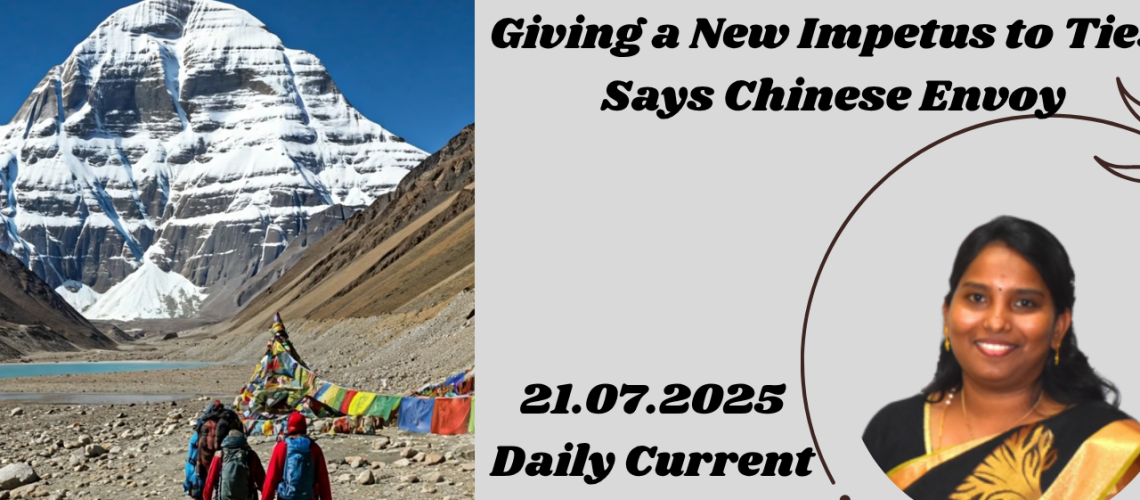
NEWS:Kailash Manasarovar Yatra Giving a New Impetus to Ties, Says Chinese Envoy
GS-2 international relation
Chinese Ambassador to India Xu Feihong highlighted China’s willingness to improve bilateral ties with India, including resuming the Kailash Manasarovar Yatra, initiating border management talks, and launching direct flights, amidst lingering tensions post-Galwan.
- China is ready to refine border management rules post-LAC standoff for sustained peace.
- Kailash Manasarovar Yatra seen as an initiative to boost bilateral ties..
- China downplays criticism of support to Pakistan during Operation Sindoor, calls ties “not targeted at third countries”.
- China warns India over Dalai Lama succession comments, implying sensitivity to Tibet issue.
- India had objected to Pakistan blocking anti-terror language at SCO Defence Ministers’ meeting.
- China encourages India to join regional trilaterals and Belt and Road Initiative (BRI), claiming trade with South Asia has doubled since BRI’s launch.
- Mount Kailash is a diamond-shaped peak made of black rock, located in Tibet.
- India organizes the KMY annually between June and September through the Lipulekh Pass (since 1981) in Uttarakhand and the Nathu La Pass (since 2015) in Sikkim.
- Mount Kailash stands at 6,638 meters and is considered a sacred peak by Hindus, Buddhists, Jains, and Bons (indigenous religion of Tibet).
- For Tibetans Buddhists, Kailash is the cosmic axis, or Mount Meru, connecting heaven and earth.
- In Hinduism, it is the abode of Lord Shiva and Goddess Parvati.
- In Jainism, Kailash is Ashtapada, where Rishabhanatha attained enlightenment.
- Mount Kailash is considered the spiritual center of the Earth, with the Sutlej, Brahmaputra, Kamali, and Indus rivers originating from it.
- Lake Mansarovar is located at the base of the mountain.
- Mount Kailash, though lower in height than Mount Everest (8,849 meters), remains unclimbed as its ascent is prohibited due to its sacred significance
NEWS:Is Israel Committing Genocide in Gaza?
GS-2 international relation
In January 2024, South Africa filed a case at the International Court of Justice accusing Israel of genocide in Gaza following the October 2023 conflict; while the final verdict is pending, the ICJ has issued provisional measures, indicating a plausible risk of genocide.
- South Africa invoked the Genocide Convention (1948), claiming Israel is violating its obligations in Gaza.
- ICJ issued binding provisional measures, including directions for unimpeded humanitarian aid to Gaza.
- Over 58,000 people killed in Gaza; more than 17,000 children dead; infrastructure devastation includes 90% of educational institutions destroyed.
- International experts, UN officials, and rights groups have increasingly described Israel’s actions as potentially genocidal.
- Israel denies genocide, asserting its campaign targets Hamas and that civilian harm is collateral damage.
- The specific intent to destroy a group, required to prove genocide, remains the most challenging element legally.
- UNGA has adopted a resolution calling for economic sanctions, but Western powers continue shielding Israel diplomatically.
Convention on the Prevention and Punishment of the Crime of Genocide, 1948
- In 1948, the Convention was adopted by the UNGA and came into force in 1951.
- It is an international convention that defines genocide and obligates State Parties to prevent and punish the crime of genocide.
- The Genocide Convention was the first human rights treaty adopted by the UNGA.
- It is an instrument of international law leading to the codification of genocide, for the first time, as a crime.
- There are about 153 member states that are engaged with the Genocide Convention.
- Zambia is the most recent country to sign the convention in 2022.
- India actively participated in the formulation of the Genocide Convention and ratified it in 1959. Despite the ratification, India is yet to define genocide by law.
NEWS:Annual Share of Abstentions in India’s UN Votes Reaches Record High
India’s voting behaviour at the UN has shifted markedly, with the share of abstentions reaching an all-time high in 2025. This reflects India’s nuanced diplomatic positioning amid rising global polarisation and increasingly complex resolutions.
- In 2025, India’s share of ‘yes’ votes dropped to 56%, the lowest since 1955.
- Share of abstentions rose to 44%, the highest in India’s UN voting history.
- The trend shift began around 2019, correlating with rising global polarisation.
- Between 1970–1994, ‘yes’ votes ranged from 74% to 96%, and abstentions from 8% to 19%.
- Former diplomats argue abstention is now a strategic tool, not indecision.
- Resolutions have become more complex and multi-issue, making binary choices harder
India has a strong and longstanding relationship with the United Nations, being a founding member and actively participating in various UN initiatives, including peacekeeping operations and advocating for global issues. India is also a strong proponent for UN reforms, particularly regarding the UN Security Council, and seeks permanent membership.
Key Aspects of India’s Relationship with the UN:
- Founding Member:
India was among the original signatories of the Declaration by United Nations in 1942 and participated in the San Francisco Conference in 1945, which established the UN.
- Active Engagement:
India has been an active member of the UN since its inception, raising concerns about issues like racism and apartheid in the UN forum and playing a significant role in the drafting of the Universal Declaration of Human Rights.
- UN Peacekeeping:
India is a major contributor to UN peacekeeping missions, consistently ranking as one of the largest troop contributors.
- Advocate for Developing Nations:
India has been a vocal advocate for the interests of developing nations, including its leadership role in the Non-Aligned Movement (NAM) and G77.
- UN Security Council:
India has served as a non-permanent member of the UNSC eight times, most recently in 2011-12 and 2021-22.
- UN Reforms:
India is a strong proponent of UN reforms, particularly regarding the UNSC, and seeks permanent membership to better reflect the global realities and contribute to international peace and security.
NEWS:The recent political row in Tamil Nadu over diverting temple funds for building colleges has reignited debate
GS-2 governance
- The Tamil Nadu Hindu Religious and Charitable Endowments (HR&CE) Act, 1959 legally allows surplus temple funds to be used for secular purposes like education.
- The East India Company initiated oversight of temple finances in Regulation 1817, refined post-1857 under British Crown.
- Section 36 of the 1959 Act allows surplus funds (after maintenance) to be used for purposes like college construction.
- Historical usage of temples as socio-cultural and educational hubs during Chola and Vijayanagara periods supports current practices.
- The Self-Respect Movement and anti-caste reforms used temple oversight to push for temple entry and backward class inclusion in priesthood.
- Temple donations, though religious in intent, historically served public welfare functions under state facilitation.
MAINS MOCK QUESTION
India china relation has many ups and down .examine the Importance of it

