
News 1:Israel Won’t Hit Key Iran Gas Facility Again: Trump
Preliminary Facts (For Mains Answer Introduction)
- Israeli Strike on South Pars: Israel carried out air strikes on Iran’s South Pars gas field in Bushehr province, one of the largest known gas fields in the world, causing a fire. This marks a significant escalation in targeting Iran’s energy infrastructure .
- US Distancing: President Donald Trump distanced the US from the strike, stating in a social media post that the “United States knew nothing about this particular attack” and warned that Israel would not target the site again unless Iran attacks Qatar .
- Iranian Retaliation: Iran launched missile attacks at energy facilities in Qatar, Saudi Arabia, the United Arab Emirates, and Israel in response. Key targets included:
- Qatar: Ras Laffan Industrial City (handles ~20% of global LNG exports) and other LNG facilities suffered “extensive damage” .
- Saudi Arabia: Samref refinery in Yanbu hit by drone .
- Kuwait: Mina Abdullah and Mina Al-Ahmadi refineries hit, causing fires .
- UAE: Habshan gas facility suspended operations; Bab oil field targeted .
- Israel: Oil refinery in Haifa reportedly hit .
- Diplomatic Fallout: Qatar declared Iranian military and security attachés “persona non grata” , giving them 24 hours to leave. Saudi Arabia’s Foreign Minister stated the kingdom reserves the right to take military action “if deemed necessary”. The UAE condemned the attacks as a “dangerous escalation” .
- Iran’s Conditional Restraint: Iran’s Foreign Minister Abbas Araghchi signalled readiness for restraint but threatened to escalate if its energy facilities are attacked again .
South Pars Context: South Pars is part of an offshore gas reservoir shared by Iran and Qatar, making the strike particularly sensitive for Qatari interests
Saudi Arabia’s Defence Ministry said a drone crashed into the Samref refinery in the Red Sea port of Yanbu.
Prelims 360
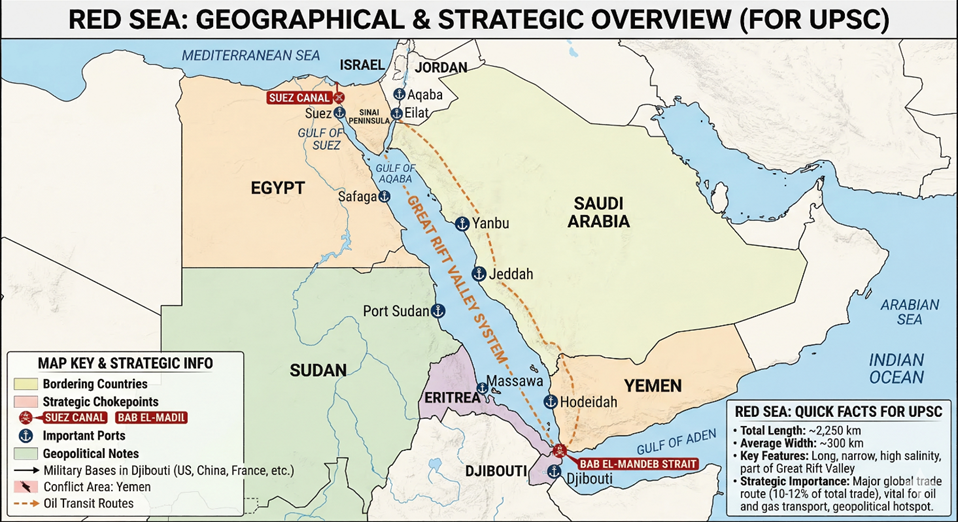
The Red Sea is a strategically crucial water body connecting the Mediterranean Sea (via the Suez Canal) to the Indian Ocean (via the Bab el-Mandeb Strait).
🌍 Red Sea – Bordering Countries
African Coast (West)
- Egypt
- Sudan
- Eritrea
- Djibouti
Asian Coast (East)
- Saudi Arabia
- Yemen
Importance in Global Economy
1. Major Global Trade Route
- One of the busiest maritime trade corridors in the world.
- Connects Europe ↔ Asia via:
- Suez Canal
- About 10–15% of global trade passes through this route.
2. Energy Lifeline (Oil & Gas Transport)
- Vital for transportation of:
- Crude oil
- LNG (Liquefied Natural Gas)
- Oil flows from:
- Persian Gulf
→ to Europe & North America
- Persian Gulf
- Disruption raises global fuel prices.
3. Strategic Chokepoint – Bab el-Mandeb
- Narrow passage connecting Red Sea to Gulf of Aden.
- Located between:
- Yemen
- Djibouti
- Any blockage affects:
- Global shipping
- Energy security
4. Alternative to Longer Sea Routes
- Avoids route around:
- Cape of Good Hope
- Saves:
- Time (10–15 days)
- Fuel cost
- Insurance costs
5. Geopolitical & Security Importance
- Presence of major powers (US, China, EU navies)
- Issues:
- Piracy (Horn of Africa)
- Conflict in Yemen
- Important for India’s maritime security and trade
News 2 :Iran May Let More Indian Vessels Pass Hormuz Strait
Preliminary Facts (For Mains Answer Introduction)
- Iran’s Approval Process: Iran is putting together a formal approval process for allowing safe passage of ships through the Strait of Hormuz, according to Lloyd’s List Intelligence (LLI), a maritime data and intelligence company. This involves vessels passing through Iranian territorial waters via a route close to Larak Island for visual inspection by the IRGC Navy .
- India’s Diplomatic Push: Following Prime Minister Narendra Modi’s conversation with Iranian President Masoud Pezeshkian on March 12, India has been in direct talks with Tehran to secure safe passage for 22 India-bound vessels stranded west of the strait. Of these, 20 are critical to India’s energy security .
- Successful Transits: Two Indian-flagged LPG carriers, Shivalik and Nanda Devi, successfully transited the strait around March 13-14 using the Iranian corridor. Shivalik has since arrived at Mundra Port, and Nanda Devi is expected at Kandla, together carrying over 92,000 metric tonnes of LPG .
- Case-by-Case Basis: External Affairs Minister S. Jaishankar clarified that while diplomatic engagement is yielding results, a formal “blanket arrangement” has not been finalized. Vessel transit is currently being handled on a “case-by-case basis” .
- Payment Controversy: LLI has reported that nine ships have exited through Iran’s corridor, with at least one tanker allowed passage reportedly for a payment of $2 million to Iran .
- Process Paused: Reliable sources in India indicate that the evacuation process has been paused after Israeli strikes on Iran’s South Pars gas field, and Indian ships have been asked to “stay put” for now .
- Iran’s Stance: Iran’s Ambassador to India, Mohammad Fathali, confirmed that Iran would try to remove problems for Indian ships, stating “India is our friend” with common interests . However, Iran has declared it will not permit vessels linked to the United States and Israel to pass .
Prelims 360
the Persian Gulf
Location & Boundaries
- The Persian Gulf is a marginal sea of the Indian Ocean located in Southwest Asia (Middle East).
📌 Boundaries:
- West → Iraq & Kuwait
- North → Iran
- South → Saudi Arabia, Bahrain, Qatar, United Arab Emirates, Oman
- East (connection) → Opens into the Gulf of Oman through the
➤ Strait of Hormuz
Dimensions (Important Facts)
- Length: ~ 990 km
- Width: 56 km (narrowest) to ~338 km (widest)
- Area: ~ 251,000 sq km
- Average Depth: ~ 50 meters (very shallow)
- Maximum Depth: ~ 90 meters
👉 Key Point: It is a shallow and semi-enclosed sea
Climatic & Oceanographic Features
- High salinity (due to high evaporation & low freshwater inflow)
- Hot arid climate surrounding region
- Limited water exchange → through Strait of Hormuz only
Classification of Maritime Zones (UNCLOS-based)
| Zone | Limit | Rights |
| Territorial Sea | Up to 12 nautical miles | Full sovereignty (water, airspace, seabed) |
| Contiguous Zone | 12–24 nautical miles | Enforcement (customs, immigration, security) |
| Exclusive Economic Zone (EEZ) | Up to 200 nautical miles | Resource exploitation rights |
| Continental Shelf | Up to 200+ nm | Seabed resource rights |
👉 BUT in the Persian Gulf:
- The Gulf is very narrow (~990 km long, ~56–338 km wide)
- Overlapping claims are common
- Most boundaries are settled through bilateral agreements
2. Semi-Enclosed Sea Status
The Persian Gulf is treated as a:
➡️ “Semi-enclosed sea” under UNCLOS (Part IX)
Implications:
- Coastal states must cooperate in:
- Resource management
- Environmental protection
- Navigation safety
News 3 : Stock Markets Crash Over 3% as Oil Price Spikes to $114 a Barrel
Preliminary Facts (For Mains Answer Introduction)
- Market Meltdown: Indian stock markets crashed over 3% on Thursday (March 19, 2026), marking the worst day since June 2024 when markets fell over 5%. This is the fifth instance since 2021 that benchmark indices dipped below 3% .
- Key Indices: Nifty closed at 23,002.15 (down from opening 23,197.75) and Sensex at 74,207.24 (down from opening 74,750.92), after hitting day’s lows of 22,930.35 and 73,950.95 respectively—levels last seen in mid-2024 .
- Trigger Events: The crash was driven by a “perfect storm” of factors:
- Oil Price Surge: Brent crude futures hit a new high of $114 per barrel following Israeli attacks on Iran’s South Pars gas field and Iranian retaliation on Gulf energy facilities .
- Rupee Depreciation: The rupee depreciated to a new low of ₹92.89 against the US dollar .
- US Federal Reserve Stance: Fed held rates steady (3.5-3.75%) but signalled higher inflation could stymie further rate cuts in 2026, potentially intensifying foreign fund outflows from India .
- Sectoral Impact: All 21 sectoral indices were down, with Nifty Auto falling over 4% . Gold also tumbled 3% to $4,650 per ounce due to inflation concerns .
- Market Fragility: Analysts warn of “heightened fragility” with sentiment driven by rapidly evolving geopolitical developments and sharp crude price rises. Volatility is expected to persist .
- Technical Analysis: Nifty breached its key prior swing low of 22,955, confirming a bearish trend .
Prelims 360
Capital Outflow – Clear UPSC Concept
Capital outflow means money moving out of a country’s financial system to foreign countries for investment, safety, or better returns.
🧾 Definition
👉 When foreign investors (or even domestic investors) sell assets in India and take money abroad, it is called capital outflow.
🔍 Types of Capital Outflow
1. Portfolio Investment Outflow
- Foreign investors sell shares/bonds
- Example: FIIs selling stocks in BSE Sensex
2. Foreign Direct Investment (FDI) Outflow
- Companies move long-term investments abroad
3. Debt Outflows
- Investors withdraw from Indian bonds
⚠️ Causes of Capital Outflow
- Global Interest Rate Rise
- Example: US interest rates increase → investors shift to US
- Economic Instability
- Inflation, recession fears
- Political Uncertainty
- Currency Depreciation Expectations
- Fear that ₹ will weaken
- Stock Market Crash
- Investors exit to avoid losses
When the stock market (like the BSE Sensex) falls sharply, the Reserve Bank of India (RBI) does not directly control stock prices, but it intervenes to stabilize liquidity, confidence, and the financial system.
Here are the step-by-step measures RBI typically takes (important for UPSC):
🧭 1. Liquidity Injection (Most Immediate Step)
- RBI ensures enough money in the banking system.
- Tools:
- Repo Rate cut → cheaper borrowing for banks
- Open Market Operations (OMO) → buys government securities
- CRR reduction → banks have more money to lend
👉 Aim: Prevent panic and credit crunch.
💰 2. Interest Rate Policy Adjustment
- RBI may reduce policy rates (Repo, Reverse Repo).
- Encourages:
- Investment
- Consumption
👉 Helps revive market sentiment.
🏦 3. Special Liquidity Windows
- RBI may open emergency funding lines for:
- Banks
- NBFCs
- Mutual funds
Example: During crises like COVID-19, RBI provided targeted liquidity.
🔄 4. Forex Market Intervention
- If fall triggers capital outflows:
- RBI sells foreign exchange reserves
👉 Stabilizes Indian Rupee.
- RBI sells foreign exchange reserves
News 4 : Unfenced Border with Myanmar in Focus After Arrest of Seven Foreigners
Preliminary Facts (For Mains Answer Introduction)
- Security Breach: Seven foreign nationals—six Ukrainians and one U.S. citizen—were arrested for allegedly crossing illegally into Myanmar via Mizoram to train armed ethnic groups in weapons handling and drone operations. The National Investigation Agency (NIA) accused them of importing drones from Europe to Myanmar via India for use by ethnically armed groups (EAGs) .
- Border Fencing Status: Of the total 1,643 km India-Myanmar border, only 43.75 km (2.6%) has been fenced so far. While 390.39 km has been sanctioned, 346.64 km is under construction .
- Free Movement Regime (FMR): India and Myanmar have a unique arrangement allowing visa-free movement within 16 km (recently restricted to 10 km) on either side of the unfenced border. Home Minister Amit Shah announced in February 2024 that FMR was being scrapped, but it has only been regulated so far .
- Proposed Gates: The fencing project includes installation of 43 designated exit and entry gates to regulate movement, recording biometrics and photographs of crossers. However, the number has declined to 38, with only 20 now functional .
- Security Coordination: The government informed a parliamentary panel that “coordination with local communities, Myanmar Army and associated security agencies is maintained” and a “joint counter-drone mechanism with monthly reporting has also been instituted” .
Resistance Factors: The project faces resistance due to deep ethnic, social, and cultural ties between communities on either side of the border .
Prelims 360
India–Myanmar Border
- Length: ~ 1,643 km
- Runs through 4 North-Eastern states:
- Arunachal Pradesh
- Nagaland
- Manipur
- Mizoram
Key Features
- Mostly hilly, forested, and porous
- Inhabited by ethnic tribes with shared cultural ties across both sides
- Important for:
- Act East Policy
- Border trade (e.g., Moreh–Tamu route)
- Security concerns (insurgency, smuggling)
🔓 Free Movement Regime (FMR)
What is FMR?
- A special arrangement between India and Myanmar
- Allows tribal people living along the border to cross freely without visa
Key Provisions
- Movement allowed up to 16 km inside each other’s territory
- Border residents need a border pass
- Applicable mainly to recognized tribes
🎯 Objectives
- Maintain traditional socio-cultural ties
- Facilitate local trade and interaction
- Reduce alienation in border areas
⚠️ Issues / Challenges
- Insurgency & militancy (safe havens across border)
- Illegal migration
- Drug trafficking (Golden Triangle proximity)
- Arms smuggling
🔄 Recent Developments (Important for Prelims)
- Government of India has decided to review/scrap FMR
- Plan to:
- Fence the border
- Replace FMR with stricter regulated movement
- Driven by:
- Security concerns in Manipur
- Rising illegal activities

