

News 1: Pak. bombs Kabul, declares ‘open war’
Preliminary Facts
Escalation to “Open War”: Pakistan bombed major cities in Afghanistan, including the capital Kabul, on Friday, with Islamabad’s Defence Minister declaring the neighbours at “open war” following months of tit-for-tat clashes .
- Immediate Trigger: Pakistan’s latest operation came after Afghan forces attacked Pakistani border troops on Thursday night in retaliation for earlier air strikes by Islamabad .
Syllabus Mapping (Relevance)
- GS Paper II: International Relations – India’s neighbourhood (Afghanistan, Pakistan), Effect of regional conflicts on India’s interests, Terrorism, Strategic stability in South Asia.
- GS Paper III: Internal Security – Cross-border terrorism, Impact on Indian security.
- GS Paper II: International Relations – India’s policy towards Taliban-ruled Afghanistan.
Deep Dive: Core Issues & Analysis
A. The Escalation: From Tit-for-Tat to “Open War”
| Phase | Events |
| Months Prior | Tit-for-tat clashes along Pakistan-Afghanistan border |
| Thursday Night | Afghan forces attack Pakistani border troops (retaliation for earlier Pakistani strikes) |
| Friday | Pakistan bombs major Afghan cities, including Kabul |
| Declaration | Pakistan’s Defence Minister declares “open war” |
- Significance of “Open War” Declaration: This is the first time since the Taliban takeover in 2021 that Pakistan has explicitly declared a state of war with its neighbour, marking a dramatic escalation .
C. Historical Context: Pakistan-Afghanistan Relations
| Period | Relationship |
| Pre-2021 | Pakistan supported Taliban against US-backed Kabul government; but relations never fully stable |
| Post-2021 (Taliban Takeover) | Pakistan expected compliant, friendly regime; hoped for strategic depth against India |
| 2021-2026 | Growing friction over border (Durand Line), Tehrik-i-Taliban Pakistan (TTP) sanctuaries, and cross-border attacks |
- The TTP Factor: Tehrik-i-Taliban Pakistan (TTP), an anti-Pakistan terrorist group, operates from Afghan soil. Pakistan accuses the Afghan Taliban of sheltering TTP fighters who launch attacks inside Pakistan .
D. Why This Matters for India
| Dimension | Implication for India |
| Pakistan’s Western Front | Pakistan now faces active conflict on its western border; may reduce focus on India (eastern border) |
| Terrorism Threat | Instability in Afghanistan could lead to increased terrorist activity, potentially spilling into India |
| Strategic Opportunities | Pakistan’s entanglement may open diplomatic space for India in Afghanistan |
| Refugee Flows | Conflict could generate new refugee flows towards India |
| Great Power Dynamics | China (Pakistan’s ally) and US (concerned about terrorism) will be drawn in |
- India’s Policy Dilemma: India has traditionally supported anti-Taliban forces but has also engaged with Taliban for humanitarian assistance. The current conflict complicates this balancing act .
E. Regional and Global Implications
| Actor | Interest | Potential Response |
| China | Strategic ally Pakistan; Belt and Road (CPEC) | May urge restraint; could mediate |
| United States | Counter-terrorism; prevent Afghanistan becoming terror hub | Concerned about ISIS/al-Qaeda resurgence |
| Iran | Shares border with Afghanistan; Shia interests | Monitoring; may support Shia groups |
| Central Asian States | Concerned about spillover | Border security; diplomacy |
Key Terms
- Durand Line: 2,640-km border between Pakistan and Afghanistan; disputed by Afghanistan .
- TTP (Tehrik-i-Taliban Pakistan): Anti-Pakistan terrorist group based in Afghanistan .
- Strategic Depth: Pakistan’s Cold War-era doctrine of using Afghanistan for strategic depth against India .
- ISKP (ISIS-Khorasan): Islamic State affiliate in Afghanistan; threat to all .
- Cross-Border Terrorism: Terrorist attacks launched from one country into another .
- Fog of War: Uncertainty in situational awareness during conflict .
Mains Question Framing
- GS Paper II (International Relations): “Pakistan’s declaration of ‘open war’ with Taliban-ruled Afghanistan marks a dramatic escalation in regional tensions. Analyze the causes of this conflict and its implications for India.”
News 2: New GDP series upgrades FY26 growth to 7.6% in second advance estimates
Preliminary Facts
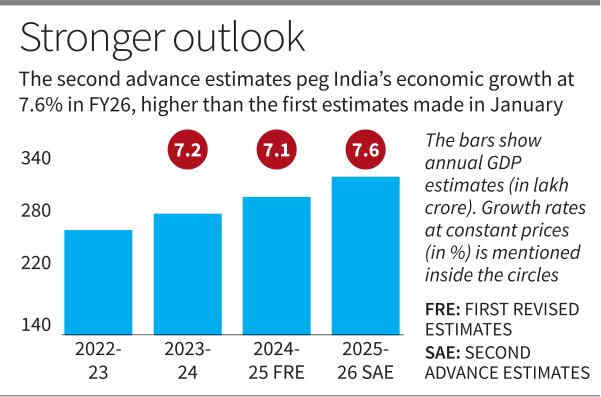
- Growth Projection: India’s economic growth is expected to touch 7.6% in the current financial year 2025-26, according to the second advance estimates of GDP based on the new and updated series released by the government on Friday .
- Revision Upward: This is faster than the 7.4% predicted in the first advance estimates for 2025-26 released in January (which was based on the older series) .
- New Series Features: The new series, released by Statistics Secretary Saurabh Garg and Chief Economic Adviser V. Anantha Nageswaran, incorporates:
- Updated base year: 2022-23 (from earlier 2011-12)
- New data sets for improved representativeness and granularity
- Methodological improvements across sectors
- Revisions to Previous Years:
- 2023-24: Revised downward to 7.2% (from 9.2% in old series)
- 2024-25: Revised upward to 7.1% (from 6.5% in old series)
- Nominal GDP Impact: India’s nominal GDP (size of the economy) has been revised downward for the three years spanning 2023-26, which will negatively impact fiscal ratios pegged to these numbers (fiscal deficit-to-GDP, debt-to-GDP) .
Syllabus Mapping
- GS Paper III: Economy – Growth and development, National income accounting, GDP/GVA estimation, Fiscal policy indicators.
- GS Paper II: Governance – Role of statistics in policy-making, Institutional mechanisms (MoSPI).
- GS Paper III: Economy – Inflation, Fiscal deficit, Public debt.
Deep Dive: Core Issues & Analysis (For Mains Answer Body)
A. Growth Trajectory: Revised Estimates at a Glance
| Year | Old Series Estimate | New Series Estimate | Revision |
| 2023-24 | 9.2% | 7.2% | -2.0% |
| 2024-25 | 6.5% | 7.1% | +0.6% |
| 2025-26 (2nd AE) | 7.4% (1st AE, old) | 7.6% (2nd AE, new) | +0.2% |
- Key Observations:
- The sharp downward revision for 2023-24 (from 9.2% to 7.2%) suggests the post-pandemic rebound was less robust than previously estimated
- The upward revision for 2024-25 (6.5% to 7.1%) and 2025-26 (7.4% to 7.6%) indicates stronger-than-expected recent momentum
- India remains the fastest-growing major economy despite revisions
B. Why the New Series Matters: Methodological Improvements
| Improvement | Old Series (2011-12 base) | New Series (2022-23 base) |
| Base Year | 2011-12 (outdated structure) | 2022-23 (current economic reality) |
| Data Sources | Limited | GST data, ASUSE, PLFS, STRBI, MCA data |
| Private Corporate Sector | Company-level allocation | Activity-wise revenue share |
| Household Sector | Extrapolated | Annual ASUSE and PLFS |
| Government Sector | Housing services excluded | Included |
| Informal Sector | Weak capture | Enhanced through ASUSE |
- Implication: The new series provides a more accurate picture of the economy, capturing structural shifts (digitalization, formalization, services growth) that the 2011-12 base missed .
C. Nominal GDP Revision: Impact on Fiscal Ratios
| Fiscal Indicator | Formula | Impact of Lower Nominal GDP |
| Fiscal Deficit-to-GDP | Deficit / Nominal GDP | Increases (denominator smaller) |
| Debt-to-GDP | Public Debt / Nominal GDP | Increases (denominator smaller) |
| Tax-to-GDP | Tax Revenue / Nominal GDP | Increases (denominator smaller, but numerator may also adjust) |
- The Mechanism: Nominal GDP has been revised downward for 2023-26. Since fiscal deficit and debt are absolute numbers (or grow at different rates), a smaller denominator makes the ratios look worse—even if the absolute fiscal situation hasn’t changed .
- Policy Implications: The government’s fiscal consolidation path (targeting 4.5% fiscal deficit by 2025-26) becomes harder to achieve in ratio terms. However, policymakers will likely focus on absolute deficit targets rather than ratios during transition .
D. Sectoral Implications (Based on Earlier New Series Analysis)
| Sector | Improved Estimation | Policy Relevance |
| Manufacturing | Activity-wise revenue share | Better targeting of PLI schemes |
| Services | GST data integration | Reflects formalization |
| Agriculture | ASUSE for informal agri-enterprises | Rural policy design |
| Construction | Enhanced data sources | Infrastructure planning |
- Better Data, Better Policy: The granularity of the new series enables more targeted policy interventions—identifying which sub-sectors are driving growth and where bottlenecks lie .
E. India’s Growth Story: Context and Credibility
| Indicator | Value | Significance |
| 2025-26 Growth | 7.6% | Fastest among major economies |
| Global Context | IMF projects global growth ~3% | India’s outperformance continues |
| Inflation | Within RBI tolerance band | Supports monetary policy |
| External Sector | CAD manageable | Resilient to global shocks |
- Credibility Boost: The transparent revision process and methodological improvements enhance the credibility of India’s GDP data, which had faced international scrutiny after the 2015 revisions .
Key Terms (For Prelims & Mains)
- GDP (Gross Domestic Product): Total value of goods and services produced within country .
- Nominal GDP: GDP at current prices (not adjusted for inflation) .
- Real GDP: GDP adjusted for inflation; measures volume growth .
- Base Year: Reference year for constant price calculations .
- Fiscal Deficit: Excess of government expenditure over revenue (excluding borrowings) .
- Debt-to-GDP Ratio: Public debt as percentage of GDP; key sustainability indicator .
- ASUSE (Annual Survey of Unincorporated Sector Enterprises): Survey of informal enterprises .
- PLFS (Periodic Labour Force Survey): Labour force indicators .
- GST Data: Goods and Services Tax transactions data .
Mains Question Framing
- GS Paper III (Economy): “India’s growth estimate for 2025-26 has been revised upward to 7.6% in the second advance estimates based on the new GDP series. Discuss the key methodological improvements in the new series and their implications for economic policymaking.”
News 3: Navy boosts anti-submarine capability with INS Anjadip
Preliminary Facts
- Commissioning Event: The Indian Navy on Friday commissioned its fourth indigenously designed and built Anti-Submarine Warfare Shallow Water Craft (ASW SWC) , INS Anjadip, at Chennai Port. The vessel was commissioned by Chief of the Naval Staff, Admiral Dinesh K. Tripathi .
- Vessel Specifications:
- Length: 77 metres
- Role: Detect, track, and neutralise enemy submarines in coastal waters
- Namesake: Named after the historic island off the coast of Karwar, carrying forward its valour
- Indigenous Content: The ship is equipped with an indigenous anti-submarine warfare weapons and sensor package, including:
- Modern shallow-water sonars
- Lightweight torpedoes
- Anti-submarine rockets
- Combat management system
- Builder: Constructed at Kattupalli by Garden Reach Shipbuilders & Engineers (GRSE) , Kolkata .
- Admiral’s Statement: “The ship and her systems distinctly reflect the growing strength of India’s indigenous design and industrial ecosystem. Aatmanirbharta, today, is moving beyond Make in India to Trust in India” .
- Additional Roles: Beyond ASW, the vessel can undertake coastal surveillance, low-intensity maritime operations, and search and rescue operations .
Syllabus Mapping
- GS Paper III: Security – Coastal security, Maritime security, Naval capabilities.
- GS Paper III: Defence – Indigenous defence production, Aatmanirbhar Bharat in defence.
- GS Paper III: Science & Technology – Indigenous shipbuilding, Sonar technology, Torpedoes.
- GS Paper II: Governance – Public sector undertakings (GRSE), Defence procurement.
Deep Dive: Core Issues & Analysis
A. The Threat: Why Shallow Water Anti-Submarine Warfare Matters
| Threat | Description | Indian Vulnerability |
| Enemy Submarines | Modern submarines are silent, stealthy, and lethal | Can operate undetected in shallow coastal waters |
| Coastal Approaches | Shallow waters (littoral zones) are difficult for deep-water sonars | Dedicated shallow-water craft needed |
| Critical Infrastructure | Ports, naval bases, offshore installations are vulnerable | Protection requires layered defence |
- ASW Shallow Water Craft Role: These vessels are designed specifically to operate in coastal waters where deep-water ASW platforms (like destroyers) cannot effectively operate. They form the inner layer of India’s anti-submarine defence .
B. Indigenous Capabilities: Aatmanirbharta in Action
| Component | Indigenous Content | Significance |
| Design | Indian-designed | Full ownership of intellectual property |
| Construction | GRSE (Kolkata) at Kattupalli yard | Public sector shipbuilding capability |
| Sonars | Modern shallow-water sonars (indigenous) | Critical technology; earlier imported |
| Weapons | Lightweight torpedoes; ASW rockets | Indigenous weapons integration |
| Combat Management System | Indigenous | Core combat capability |
- Admiral’s Framing: “Aatmanirbharta, today, is moving beyond Make in India to Trust in India.” This shift emphasizes not just domestic production but confidence in indigenous design, quality, and reliability .
C. INS Anjadip: Fourth in the Series
| Vessel | Commissioning Date | Significance |
| First of Class | (Earlier) | Established the class |
| Second | (Earlier) | Series production validated |
| Third | (Earlier) | Fleet strength growing |
| INS Anjadip (Fourth) | February 2026 | Demonstrates sustained production capability |
- Series Production: The commissioning of the fourth vessel indicates that the design is mature and production is streamlined—key for fleet expansion .
D. Strategic Context: India’s Maritime Challenges
| Challenge | Relevance to INS Anjadip |
| Pakistan Navy submarines | Agosta-class, air-independent propulsion (AIP) submarines can threaten Indian west coast |
| Chinese Navy presence | Increased PLA Navy activity in Indian Ocean; submarines monitored |
| Maritime terrorism | Coastal security against non-state threats |
| Critical infrastructure protection | Ports (like Chennai, Mumbai, Karwar) need layered defence |
- Littoral Focus: The vessel’s primary role in “littoral combat environment” addresses a specific gap—submarines are hardest to detect in shallow, noisy coastal waters .
E. Economic and Industrial Impact
| Aspect | Impact |
| Employment | Shipbuilding creates direct and indirect jobs |
| Supply Chain | Indigenous content builds MSME ecosystem |
| Exports Potential | Proven design can be exported to friendly foreign countries |
| Technology Spin-off | Sonar, combat management systems have civilian applications |
- GRSE’s Role: Garden Reach Shipbuilders & Engineers is a key Defence Public Sector Undertaking (DPSU). Its capability to build advanced warships at multiple yards (Kolkata, Kattupalli) enhances national shipbuilding capacity .
Key Terms
- ASW (Anti-Submarine Warfare): Naval warfare involving detection, tracking, and neutralization of enemy submarines .
- Shallow Water Craft: Vessels designed for littoral (coastal) waters, where deep-water ASW platforms cannot operate effectively .
- INS Anjadip: Fourth indigenously built ASW Shallow Water Craft; named after island off Karwar coast .
- GRSE (Garden Reach Shipbuilders & Engineers): Kolkata-based DPSU; builder of INS Anjadip.
- Aatmanirbharta: Self-reliance; government’s push for indigenous defence production .
- Sonar: Sound Navigation and Ranging; technology for underwater detection .
- Lightweight Torpedo: Anti-submarine weapon launched from ships, aircraft, or helicopters .
- Combat Management System: Integrated system for sensor fusion, threat evaluation, and weapon control .
Mains Question Framing
- GS Paper III (Security): “The commissioning of INS Anjadip, the fourth indigenous Anti-Submarine Warfare Shallow Water Craft, strengthens India’s coastal defence capabilities. Analyze the strategic importance of such platforms in India’s maritime security architecture.”

