1 Electoral roll revision and voter inclusion
GS II Constitution Electoral reforms Rights of voters
Why this is in the news
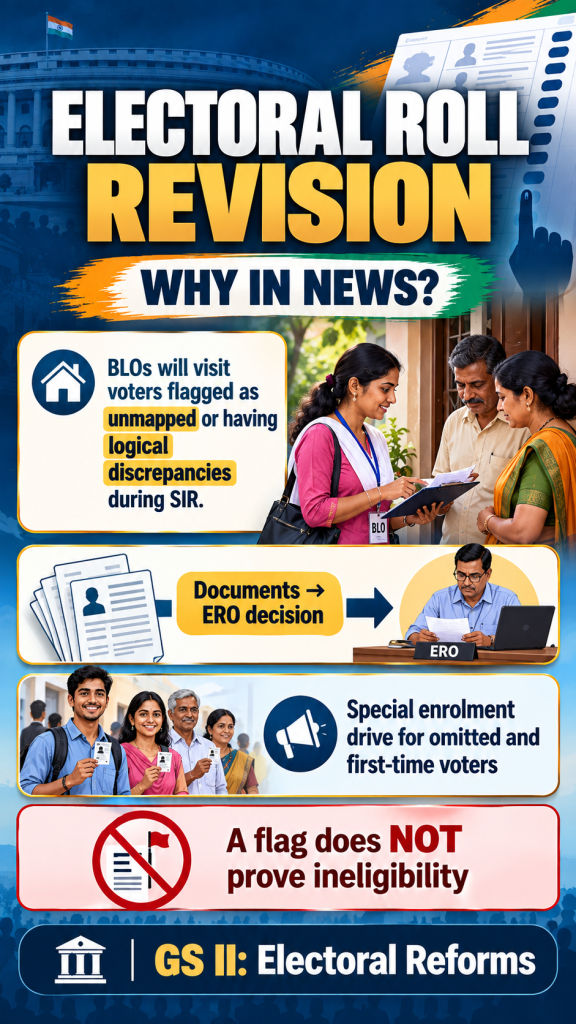
At its meeting on 26 September 2026, the Election Commission said that Booth Level Officers would visit persons flagged as unmapped or as having logical discrepancies during the ongoing Special Intensive Revision (SIR). They would collect documents and upload them for a decision by the Electoral Registration Officer (ERO). The Commission also announced a special enrolment drive for persons left out of the rolls, including first-time voters. The additional declaration accompanying Form 6 applies during SIR; the ordinary prescribed forms continue outside that exercise. The supplied report says the revision has concluded in 20 States and Union Territories.
Static foundation
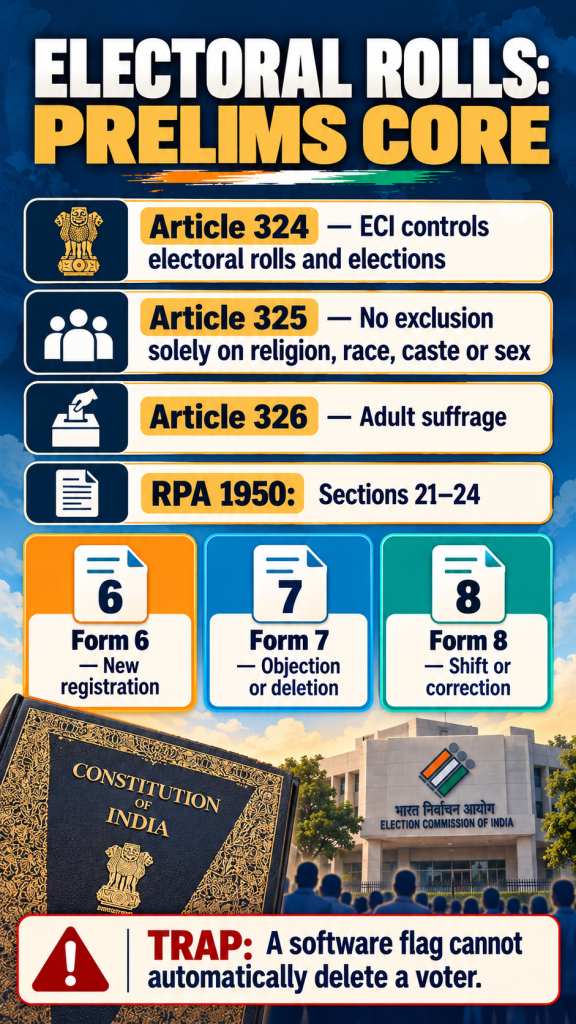
- Article 324 vests superintendence, direction and control of electoral rolls and elections in the Election Commission of India (ECI).
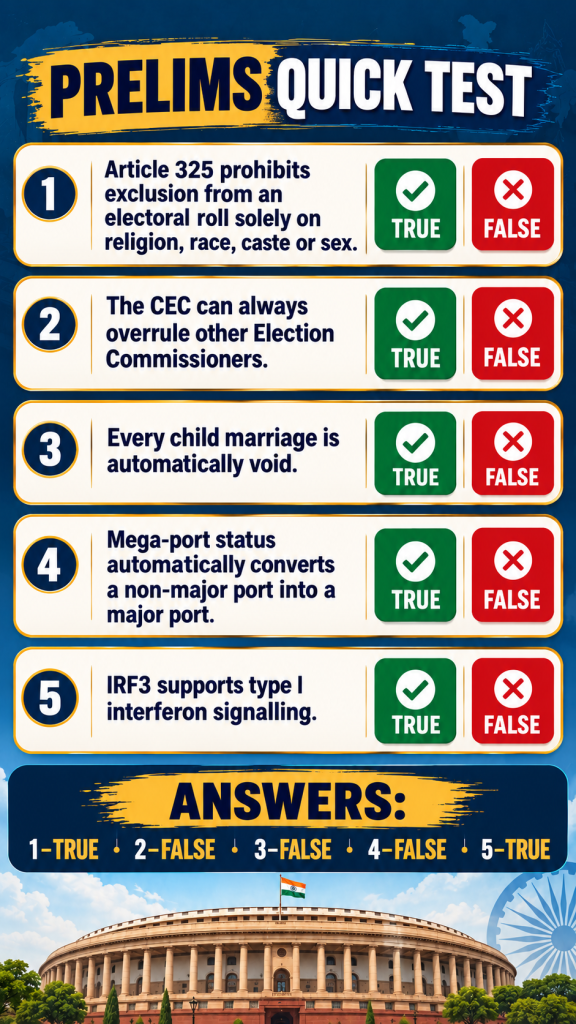
- Article 325 bars exclusion from a roll or claims to special rolls solely on religion, race, caste or sex. Article 326 bases Lok Sabha and Assembly elections on adult suffrage, subject to lawful disqualifications.
- The Representation of the People Act, 1950 addresses electoral rolls: Section 21 deals with preparation and revision; Section 22 with correction or deletion of entries; Section 23 with inclusion of names; Section 24 provides appeals against specified ERO orders.
- Form 6 is for new registration, Form 7 for objection or deletion, and Form 8 for shifting residence, correction, replacement of EPIC or marking disability. The extra SIR declaration should not be confused with the ordinary declarations in the prescribed forms.
How the process should be understood
An unmapped entry means the current voter record could not be linked to a previous revision record. A logical discrepancy is an apparent inconsistency in data. Neither label by itself proves ineligibility. The BLO gathers field material; the ERO makes the statutory decision. The reported move from routine physical hearings in these categories to doorstep document collection should still preserve notice, a reasoned decision, the required opportunity to respond and available appeal rights.
Mains analysis
Integrity Revision can remove duplicate or ineligible entries and improve the roll used on polling day.
Inclusion Errors in old rolls, spelling, migration and weak documents can place eligible electors under a heavy burden. A name omitted by mistake may still be sought through the statutory inclusion route.
Institutional design Publish clear criteria for discrepancy flags, give accessible methods to submit proof, record ERO reasons, and monitor false positives. Targeted assistance matters for migrants, older people and first-time voters.
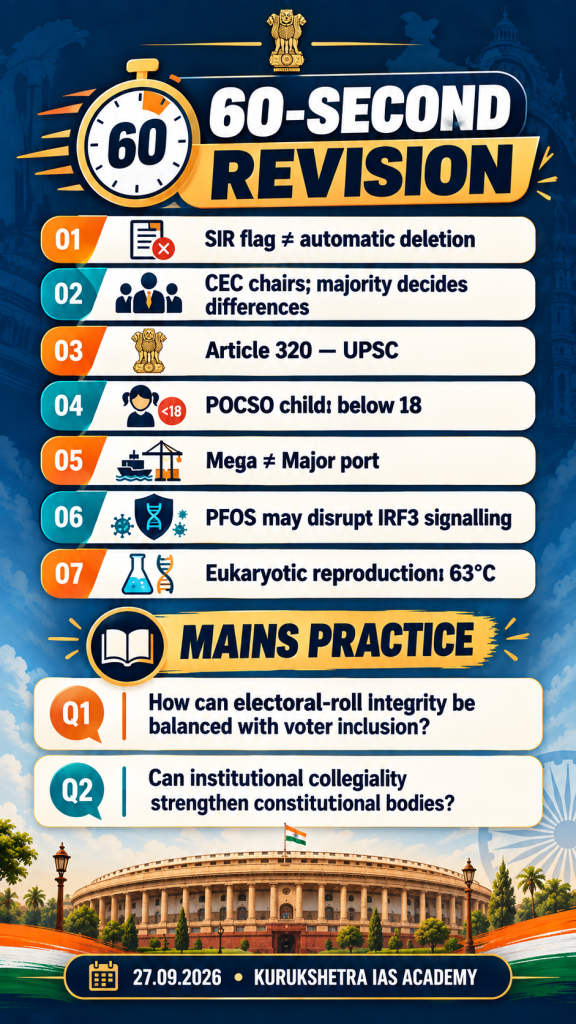
| Prelims trap Do not say that every voter needs the additional SIR declaration forever, or that a software flag automatically deletes a voter. |
Source: ECI press note of 26 September 2026; Constitution of India; Representation of the People Act, 1950; ECI Voters Service Portal.
2 Collegiality in the Election Commission
GS II Constitutional bodies Institutional accountability
Why this is in the news
Reports of differences among Election Commissioners revived interest in whether a Chief Election Commissioner (CEC) can act alone. The Commission said its SIR decisions had approval of the full Commission. Keep the reported internal differences and the Commission’s response distinct; an allegation is not a judicial finding.
Constitutional and statutory position
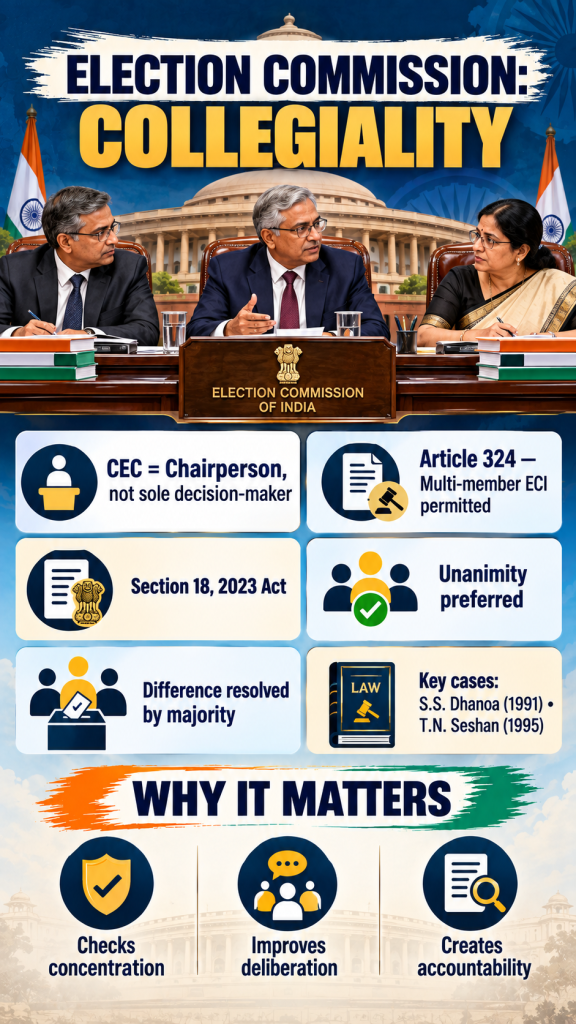
- Article 324 permits a CEC and such number of other Election Commissioners as the President may fix, subject to parliamentary law. When other Commissioners are appointed, the CEC acts as chairperson.
- In S S Dhanoa v Union of India (1991), the Supreme Court observed that broad discretionary powers with limited checks make association of more than one person desirable. The observation did not itself require a permanently multi-member body.
- In T N Seshan v Union of India (1995), a Constitution Bench upheld a multi-member Commission. The other Commissioners are participants in decision making, rather than advisers whose views the CEC can disregard.
- Section 18(2) of the CEC and Other Election Commissioners Act, 2023 says business should, as far as possible, be transacted unanimously. A difference of opinion is resolved according to the majority.
Why collegiality matters
Collective deliberation checks concentration of power and can improve the reasons for decisions on voting rights, electoral data and election schedules. A majority rule also allows the institution to decide when consensus fails. Recording the matter placed before the Commission, the differing views and the final decision creates a clearer audit trail without treating every disagreement as institutional failure.
| Prelims trap The CEC chairs a multi-member ECI. Chairmanship does not make the CEC the sole decision maker; unanimity is preferred, while majority resolves differences. |
Source: Constitution of India, Article 324; S S Dhanoa (1991); T N Seshan (1995); CEC and Other Election Commissioners Act, 2023, Section 18.
3 Disputed questions in the civil services preliminary examination
GS II Public institutions Fair recruitment Ethics
Why this is in the news
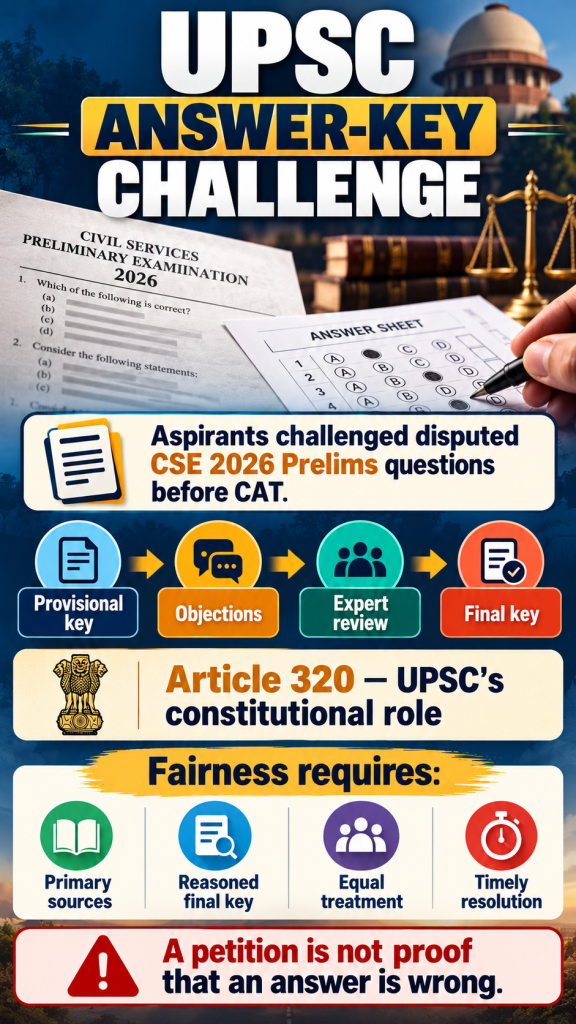
The supplied report says two groups of CSE 2026 aspirants have challenged questions in the provisional Prelims answer key before the Central Administrative Tribunal. One group of four disputed eight questions; another group of 63 disputed 27 questions, including those eight. Candidates allege wrong answers, multiple defensible answers or no correct option. These are allegations under adjudication, not settled errors.
Exam process and institutions
- The provisional key gives candidates an opportunity to submit reasoned objections. An objection should identify the question, the challenged option, the precise authority relied on and how the proposed answer follows from it.
- UPSC conducts the Civil Services Examination under its constitutional role in Article 320. The CSE 2026 notice and examination page are the authoritative sources for the scheme and candidate instructions.
- Prelims General Studies Paper II is qualifying; performance in Paper I determines selection for Mains after the qualifying condition. A disputed answer near the cut-off can therefore affect progression, but a petition alone does not change a result.
Mains analysis
A credible examination requires accurate questions and a transparent method to consider objections, while preserving equal treatment of candidates and a workable timetable. Expert review should use primary sources, publish a reasoned final key, and state whether a defective question is retained, revised or dropped under the examination rules. Courts and tribunals assess legality; they do not routinely substitute their own academic judgment for a specialist body.
| For aspirants Use official statutes, government notifications, standard reference texts or original research when contesting an answer. Avoid treating a social media consensus as proof that UPSC’s key is wrong. |
Source: UPSC Civil Services Preliminary Examination 2026 page and notification. The reported CAT matters remain pending.
4 POCSO and marriage under personal law
GS I Society GS II Child rights Statutory protection
Why this is in the news
The supplied report describes a Delhi High Court decision refusing to quash an FIR under the Bharatiya Nyaya Sanhita (BNS) and the POCSO Act. The wife was below 18 at the relevant time. The court held that even if personal law recognises a marriage for some civil purposes, it does not create an exception to Parliament’s child protection offences. Refusal to quash an FIR permits the prosecution to proceed; it is not a finding of guilt after trial.
The legal distinctions
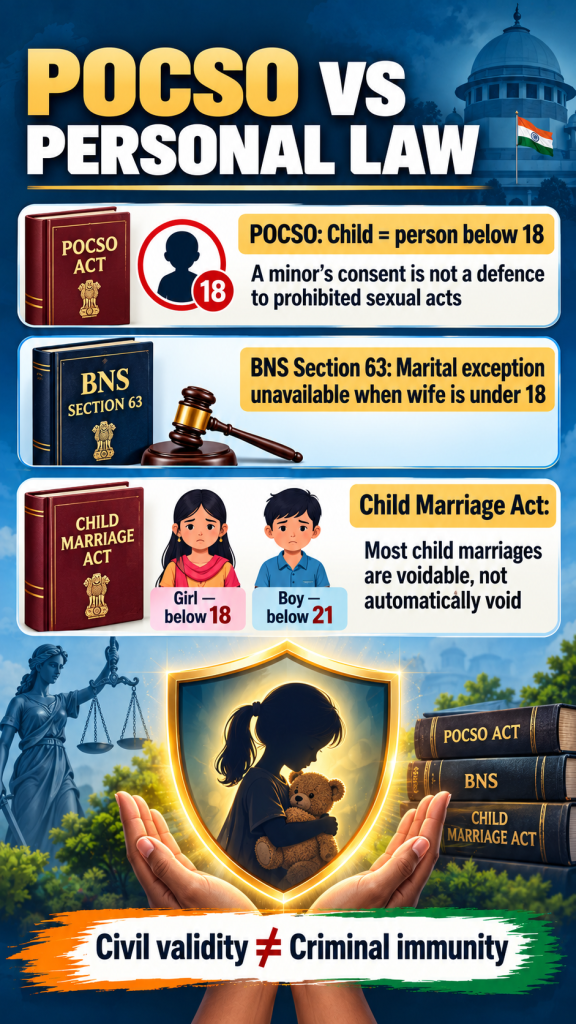
- Section 2(1)(d) of the Protection of Children from Sexual Offences Act, 2012 defines a child as a person below 18. The Act’s offences do not recognise a minor’s agreement as a defence to the prohibited sexual act.
- Exception 2 to the BNS definition of rape in Section 63 applies to sexual acts with one’s wife only where she is not under 18. Marriage to a minor does not bring the act within that exception.
- The Prohibition of Child Marriage Act, 2006 uses 18 for a girl and 21 for a boy. A child marriage is generally voidable at the option of the contracting party who was a child; it is void in specified circumstances. Do not state that every such marriage is automatically void.
- Civil consequences of marriage, criminal liability for an act, and the child’s welfare are separate questions. The existence of a marriage certificate or family consent cannot itself displace a later protective criminal statute.
Mains analysis
The State has a strong interest in preventing child sexual exploitation and early marriage. Enforcement also needs child-sensitive medical care, education and legal support. A court should apply the statutory age rule while hearing the young person’s account and protecting privacy. This avoids making the case a general claim about a community or religion.
| Prelims trap POCSO’s age threshold is below 18 for every child. The marital exception in BNS Section 63 is unavailable when the wife is under 18. These questions are separate from whether a marriage has civil validity. |
Source: POCSO Act, 2012; BNS, 2023, Section 63; Prohibition of Child Marriage Act, 2006; Delhi High Court decision reported in the supplied digest.
5 Four ports notified as mega ports
GS III Infrastructure Economy Maritime transport Map work
Why this is in the news
Under Section 73 of the Indian Ports Act, 2025, the Union notified four ports as mega ports through S.O. 5303(E) dated 25 September 2026. Three were already major ports. Mundra was a port other than a major port. The classification took effect on publication in the Gazette.
| Port | State | Status before and after mega label |
| Deendayal Port Kandla | Gujarat | Major port |
| Jawaharlal Nehru Port Nhava Sheva | Maharashtra | Major port |
| Paradip Port | Odisha | Major port |
| Mundra Port | Gujarat | Port other than a major port |
What Section 73 provides
- Under Section 73(1), the Union specifies mega port criteria in consultation with State governments. Subsection (2) covers eligible major ports; subsection (3) allows an eligible other-than-major port to be notified in consultation with the State government.
- Section 73(4) preserves the port’s existing status and its applicable law. Mega is an additional classification, not a conversion of Mundra into a major port.
- The criteria notification S.O. 4233(E), dated 30 July 2026, specifies 150 million metric tonnes of cargo throughput for a bulk port or 7.5 million twenty-foot equivalent units for a container port in the preceding financial year. Mixed cargo is converted according to the notified method. The classification remains valid for five years before review, even if throughput later dips below the threshold.
Mains significance
The category recognises high throughput and may help coordinate logistics, hinterland connections and long-term capacity planning. The label alone neither transfers State control over a non-major port nor removes environmental, safety or labour duties. Compare port efficiency with coastal ecological protection and the need for resilient transport links.
| Prelims trap Major port describes the port’s legal status; mega port is a throughput-based classification under the 2025 Act. Mundra is mega and remains non-major. |
Source: Indian Ports Act, 2025, Section 73; Gazette notifications S.O. 4233(E) and S.O. 5303(E).
6 PFOS and the antiviral immune response
GS III Environment and biotechnology GS II Public health
Why this is in the news
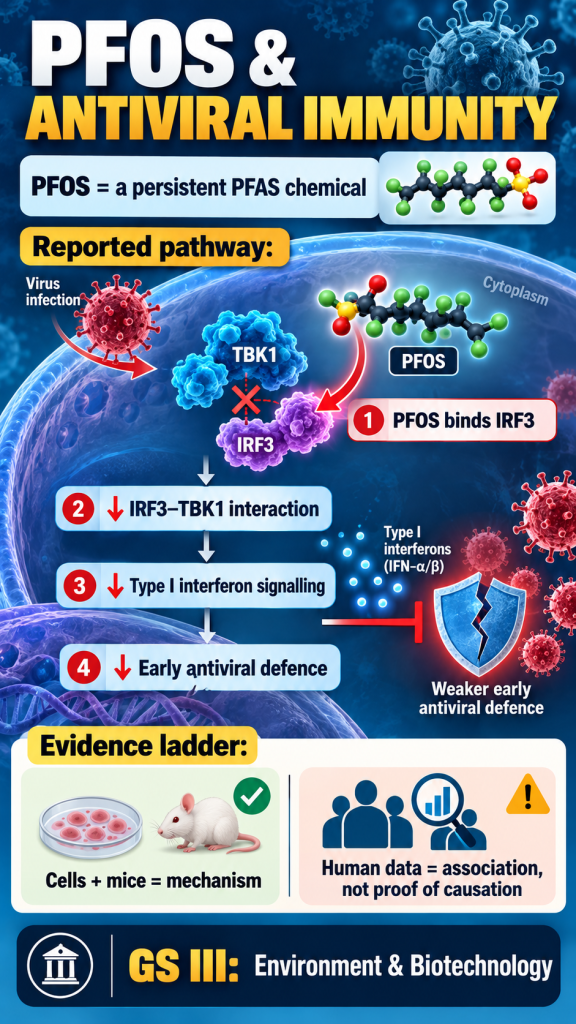
A study reported that perfluorooctane sulfonate (PFOS), a persistent PFAS chemical, can weaken an early antiviral defence. Experiments in human cells and mice identify interferon regulatory factor 3 (IRF3) as a direct molecular target. The research team also found associations between higher PFOS levels and lower antiviral antibodies or higher viral loads in human datasets.
Prelims science
- PFAS are per- and polyfluoroalkyl substances. PFOS is one member of this large group. Persistence is linked to the strength of carbon-fluorine bonds; persistence does not mean every PFAS has identical toxicity.
- In an antiviral response, upstream sensing activates TBK1, which activates IRF3. Active IRF3 helps induce type I interferons. These signals stimulate genes that restrict viral replication.
- The study reports that PFOS binds IRF3 and disrupts its interaction with TBK1. Lower IRF3 activation reduces type I interferon signalling in the experimental models.
How to read the evidence
Cell and animal experiments support a mechanism. The human observations link exposure levels to immune or viral measurements, but association alone cannot show that PFOS caused an individual infection. Exposure assessment, dose, other pollutants and clinical context still matter when translating laboratory findings into policy.
Mains relevance
Persistent chemicals can connect industrial production, water quality and public health. Policy responses include monitoring, safer substitutes, disclosure of exposure and targeted risk assessment. Keep laboratory findings, human correlations and proven population-level disease effects separate in an answer.
| Prelims trap IRF3 is a transcription factor in innate antiviral immunity. PFOS is a PFAS; type I interferons are host defence signals, not the virus itself. |
7 An amoeba reproduces at 63 degrees Celsius
GS III Biology Adaptation Extremophiles
Why this is in the news
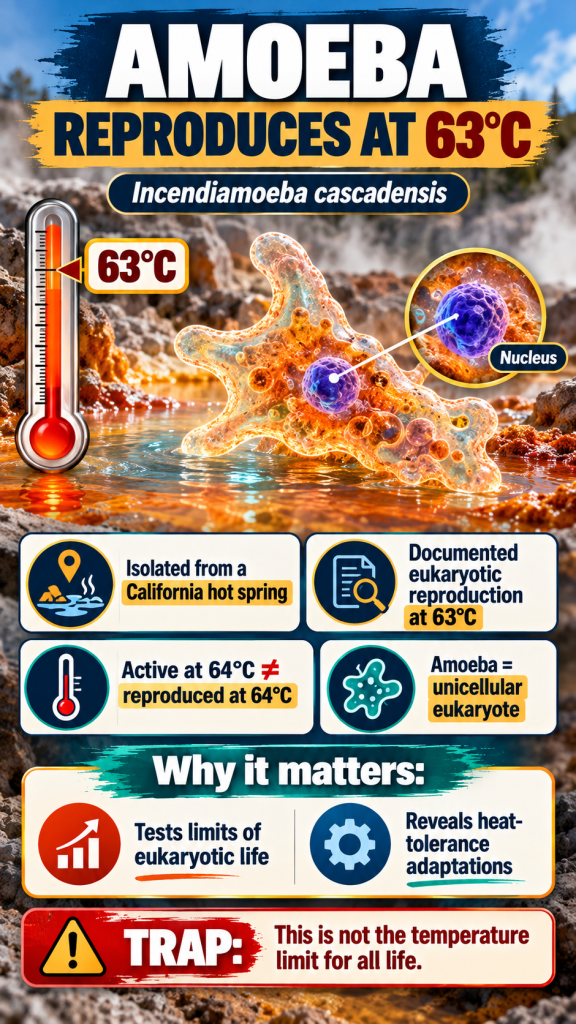
Researchers isolated a new amoeba, Incendiamoeba cascadensis, from a California hot spring. They observed cell division at 63 degrees Celsius, a reported upper record for documented eukaryotic reproduction. Cells remained active at a slightly higher temperature in the study.
Static concepts
- An amoeba is a unicellular eukaryote. Eukaryotes have a membrane-bound nucleus and organelles. Bacteria and archaea are prokaryotes, so this finding does not set the upper temperature limit for all life.
- Survival, movement and reproduction are different endpoints. A cell that moves at 64 degrees Celsius has not necessarily completed cell division there.
- Heat can damage proteins, membranes and DNA. The researchers report features associated with protein stability, cellular repair and genome maintenance that may help this organism withstand heat.
Why the finding matters
The record informs research on the limits of eukaryotic cells and the evolution of heat tolerance. It does not mean every eukaryote can reproduce at 63 degrees Celsius or that the amoeba’s mechanisms are fully established for other species.
| Prelims trap The figure to remember is reproduction at 63 degrees Celsius in a eukaryote. Do not generalise it to all organisms or confuse activity at 64 degrees with reproduction there. |