News 1:Centre Increases Commercial LPG Allocation to 50%
Preliminary Facts (For Mains Answer Introduction)
- Increased Allocation: The Ministry of Petroleum and Natural Gas (MoPNG) has decided to allocate States and Union Territories an additional 20% of their average monthly requirement of commercial LPG, effective from March 23, 2026. This brings the overall allocation to 50% of pre-crisis levels (combined with a previous 30% allocation) .
- Priority Sectors: The additional quantum is to be allocated on priority basis to restaurants, dhabas, hotels, industrial canteens, food processing units, dairies, subsidised canteens, community kitchens, and 5 kg free trade LPG for migrant labourers .
- PNG Transition Mandate: The directive mandates that all commercial and industrial LPG consumers must apply for piped natural gas (PNG) with a city gas distribution (CGD) entity and achieve a “state of readiness for receiving PNG” before they can be allotted commercial LPG from the revised allocation .
- Crisis Context: India imports 60% of its overall LPG requirements, of which 90% is routed through the Strait of Hormuz—currently blocked due to the West Asia conflict .
- Domestic Production Boost: Domestic LPG production by refineries has risen by about 40% compared to pre-crisis levels after the government mandated refineries to use propane, butene, and other streams for cooking gas instead of petrochemicals .
- Previous Allocation: On March 18, the government had pledged an extra 10% allocation to States, contingent on support for PNG transition .
the domestic production of LPG by refineries has risen about 40% compared to their production levels before the crisis, ever since supply maintenance orders mandated that refineries use propane, butene and other relevant streams to produce cooking gas, instead of petrochemicals.
Prelims 360
1. LPG is a mixture of C3 + C4 hydrocarbons
LPG = Propane + Butane + small amounts of C4 olefins (like butene).
Refineries have always blended C4 olefins depending on availability.
📌 2. Modern FCC units produce more C4 olefins
In recent years, FCC units generate high amounts of:
- butenes (1-butene, 2-butene)
- iso-butene
Instead of routing all of it to petrochemicals, some quantity is blended into LPG.
LPG is a high-value, essential domestic fuel
- LPG = mixture of propane (C₃H₈) + butane (C₄H₁₀).
- India has a huge domestic demand → Ujjwala scheme, 30+ crore households depend on it.
- Government prioritises availability of clean domestic fuel over petrochemical feedstock.
Hence refineries divert these streams to ensure nationwide LPG supply.
LPG demand > domestic petrochemical demand
India often faces a shortage of LPG → imports from Gulf countries.
So refineries cannot divert propane/butene to petrochemicals because:
- Domestic LPG requirement must be met first
- Public distribution system (PDS) depends on stable supply
PNG (Piped Natural Gas) is natural gas supplied to households, commercial places, and small industries through an underground pipeline network.
Composition:
PNG is mainly Methane (CH₄) — 85% to 95%.
Minor components: Ethane, Propane, CO₂, Nitrogen.
Used For:
- Domestic cooking (replacement for LPG cylinders)
- Water heaters (gas geysers)
- Commercial kitchens (hotels, restaurants)
- Small industries (boilers, furnaces)
Delivered Through:
- City Gas Distribution (CGD) networks
- Metered connections inside homes
Status of PNG
1. Household PNG Connections – Rapid Growth
- India has 1.2 crore+ domestic PNG connections (2025–26 estimates).
- Compared to 2014, PNG connections increased nearly 6–7 times.
- Growth driven by expansion of City Gas Distribution (CGD) networks.
✔ 2. CGD Network Expansion
- 20 Geographical Areas (GA) in 2008 → 300+ GAs by 2026.
- PNGRB’s 10th & 11th CGD rounds expanded coverage to:
- 98% of India’s population
- 88–90% of India’s geographical area
This makes PNG a pan-India urban fuel.
✔ 3. Pipeline Infrastructure
National Gas Grid Length:
- ~ 34,000 km operational
- Target: 45,000 km by 2030
City Gas Pipelines:
- Lakhs of km of local distribution pipelines laid within cities.
NEWS 2: PM Speaks with Iran President, Pushes for Secure Shipping Lanes, on the occasion of Id and the Persian new year Nowruz
Preliminary Facts (For Mains Answer Introduction)
- High-Level Engagement: Prime Minister Narendra Modi spoke with Iranian President Masoud Pezeshkian on Saturday (March 21, 2026) on the occasion of Id and the Persian new year Nowruz. The conversation focused on the escalating West Asia conflict and its implications for India .
- India’s Core Demand: PM Modi urged for “freedom of navigation,” expressing India’s concern over disruptions in the Strait of Hormuz, which has effectively been closed, threatening India’s energy supplies .
- Iran’s Position: President Pezeshkian called for an “independent role” for BRICS (under India’s presidency) in halting U.S. and Israeli attacks. He stated that the “prerequisite” to ending the war is the “immediate cessation of aggressions by the U.S. and Israel” with guarantees against recurrence .
- Diplomatic Follow-Up: External Affairs Minister S. Jaishankar subsequently spoke with his Iranian counterpart Seyed Abbas Araghchi, discussing the “evolving conflict and implications for the larger region” .
- Regional Security Framework: President Pezeshkian proposed the creation of a “regional security framework” composed of West Asian countries, free of “foreign interference” .
- Indian Casualties: India’s concerns extend to the safety of its citizens. The latest fatality (March 18) in Riyadh brought the number of Indians killed in the conflict to six, with one missing and presumed dead. Approximately 882 Indians have been evacuated from Iran .
Prelims 360
Nowruz is the Persian New Year, celebrated on the spring equinox across Iran and Central Asia, symbolizing renewal and marked by traditions like the Haft-Seen table, fire festivals, and family gatherings.
The Delhi Sultan who introduced the Nowroz festival was — Sultan Balban (1266–1287).
Key Policies
A. Theory of Kingship
• Introduced Persian-style royal authority
- Niyābat-e-Khudā → “King is the shadow of God”.
- Emphasized divine right of kings.
- Sultan must be obeyed unquestioningly.
• Court Ceremonies
- Sijda – prostration before the Sultan.
- Paibos – kissing the Sultan’s feet/throne.
- Nowroz festival – introduced as a royal celebration.
3. Administrative Measures
A. Destroyed the Chahalgani (Turkish Forty)
- They had grown too powerful → Balban eliminated them systematically.
B. Strong spy system (Barid)
- Spies reported directly to Sultan.
- Prevented rebellion.
C. Law and Order
✔ Blood and Iron Policy
- Harsh punishments, strict policing.
- No tolerance for revolts.
(Mughal Empire)
Akbar was the Muslim ruler who formally introduced and institutionalized the celebration of Nowruz in India.
Mansabdari System
- Introduced to organize Mughal nobility.
- Mansab = rank.
- Two parts:
- Zat → personal rank.
- Sawār → cavalry to be maintained.
- No hereditary rights.
B. Land Revenue – Todar Mal’s Reforms
Zabti / Dahsala system (1580)
- Land measured; average of last 10 years’ produce used.
- Cash revenue demand.
C. Central Administration
- Wazir → revenue
- Mir Bakshi → army & mansabdars
- Mir Saman → royal household
- Qazi-ul-Quzat → chief judge
4. Religious Policies
✔ Abolished Jizya – 1564
✔ Abolished Pilgrimage Tax – 1563
Din-i-Ilahi (1582)
- Not a religion; a sulh-i-kul based spiritual order.
- Very few followers (Birbal).
- Prelims: It was not a syncretic religion with scriptures — just personal ethical code.
Ibadat Khana (1575)
- Debate hall at Fatehpur Sikri.
- Debates among: Sunni, Shia, Jain, Hindu, Zoroastrian, Christian scholars.
News 3 :Cost Concerns Delay Safer Building Codes for Himalayas
Preliminary Facts (For Mains Answer Introduction)
- Policy Withdrawal: The Bureau of Indian Standards (BIS) withdrew updated earthquake safety standards (IS 1893: 2025) in early March 2026, following a Cabinet Secretariat order that cited “materially affected” ongoing and future infrastructure projects. The new standards, backed by a decade of scientific research, would have nearly doubled hazard estimates in the Himalaya and northeast .
- Scientific Consensus: A decade of government-commissioned studies involving IITs, the Geological Survey, the Atomic Energy Regulatory Board, and the National Disaster Management Authority (NDMA) concluded that the potential damage to structures in Himalayan States is higher than current risk assessments .
- Current vs. Proposed Framework: India’s existing approach assesses risk based on past seismicity, while the proposed probabilistic framework incorporates multiple variables to forecast forces during the strongest probable earthquakes. The new map assigned PGA (peak ground acceleration) values of 0.15-0.75 g for Zones II through a newly introduced Zone VI .
- Cost Concerns: The primary reason for withdrawal was apprehension about spiralling construction costs. Agencies like the Delhi Metro Rail Corporation and the National Dam Safety Authority flagged that higher standards would significantly increase steel, cement, and overall project costs .
- Implementation Gap: A senior NDMA official noted that “a large proportion do not follow even the [2016] codes.” With stricter norms, “where there is money to build four schools or clinics in a village, only one will be made” .
- International Comparison: Pakistan and Nepal use PGA values close to 0.75g, while the U.S. and Japan routinely calculate 1g or more. India’s existing standards are lower than global benchmarks .
Prelims 360
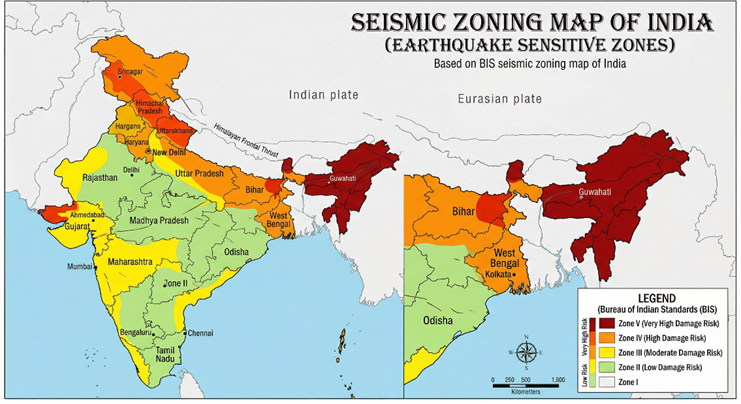
Earthquake Classification Zones in India (IS 1893:2016)
India is divided into four seismic zones based on expected earthquake intensity.
Zone II – Low Hazard
- Least active zone
- Covers: parts of Peninsular India (e.g., Karnataka, Andhra interior, Tamil Nadu interior)
Zone III – Moderate Hazard
- Includes:
– Kerala
– Remaining peninsular areas
– Gangetic plains (major portion)
– Parts of Rajasthan & Gujarat
Zone IV – High Hazard
- Includes:
– Delhi
– Northern Bihar
– Parts of Haryana
– Eastern India (Sikkim)
– Northern UP
– Parts of Gujarat & Rajasthan
Zone V – Very High Hazard
- Most seismically active
- Includes:
– Entire Northeast India
– Jammu & Kashmir
– Himachal Pradesh
– Uttarakhand
– Rann of Kutch
– Andaman & Nicobar Islands
What is PGA?
Peak Ground Acceleration (PGA) is the maximum acceleration of the ground recorded during an earthquake.
- Measured in g (acceleration due to gravity) or m/s²
- Indicates how strong the shaking is at a location
- Higher PGA = more destructive potential
📏 Why PGA Matters?
- Used in earthquake-resistant building design
- Forms the basis of India’s seismic zoning (IS 1893:2016)
- Helps estimate structural forces during earthquakes