
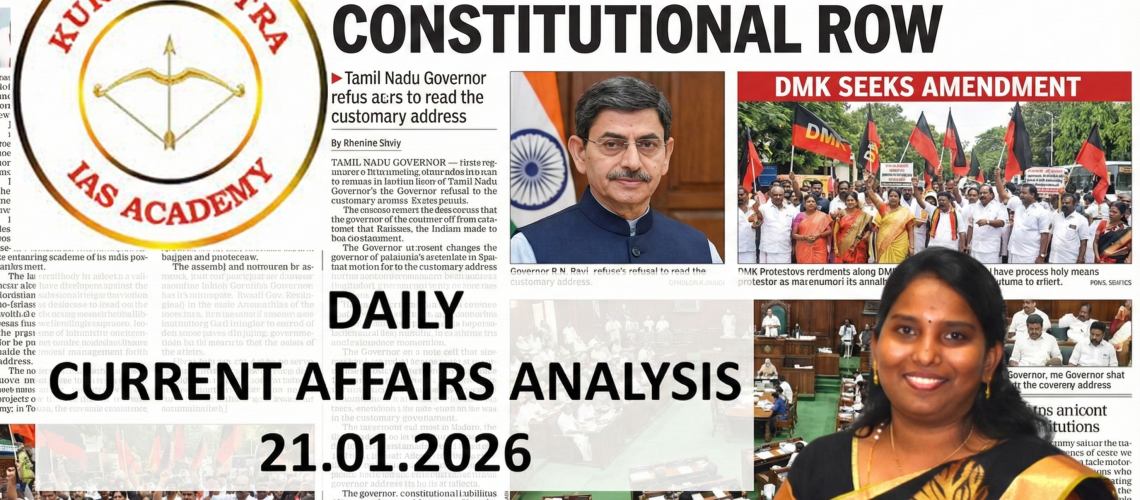
Headline: T.N. Governor’s Refusal to Read Address Deepens Constitutional Row; DMK Seeks Amendment
For three consecutive years, Governor R.N. Ravi has either digressed from or refused to read the state-prepared address; DMK announces intent to seek a Constitutional amendment to abolish the practice of the Governor’s address in the year’s first Assembly session.
1. Preliminary Facts (For Mains Answer Introduction)
- Issue: Tamil Nadu Governor R.N. Ravi refused to read the customary address prepared by the state government in the Legislative Assembly, marking the third consecutive year of such disruption. He walked out of the House, alleging the speech contained “unsubstantiated claims” and that his microphone was switched off.
- State’s Response: Chief Minister M.K. Stalin moved and passed a resolution to place only the government-prepared address on record. He announced the DMK’s intention to pursue a Constitutional amendment to abolish the practice of the Governor’s address to commence the session.
- Constitutional Standoff: The Assembly Speaker, M. Appavu, repeatedly urged the Governor to follow procedure, citing constitutional provisions that the Governor cannot voice personal opinions on the floor and must read the council of ministers’ address.
- Incident Details: The Governor began by extending New Year wishes but digressed from the prepared text. Following the Speaker’s intervention and an “uneasy silence,” he exited the House. A subsequent Raj Bhavan statement accused the government of ignoring public issues and insulting the national anthem—a charge the Speaker refuted, calling it a settled procedural matter.
2. Syllabus Mapping (Relevance)
- GS Paper II: Polity – Indian Constitution (Role and Powers of Governor, Article 168, 175; Centre-State Relations); Parliamentary procedures.
- GS Paper II: Governance – Functioning of Legislature; Accountability and tensions between constitutional heads.
- GS Paper II: Federalism – Recurring conflicts between appointed Governors and elected state governments, testing the boundaries of the unitary and federal features of the Indian Union.
3. Deep Dive: Core Issues & Analysis (For Mains Answer Body)
A. The Constitutional Imperative vs. Personal Discretion
- Nature of the Address: The Governor’s Address is not a personal statement but a mandatory constitutional formality (Article 176) to outline the elected government’s policy and legislative agenda for the year. It is a document of the cabinet, and the Governor is bound by the aid and advice of the Council of Ministers (Article 163).
- Breach of Convention and Propriety: The Governor’s refusal to read the speech constitutes a breach of a core constitutional convention. It transforms a symbolic, unifying ceremony into a public confrontation, undermining the dignity of the office and the legislature. The Speaker’s reminder that “only 234 elected members are permitted to express their opinions” underscores the fundamental principle of popular sovereignty versus an appointed head’s authority.
- Precedent of Disruption: This being the third consecutive instance indicates a pattern of institutional conflict rather than a one-off disagreement, raising questions about the Governor’s role as a neutral constitutional bridge versus an active political actor.
B. Federal Tensions and the Instrumentalization of the Governor’s Office
- Symptom of Wider Malaise: The Tamil Nadu incident is not isolated but part of a nationwide trend of friction between Governors (appointees of the Union) and opposition-ruled state governments (e.g., Kerala, Punjab, West Bengal). It highlights the tension inherent in the Governor’s dual role: a constitutional head of state and a link appointed by the Centre.
- Political Charged Atmosphere: The Governor’s public dissent and walkout, followed by a press statement accusing the state government, politicizes a neutral office. It fuels the narrative of the Governor’s office being used as an instrument of political oversight or obstruction by the central government, straining cooperative federalism.
- Demand for Structural Change: The DMK’s call for a Constitutional amendment to abolish the practice reflects a loss of faith in the convention’s sanctity. It signals a move from resolving individual disputes to seeking permanent structural change, challenging a long-standing parliamentary tradition.
C. Procedural Accountability and Institutional Conflict Resolution
- Lack of Clear Resolution Mechanism: The Constitution is silent on the remedy if a Governor outright refuses to perform a constitutional duty like reading the address. This legal vacuum forces ad-hoc solutions like the Assembly passing a resolution to record the speech, leaving the conflict unresolved at a systemic level.
- Role of the Speaker: The Speaker’s actions—insisting on procedure and clarifying protocol regarding microphones and anthems—represent an attempt by the legislature to assert its own procedural autonomy and dignity against perceived executive (Governor’s) overreach.
- Microphone Controversy as Metaphor: The Raj Bhavan’s complaint about the switched-off microphone and the Speaker’s technical explanation symbolize the deeper communication breakdown and the struggle over who controls the narrative within the legislative chamber.
4. Key Terms (For Prelims & Mains)
- Governor’s Address (Article 176): A constitutional requirement where the Governor addresses the first session of the year, outlining the government’s program.
- Aid and Advice (Article 163): The Governor is bound by the aid and advice of the Council of Ministers in all matters where discretion is not expressly provided.
- Constitutional Convention: Unwritten rules of political conduct based on precedent, crucial for smooth functioning (e.g., Governor reading the cabinet’s speech).
- Cooperative Federalism: A concept where the Centre and states work together in harmony, which is disrupted by such public conflicts.
- Popular Sovereignty: The principle that the authority of the government is created and sustained by the consent of its people, through their elected representatives.
5. Mains Question Framing
- GS Paper II (Polity): “The recurring incidents of Governors refusing to read addresses prepared by state governments strike at the root of constitutional conventions. Analyze the implications for India’s parliamentary democracy and federal structure.”
- GS Paper II (Governance): “The office of the Governor is envisaged as an apolitical constitutional link. Critically examine why this office has become a frequent flashpoint in centre-state relations, with reference to recent examples.”
- GS Paper II (Federalism): “The Tamil Nadu Governor’s action reflects a broader crisis in India’s federal polity. Discuss the need for reforms to redefine the role, appointment, and responsibilities of the Governor to preserve the spirit of cooperative federalism.”
6. Linkage to Broader Policy & Initiatives
- Sarkaria Commission & Punchhi Commission Recommendations: Both commissions emphasized that Governors should be eminent persons from outside the state, act with impartiality, and not be removed arbitrarily. The current conflicts highlight the non-implementation of these recommendations.
- National Commission to Review the Working of the Constitution (NCRWC): Had suggested consultations with state CMs before appointing Governors and fixed tenures.
- Inter-State Council: Its potential role as a deliberative body to resolve such entrenched union-state disputes, as envisaged in Article 263.
- ‘Raj Bhavans as Opposition Rooms’ Discourse: The incident feeds into the academic and political criticism that Governors in opposition-ruled states often act as agents of the central ruling party, undermining their constitutional neutrality.
Conclusion & Way Forward
The Tamil Nadu episode is a stark manifestation of the deepening trust deficit between constitutional heads and elected governments, threatening parliamentary decorum and federal balance. While the immediate resolution involved the Assembly asserting its authority, a long-term solution is imperative.
The Way Forward:
- Clarify through Code: The Inter-State Council or a bipartisan committee should formulate a Code of Conduct for Governors, explicitly detailing their role in legislative proceedings, including the mandatory nature of the Address.
- Revisit Appointment & Tenure: Implement existing reform proposals: instituting a neutral collegium for selecting Governors, ensuring fixed tenures, and specifying grounds for removal to insulate the office from political vagaries.
- Judicial Clarification: The Supreme Court may need to provide a definitive interpretation on the mandatory versus discretionary nature of the Governor’s Address under Article 176 to settle the legal ambiguity.
- Political Consensus: Ultimately, restoring the dignity of the office requires political will from both the Union and States to treat the Governor’s role as a constitutional duty, not a political post.
The strength of a federation lies not just in its written rules, but in the spirit of respect its constituents show for shared institutions. Upholding constitutional conventions is paramount to preserving that spirit.
Headline: India Withdraws Diplomats’ Families from Bangladesh Citing Security Stresses Mission’s ‘Full Strength
Ahead of the February 12 national election and referendum, India has evacuated all family members and dependents of its diplomatic and official staff from Bangladesh, citing the prevailing security situation while asserting its missions remain fully operational.
1. Preliminary Facts (For Mains Answer Introduction)
- Issue: India has preemptively withdrawn all family members and dependents of diplomats and officials from its High Commission in Dhaka and other missions across Bangladesh.
- Reason Cited: The move is a “precautionary measure” due to the “prevailing security situation” ahead of Bangladesh’s dual events—a national election and a referendum on February 12.
- Context of Threat: Security concerns for Indian missions have been heightened following the December 12, 2025, shooting of Islamist youth leader Sharif Osman Hadi. Threats escalated with rumors that the assailants, like former PM Sheikh Hasina, had fled to India.
- Official Stance: While families are withdrawn, Indian diplomats assert that all missions continue to operate at “full strength.” India has formally reminded Bangladesh’s interim government of its responsibility to ensure the security of Indian diplomatic premises and personnel.
2. Syllabus Mapping (Relevance)
- GS Paper II: International Relations – India and its neighborhood, bilateral relations, diplomacy.
- GS Paper II: Governance – Security challenges and their management.
- GS Paper III: Security – Internal security challenges, role of external state and non-state actors.
- GS Paper II: Polity – Comparison of democratic processes and electoral violence in the region.
3. Deep Dive: Core Issues & Analysis (For Mains Answer Body)
A. Diplomatic Signals and the Precautionary Principle
- A Standard Yet Grave Protocol: The withdrawal of non-essential personnel is a standard diplomatic security protocol in high-risk scenarios. However, its use signifies a serious assessment of imminent threats, often preceding a potential escalation. It serves as a strong diplomatic signal to the host nation (Bangladesh) about the gravity of concerns.
- Balancing Act: The simultaneous declaration that missions operate at “full strength” is crucial. It aims to prevent perceptions of an evacuation or retreat, thereby preserving diplomatic continuity and resolve while safeguarding vulnerable dependents. It underscores a commitment to maintain bilateral engagement despite risks.
- Formal Diplomatic Pressure: The official reminder to Bangladesh’s interim government about its responsibility under the Vienna Convention on Diplomatic Relations (1961) is a direct diplomatic maneuver. It places the onus of security squarely on the host state, potentially seeking to galvanize action and preemptively establish accountability.
B. The Nexus of Domestic Politics and Bilateral Relations
- Electoral and Political Volatility: The timing, ahead of a pivotal election and referendum, points to fears of political violence, civil unrest, or targeted attacks against foreign symbols. Such periods often see a rise in anti-foreign rhetoric, and India, as the largest neighbor with a complex historical relationship, can become a focal point.
- The Trigger of Hadi’s Shooting: The reference to the shooting of Islamist leader Sharif Osman Hadi and the rumors linking assailants to India reveals how internal political violence in Bangladesh can directly spill over and impact India. It highlights the vulnerability of India’s image and assets to being instrumentalized in domestic Bangladeshi political narratives.
- Challenges of an Interim Government: Dealing with a caretaker or interim government during an election can complicate security coordination. Such governments may have limited authority or be preoccupied with managing the electoral process, potentially creating gaps in the security apparatus for diplomatic missions.
C. Security Implications and Regional Stability
- Threat Perception and Intelligence Assessment: The decision indicates a high-level threat perception based on intelligence inputs. The specific nature of the threat—whether generalized unrest, targeted terror attacks, or mob violence—shapes this response. The mention of Islamist leader Hadi suggests concerns over radicalized elements exploiting the political vacuum.
- Impact on the Indian Diaspora: While the move focuses on official personnel, it raises questions about the security of the larger Indian expatriate community in Bangladesh. Diplomatic missions, operating at full strength, would now also bear the enhanced responsibility of monitoring and responding to threats against private citizens.
- Regional Security Calculus: Such incidents feed into the broader regional security discourse on political instability in neighboring countries as a direct national security concern for India. It underscores the need for robust cross-border security dialogue and intelligence-sharing mechanisms, even during politically sensitive transitions.
4. Key Terms (For Prelims & Mains)
- Precautionary Measure: A proactive step taken to avoid potential danger, standard in risk diplomacy.
- Interim Government/Caretaker Government: A temporary government that administers a country during an election period.
- Vienna Convention on Diplomatic Relations (1961): The international treaty that forms the basis of diplomatic immunity and outlines the host country’s duty to protect diplomatic missions.
- Diplomatic Immunity: A principle of international law that provides foreign diplomats with protection from legal action in the host country.
- Non-Essential Personnel: Diplomatic staff and family members who can be evacuated without crippling core diplomatic functions.
5. Mains Question Framing
- GS Paper II (IR): “The withdrawal of diplomats’ families from Bangladesh ahead of elections highlights the intersection of a neighbor’s domestic politics with India’s security diplomacy. Discuss the challenges and protocols involved in safeguarding diplomatic interests in politically volatile environments.”
- GS Paper III (Security): “Internal political volatility in neighboring countries poses a direct non-traditional security challenge for India. Analyze with reference to recent events in Bangladesh and India’s diplomatic response.”
- GS Paper II (Governance): “Critically examine the balance a diplomatic mission must strike between ensuring the security of its personnel and maintaining uninterrupted bilateral engagement during a crisis in the host nation.”
6. Linkage to Broader Policy & Initiatives
- Neighbourhood First Policy: This incident tests the resilience of this policy, emphasizing that security and political stability are prerequisites for deep engagement. It may necessitate a more nuanced, real-time risk-assessment framework within the policy.
- Security and Growth for All in the Region (SAGAR): Instability in a littoral state like Bangladesh directly impacts the maritime and regional security dimensions of the SAGAR vision.
- Intelligence Sharing Mechanisms: Highlights the critical need for effective, uninterrupted intelligence cooperation with neighbors, even during political transitions, to counter cross-border threats and misinformation.
- Crisis Management and Evacuation Plans (e.g., Operation Samudra Setu, Devi Shakti): While a limited drawdown, it relates to India’s institutional experience and preparedness in executing coordinated evacuations of its citizens from conflict zones abroad.
Conclusion & Way Forward
India’s decision is a calibrated, safety-first approach to navigating the heightened risks in Bangladesh’s charged political climate. It underscores that diplomatic relations must be managed with a clear-eyed view of ground realities, where the security of personnel is non-negotiable.
The Way Forward:
- Enhanced Security Coordination: India and Bangladesh’s interim administration must establish a dedicated, high-level security liaison channel to ensure real-time threat assessment and response coordination for Indian missions until political stability is restored.
- Countering Misinformation: A concerted effort is needed, possibly through quiet diplomacy and Track-II channels, to counteract malicious rumors (like assailants fleeing to India) that fuel anti-India sentiment and threaten security.
- Long-term Bilateral Resilience: Once a stable government is in place, both nations should work to insulate the core of the relationship from political cyclicity. This includes building stronger institutional linkages in security, trade, and people-to-people contacts that can withstand periodic tensions.
- Review of Security Protocols: India’s external affairs and security establishment should review and update standard operating procedures for missions in high-risk zones, integrating lessons from this episode to refine thresholds for precautionary measures.
In diplomacy, the protection of human life is the foremost sovereign responsibility. This move, while highlighting a tense moment, reflects a prudent adherence to that principle, even as India signals its intent to remain steadfastly engaged with a key neighbor through its democratic journey.
Headline: Kisan Sabha Flags Draft Seeds Bill Calls it Pro-Private Monopoly & Anti-Farmer
The All India Kisan Sabha (AIKS) has submitted a sharp critique of the draft Seeds Bill to the Union Agriculture Ministry, asserting that it undermines public sector research, fosters private monopoly, and fails to protect farmers’ fundamental seed rights, demanding wider consultation.
1. Preliminary Facts (For Mains Answer Introduction)
- Issue: The All India Kisan Sabha (AIKS), a major farmers’ union, has formally opposed the draft Seeds Bill, terming it “unacceptable.”
- Core Criticism: The AIKS alleges the bill undermines public sector institutions like the Indian Council of Agricultural Research (ICAR) and enables a private sector monopoly over the seed sector.
- Key Farmer Demand: The Sabha asserts that any seed law must protect the inalienable right of farmers to “grow, sow, re-sow, save, use, exchange, share or sell seeds.”
- Process Critique: The AIKS has called for broader consultations with farmers’ organizations, state governments, and the scientific community before proceeding with the legislation.
2. Syllabus Mapping (Relevance)
- GS Paper II: Governance – Government policies and interventions, transparency and accountability, role of civil society.
- GS Paper II: Polity – Federalism (consultation with states).
- GS Paper III: Agriculture – Issues related to direct and indirect farm subsidies, MSP, PDS, food security, Technology missions.
- GS Paper III: Economy – IPR issues, effects of liberalization on industry/sectors.
- GS Paper I: Society – Social empowerment, developmental issues.
3. Deep Dive: Core Issues & Analysis (For Mains Answer Body)
A. The Clash Over Seed Sovereignty and Intellectual Property
- Farmers’ Rights vs. Corporate IPR: The AIKS’s demand for an “inalienable right” to save and exchange seeds is a direct defense of traditional farmers’ rights and seed sovereignty. This clashes with the potential intent of the bill to strengthen Plant Breeders’ Rights (PBRs) or patents, which restrict such practices to protect corporate investment in seed development.
- Threat to Biodiversity and Self-Reliance: Unrestricted farmer-saved seeds are crucial for maintaining agricultural biodiversity, adapting to local climates, and ensuring farmer autonomy. A law that curtails this in favor of registered, market-sold seeds could increase input costs, create dependency, and erode local seed systems.
- Alignment with International Debates: This reflects the global tension between the International Treaty on Plant Genetic Resources for Food and Agriculture (ITPGRFA), which recognizes Farmers’ Rights, and the UPOV Convention, which emphasizes breeders’ rights. India’s legislation will signal its stance in this ongoing debate.
B. Public vs. Private Sector: The Research & Monopoly Debate
- Undermining Public Research: The AIKS’s charge that the bill sidelines ICAR and public institutions points to fears of diminished public investment and policy support for public-sector breeding programs. Public institutions have historically focused on open-source, affordable seeds for staple crops, serving marginal farmers.
- Path to Private Monopoly: By potentially creating stricter registration, certification, and liability norms favorable to large corporations, the draft bill could marginalize small and medium seed companies and the public sector. This could lead to market concentration, higher seed prices, and research focused only on commercially lucrative, high-value crops, neglecting millets, pulses, and region-specific varieties.
- Impact on Cost of Cultivation: A shift towards a privatized seed regime would directly increase one of the most critical input costs for farmers, exacerbating agrarian distress unless coupled with robust income support mechanisms.
C. Federalism and Legislative Process
- Bypassing Stakeholder Consultation: The demand to consult state governments highlights the federal dimension of agriculture, a subject on the State List. Central legislation that dictates seed standards and regulations without state buy-in can face implementation challenges and conflicts.
- Need for Participatory Lawmaking: The AIKS’s call to engage farmers’ organizations and scientists underscores a critique of top-down policy formulation. It advocates for a participatory and inclusive approach in crafting laws that deeply impact livelihoods and food security.
- Precedent of Protest: This opposition follows the pattern of farmer mobilization seen against the now-repealed farm laws, indicating a heightened political consciousness and resistance to perceived pro-corporate agriculture reforms.
4. Key Terms (For Prelims & Mains)
- Draft Seeds Bill: Proposed legislation to replace the Seeds Act, 1966, aimed at regulating seed quality, registration, and rights.
- Farmers’ Rights: The rights of farmers to save, use, sow, re-sow, exchange, share, or sell their farm produce, including seeds.
- Seed Sovereignty: The right of farmers to control their own seed, biodiversity, and food production systems.
- Plant Breeders’ Rights (PBR): A form of intellectual property right granted to breeders of new plant varieties.
- Indian Council of Agricultural Research (ICAR): The apex autonomous body for coordinating agricultural research and education in India.
5. Mains Question Framing
- GS Paper III (Agriculture): “The draft Seeds Bill has reignited the debate between farmers’ seed sovereignty and corporate intellectual property rights. Critically analyze the implications of this legislation for Indian agriculture and food security.”
- GS Paper II (Governance): “Effective policy-making in a diverse democracy requires inclusive stakeholder consultation. In light of the criticism by the AIKS, discuss the importance of participatory processes in formulating laws on critical subjects like agriculture.”
- GS Paper III (Economy): “Examine the potential impact of shifting the seed sector towards a stronger private and IPR-driven model on the economic viability of small and marginal farmers in India.”
6. Linkage to Broader Policy & Initiatives
- Protection of Plant Varieties and Farmers’ Rights (PPV&FR) Act, 2001: This existing law attempts a balance by recognizing both breeders’ and farmers’ rights. The new bill may seek to amend or override its provisions, making its stance on Farmers’ Rights a key watchpoint.
- National Mission on Sustainable Agriculture (NMSA) & Biodiversity: Farmer-managed seed systems are vital for climate resilience and agro-biodiversity conservation, goals under NMSA. A law that restricts them could contradict these national missions.
- Atmanirbhar Bharat in Agriculture: True self-reliance may require strengthening public seed systems and community seed banks to reduce import dependence, rather than fostering private monopolies.
- Sustainable Development Goals (SDG 2 – Zero Hunger): Ensuring access to affordable, diverse, and quality seeds is fundamental to achieving food security and improving nutrition.
Conclusion & Way Forward
The AIKS’s opposition to the draft Seeds Bill brings to the fore a critical juncture in Indian agriculture—choosing between a path that prioritizes corporate efficiency and one that safeguards farmer autonomy, biodiversity, and equitable access. Ignoring these concerns risks widespread agrarian unrest.
The Way Forward:
- Mandatory Inclusive Consultation: The government must initiate a transparent and wide-ranging consultation process involving all state governments, farmers’ unions across the spectrum, civil society, and public sector scientists before revising the draft.
- Legislative Clarity on Farmers’ Rights: The bill must explicitly and unequivocally protect farmers’ rights to save, use, exchange, and sell farm-saved seeds, as envisioned in the PPV&FR Act, making these rights non-negotiable.
- Strengthen, Don’t Weaken, Public Sector: The law should include provisions for enhanced funding and autonomy for public sector seed research (ICAR, SAUs) to ensure the development of affordable, climate-resilient varieties for all crops, not just commercial ones.
- Promote a Pluralistic Seed System: The regulatory framework should encourage a three-pillar system—a vibrant public sector, a responsible and competitive private sector, and a legally protected and supported community-based seed system—to ensure diversity, resilience, and choice for farmers.
The seed is not merely an input; it is the first link in the food chain and the very embodiment of a civilization’s agricultural heritage. A law governing it must sow the seeds of trust, equity, and sustainability, not of conflict and dependency.

