
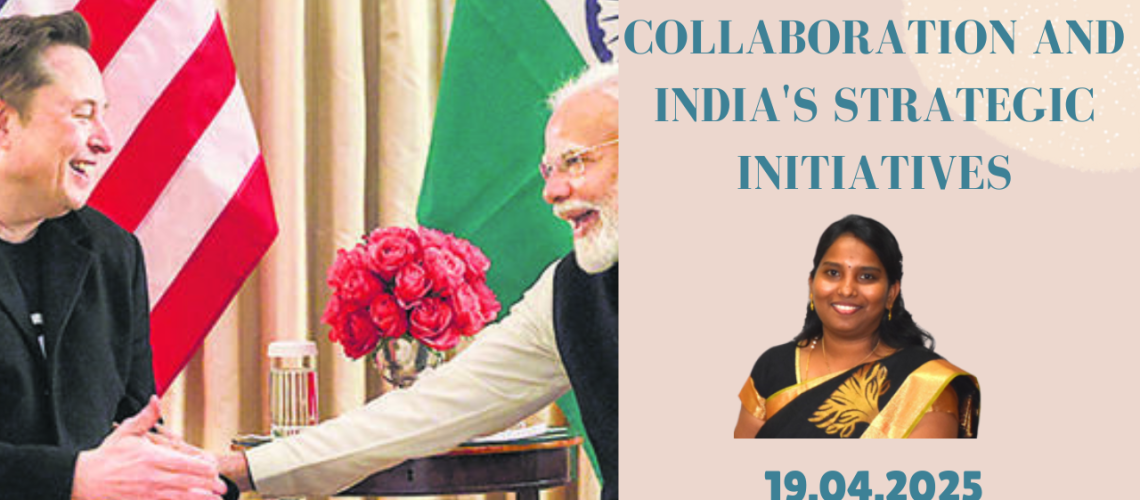
NEWS:Spoke to Elon Musk on collaboration in technology: Modi,
GS-3: Science & Technology – Emerging tech, internet infrastructure, space communication
1. High-Level Tech Diplomacy
- PM Narendra Modi spoke to Elon Musk, discussing avenues of collaboration in technology and innovation.
- Recalled earlier in-person meeting in Washington DC in February 2024.
- Highlighted India’s commitment to strengthening ties with the U.S. in advanced tech domains.
2. Focus Areas
- Talks revolved around expanding India-U.S. technology partnerships.
- Possible collaborations likely include:
- Electric mobility (Tesla)
- Satellite internet connectivity (Starlink)
- Innovation ecosystems
Advantages of EVs
An analysis by TERI suggests that shifting towards EVs would reduce pollution, lower oil imports, and cut carbon emissions and road congestion.
- Curbing Pollution: India has 21 of the world’s 30 cities with the worst air pollution as per data from IQAir AirVisual’s 2019 World Air Quality Report. Much of the pollution load can be traced to vehicular emissions.
- In this context, electric vehicles’ adoption will reduce overall emissions and meet the Paris agreement targets.
- Energy Security: Such a shift would also help lower the country’s dependence on oil imports.
- Moreover, the fuel cost has increased across households as the number of people with vehicles is rising.
- As there is further up and down in petrol and diesel costs due to fluctuations in the international market price, the electric vehicles come across as a suitable way to save money.
- Starlink: Developed by SpaceX, it is a satellite-based internet service designed to provide high-speed, low-latency connectivity, especially in remote areas.
- Starlink’s around 7,000 low-earth orbit (LEO) satellites form a mega-constellation, ensuring global coverage.
- India has not approved Starlink due to security, privacy, and pricing concerns, along with opposition from the local telecom and satellite industry.
- Eutelsat: Eutelsat, Starlink’s closest competitor, operates 630 LEO satellites and 35 geostationary satellites, offering speeds up to 150 Mbps.
- India lacks widespread commercial satellite internet, but the Telecommunications Act, 2023 provides for the assignment of spectrum through an administrative process for satellite-based services, whereas terrestrial spectrum is allocated through auctions.
NEWS:A welcome move: Arbitrary takedown orders on Wikipedia will stifle flow of information
GS-2: Polity & Governance – Judiciary, Fundamental Rights (Article 19)
1. SC Quashes Delhi HC Order
- Supreme Court overturned Delhi High Court’s directive to Wikimedia to take down a Wikipedia article based on a defamation case filed by Asian News International (ANI).
- The HC had called the Wikipedia page defamatory due to references that were allegedly editorials/opinionated, placing a “higher responsibility” on Wikipedia.
2. Supreme Court’s Stand
- Observed that:
- HC’s takedown direction was too broad.
- Removing all false/misleading content could punish the open, user-driven model of Wikipedia.
- Directed ANI to file a specific plea for removal of identified defamatory content.
Wikipedia
- Wikipedia is a free Internet-based encyclopedia, started in 2001, that operates under an open-source management style.
- It is overseen by the nonprofit “Wikimedia Foundation”.
- It is maintained by a community of volunteers through open collaboration and a wiki-based editing system.
- Anyone can contribute to their pool of knowledge by making edits to existing pages for updating or correction and can even add new pages.
Responsibility for Content:
- intermediaries are endowed with immunity .
- Wikimedia can be held responsible for illegal content being hosted on Wikipedia
Acts regarding online content
Section 69A of IT Act 2000:
- enables the Centre to ask any agency of the government, or any intermediary, to block access to the public of any information generated, transmitted, received or stored or hosted on any computer resource.
Section 79 of IT Act 2000:
- Under Section 79 of Information Technology Act 2000, intermediaries can claim the “safe harbour” of not being responsible for the content they host, considering they abide by due diligence requirements under the Act and its Rules.
IT Rules 2021:
- As per the Information Technology (Intermediary Guidelines and Digital Media Ethics Code) Rules, 2021, there are certain categories of information that an intermediary should not allow to be hosted or uploaded on its platform which includes:
- Information that is “patently false and untrue, and is written or published in any form, with the intent to mislead or harass a person, entity or agency for financial gain or to cause any injury to any person”.
NEWS:Two Kuno cheetahs to be moved to Gandhi Sagar on April 20
GS-3: Environment – Biodiversity Conservation, Protected Areas
- Date of Transfer: April 20, 2025
- From: Kuno National Park, Madhya Pradesh
- To: Gandhi Sagar Wildlife Sanctuary, Mandsaur and Neemuch districts
- Animals Involved: Two male cheetahs identified for relocation
Context & Background
- This is the second phase of cheetah reintroduction in India since the species was brought back in 2022.
- Decision follows a review by:
- Union Environment Minister Bhupender Yadav
- MP Chief Minister Mohan Yadav
- MP State Forest Department officials
- Kuno was developed as a habitat for cheetahs under the Cheetah Project, but space and human-animal conflict are key concerns.
About Gandhi Sagar Sanctuary
- Location: Mandsaur district, MP
- Enclosure: 64 sq. km dedicated cheetah zone
- Preparedness: Infrastructure and habitat ready
- Earlier Plan: 6–8 cheetahs from South Africa (delayed due to negotiations)
NEWS:NCERT insists all new school textbooks were ‘named thoughtfully’
GS 2 GOVERNANCE Structure, Organization and Functioning
ISSUE:
- Amid row over use of Hindi names for English textbooks, NCERT says the titles reflect diversity and unity;
- it adds that names were chosen for their cultural, linguistic, pedagogical significance
National Council of Educational Research and Training (NCERT)
- It is an autonomous organisation set up in 1961 by the Government of India to assist and advise the Central and State Governments on policies and programmes for qualitative improvement in school education.
- The major objectives of NCERT and its constituent units are to:
- Undertake, aid, promote and coordinate research in areas related to school education;
- Prepare and publish model textbooks, supplementary material, newsletters, journals and other related literature;
- Organise pre-service and in-service training of teachers;
- Develop and disseminate innovative educational techniques and practices;
- Collaborate and network with state educational departments, universities, NGOs and other educational institutions;
- Act as a clearing house for ideas and information in matters related to school education;
- Act as a nodal agency for achieving the goals of universalization of elementary education.
- NCERT is an implementation agency for bilateral cultural exchange programmes with other countries in the field of school education.
- The NCERT also interacts and works in collaboration with international organisations, visiting foreign delegations and offering various training facilities to educational personnel from developing countries.
- As per the National Education Policy 2020, NCERT is the nodal agency to develop National Curriculum Frameworks (NCFs) for (a) Early Childhood Care and Education (ECCE), (b) School Education, and (c) Adult Education.
- The council headquarters is located at Sri Aurobindo Marg, New Delhi.
- Organizational Structure:
- The Union Minister of Education is the President (ex-officio) of the General Body of NCERT.
- The members of the General Body include Education Ministers of all States and Union Territories.
- The Secretary, NCERT is the Convenor of the General Body of the NCERT.
- The Executive Committee is the main governing body of NCERT. The Union Minister of Education is its President (ex-officio) and the Union Minister of State in the Ministry of Education is the ex-officio Vice-President.
- The Executive Committee is assisted in its work by the various Standing Committees/Boards.
- The functions of the Council are looked after by the Director, Joint Director and Secretary.
MAINS QUESTION
Discuss the challenges and prospects of India’s cheetah reintroduction programme in the context of wildlife relocation and landscape-based conservation.”

