
News 1: India to Sign U.S. Deal Only After Clarity on Tariff Rates
Preliminary Facts (For Mains Answer Introduction)
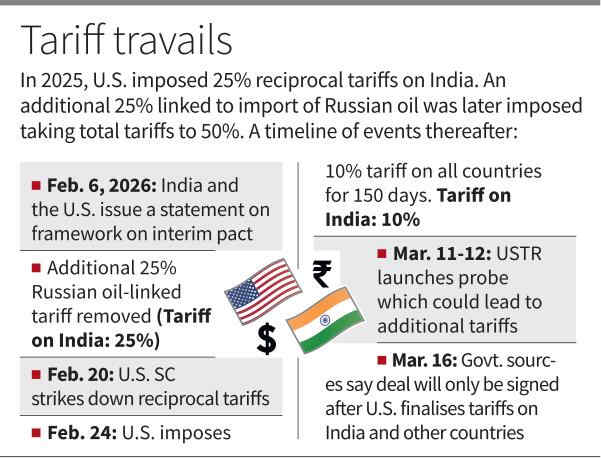
- Decision to Delay: India will sign a trade deal with the U.S. only after the country settles its “tariff architecture” and clarifies country-wise tariff rates, according to senior officials in the Ministry of Commerce. The deal, initially expected to be signed in March 2026, has been postponed .
- Context of Supreme Court Ruling: The U.S. Supreme Court on February 20, 2026, struck down President Trump’s use of the International Emergency Economic Powers Act (IEEPA) to levy reciprocal tariffs on trading partners. Consequently, the reciprocal tariffs that formed the basis of the February framework agreement no longer exist .
- Current Tariff Regime: Following the Supreme Court ruling, the U.S. imposed 10% tariffs on all countries under Section 122 of the Trade Act, 1974, which will remain in force for 150 days from February 24, 2026 .
- New Section 301 Investigations: On March 11-12, 2026, the U.S. Trade Representative initiated two separate investigations under Section 301 of the Trade Act, 1974—one targeting 16 economies over excess manufacturing capacity, and another covering 60 economies over alleged failure to ban imports of goods made with forced labour. These could result in additional country-specific tariffs .
- India’s Conditional Approach: “Any deal that we finalise and sign has to be seen against the tariff structure or comparative advantage that India gets in the U.S. market,” a senior official stated. The 18% tariff agreed under the February framework may be renegotiated depending on rates imposed on India’s competitors .
- Russian Oil Context: On February 7, 2026, the U.S. removed 25% additional tariffs on Indian exports that were linked to India’s imports of Russian oil. Commerce Secretary Rajesh Agrawal confirmed that India has increased Russian oil purchases in March due to challenges arising from the West Asia conflict .
Syllabus Mapping (Relevance)
- GS Paper II: International Relations – Bilateral trade relations (India-US), Effect of policies of developed countries on India’s interests, Geopolitics of energy.
- GS Paper III: Economy – Foreign trade, Tariff policy, Export-import dynamics, Trade agreements.
- GS Paper II: International Relations – Impact of judicial decisions (US Supreme Court) on international economic relations.
- GS Paper III: Internal Security – Energy security, Supply chain vulnerabilities.
Deep Dive: Core Issues & Analysis (For Mains Answer Body)
A. The Original Framework: What Was Agreed in February?
| Aspect | Details |
| Announcement Date | February 2, 2026 (following PM Modi-Trump call) |
| Framework Finalised | February 7, 2026 (joint statement) |
| Key Elements | US to reduce tariffs on India to 18%; India to import $500 billion of US energy, aircraft, tech, and coking coal over five years; removal of 25% Russian oil-linked tariffs |
| Expected Signing | March 2026 (as stated by Commerce Minister Piyush Goyal) |
- Strategic Rationale: The framework was designed to reset trade ties, give Indian exporters preferential access (18% vs. competitors at 19-20%), and deepen energy cooperation .
B. The Legal Disruption: US Supreme Court Ruling
| Aspect | Details |
| Date | February 20, 2026 |
| Ruling | 6-3 decision striking down President Trump’s use of IEEPA to impose reciprocal tariffs |
| Effect on India Deal | The 18% tariff agreed under the framework was based on IEEPA tariffs that “per se don’t exist” |
| Current Tariff Basis | Section 122 of Trade Act, 1974 – 10% universal tariffs for 150 days (until July 2026) |
- Government’s Explanation: “The U.S. deal was to be signed in March. When we said this, at that time the Supreme Court judgement on IEEPA tariffs had not come. Now with the Supreme Court judgement on IEEPA tariffs, the tariffs per se don’t exist” .
C. New Section 301 Investigations: Additional Uncertainty
| Investigation | Scope | Potential Impact |
| Investigation 1 (March 11) | 16 economies (including India, China, EU) over excess manufacturing capacity | Additional tariffs if findings warrant |
| Investigation 2 (March 12) | 60 economies (including India) over failure to ban imports made with forced labour | Additional tariffs; compliance costs |
- Official’s Observation: “The U.S. is working on trying to recreate a tariff architecture globally. If they are able to finalise that, at that juncture it would be right to sign the deal” .
D. India’s Conditional Approach: Waiting for Clarity
| Principle | Explanation |
| Comparative Advantage | The 18% rate was advantageous when competitors faced 19-20% tariffs |
| Dynamic Benchmarking | “In case all others are at 19%, 20%, 21%, 22%, then India will remain at 18%. But if others come down, then India will also come down” |
| No Standoff | Officials emphasise that the deal is not abandoned; signing awaits US tariff architecture finalisation |
- Commerce Secretary’s Assurance: “India remains engaged with the U.S. side for a mutually beneficial trade agreement” .
E. Russian Oil: The Geopolitical Context
| Development | Significance |
| February 7, 2026 | US removed 25% tariffs on Indian exports linked to Russian oil purchases |
| March 2026 | India increased Russian oil imports due to West Asia conflict disruptions |
| Official Statement | “We can say that we are buying Russian oil and there has been an increased buying of Russian oil in the current month because of the challenges we are facing” |
- Strategic Autonomy: India’s continued Russian oil purchases, even after US tariff removal, demonstrate its commitment to energy security and independent foreign policy .
F. Broader Trade Implications
| Aspect | Analysis |
| West Asia Conflict | Logistical challenges affecting shipping and air cargo; exports to Gulf may decline |
| Export Target | Government still expects total goods and services exports to reach ~$860 billion |
| Support Measures | Government considering support for exporters affected by West Asia disruptions |
Key Terms (For Prelims & Mains)
- IEEPA (International Emergency Economic Powers Act, 1977): US law struck down by Supreme Court as basis for reciprocal tariffs .
- Section 122, Trade Act of 1974: Allows temporary (150-day) universal tariffs to address balance-of-payments deficits .
- Section 301, Trade Act of 1974: Authorizes investigation of foreign trade practices deemed unfair; can lead to tariffs .
- BTA (Bilateral Trade Agreement): Comprehensive trade pact covering goods, services, investment .
- Comparative Advantage: Ability of a country to produce goods at lower opportunity cost than competitors .
- Strategic Autonomy: India’s ability to make sovereign foreign policy decisions independent of major powers .
Mains Question Framing
- GS Paper II (International Relations): “India’s decision to postpone signing the trade deal with the US pending clarity on tariff architecture reflects the complex interplay of judicial decisions, trade investigations, and geopolitical factors. Analyze the challenges and opportunities in India-US trade relations.”
- GS Paper III (Economy): “The US Supreme Court’s invalidation of IEEPA tariffs and subsequent Section 301 investigations have created uncertainty for India’s trade deal with the US. Discuss India’s calibrated approach and its implications for export competitiveness.”
- GS Paper II (International Relations): “India’s continued purchase of Russian oil despite US pressure underscores its commitment to strategic autonomy. Examine this in the context of the evolving India-US trade relationship.”
Linkage to Broader Issues & Debates
- Strategic Autonomy: India’s refusal to sign the deal until US tariff architecture is clear demonstrates its commitment to protecting national interests .
- Rule of Law in International Trade: The US Supreme Court ruling reinforces the importance of legal frameworks in trade policy .
- Geopolitical Balancing: India’s increased Russian oil purchases amid West Asia conflict show its multi-alignment strategy .
- Trade Diversification: India’s engagement with EU (recent FTA) provides alternative markets as US uncertainty persists .
- Energy Security: The West Asia conflict underscores India’s vulnerability to oil shocks and need for diversification .
News 2: USCIRF is Creating a Distorted Picture of India, Says Centre
Preliminary Facts (For Mains Answer Introduction)
- USCIRF Report: The U.S. Commission on International Religious Freedom (USCIRF), in its latest annual report, has presented what India terms a “distorted and selective picture” of the country. The report called for “targeted sanctions” against India’s external intelligence agency, the Research & Analysis Wing (R&AW) , and the Rashtriya Swayamsevak Sangh (RSS) , alleging their “responsibility and tolerance of several violations of religious freedom” .
- Sanctions Recommendation: USCIRF recommended freezing the assets of these entities and barring their entry into the United States. It further suggested that bilateral trade policies with India should be linked to “improvements in religious freedoms” .
- India’s Response: Ministry of External Affairs (MEA) Spokesperson Randhir Jaiswal strongly rebutted the report, stating that USCIRF relies on “questionable sources and ideological narratives rather than objective facts”. He asserted that such “repeated misrepresentations only undermine the credibility of the Commission itself” .
- Counter-Narrative on US: India turned the spotlight on the US, urging the USCIRF to reflect on the “disturbing incidents of vandalism and attacks on Hindu temples in the United States”. The MEA also flagged “growing intolerance and intimidation of members of the Indian diaspora in the United States” as issues meriting serious attention .
- Pattern of Incidents: There have been multiple incidents of violence against Indian community members and vandalism at Hindu temples and properties in the US in recent years, which India has consistently urged US authorities to address .
Syllabus Mapping (Relevance)
- GS Paper II: International Relations – Effect of foreign policies on India’s interests, India-US bilateral relations, Role of non-state actors in international relations.
- GS Paper II: Governance – Human rights issues, Religious freedom, Government policies and interventions.
- GS Paper II: Polity – Fundamental Rights (Article 25-28 – Freedom of Religion), Secularism.
- GS Paper III: Internal Security – Role of intelligence agencies (R&AW), Internal security challenges.
- GS Paper II: International Relations – Diaspora diplomacy, Protection of Indian citizens abroad.
Deep Dive: Core Issues & Analysis (For Mains Answer Body)
A. The USCIRF Report: Key Recommendations
| Recommendation | Target | Significance |
| Targeted Sanctions | R&AW (India’s external intelligence agency) | Unprecedented call to sanction a sovereign state’s intelligence apparatus |
| Asset Freeze and Travel Ban | R&AW and RSS leadership/entities | Would bar designated individuals/entities from US financial system and entry |
| Link Trade to Religious Freedom | India-US bilateral trade | Suggests conditioning trade agreements on religious freedom “improvements” |
- Unprecedented Nature: Calling for sanctions against a friendly foreign government’s intelligence agency is a highly unusual step that, if acted upon, would represent a major deterioration in bilateral relations .
B. India’s Strong Rebuttal: Key Arguments
| Argument | Details |
| Distorted and Selective Picture | USCIRP presents a biased view, ignoring India’s constitutional protections and pluralistic traditions |
| Questionable Sources | Relies on “ideological narratives rather than objective facts” |
| Undermining Credibility | Repeated misrepresentations damage USCIRF’s own credibility, not India’s |
| Focus on US Incidents | USCIRF should examine vandalism of Hindu temples and attacks on Indian diaspora in US |
| Growing Intolerance in US | “Growing intolerance and intimidation of members of the Indian diaspora in the United States merit serious attention” |
- Strategic Counter: By highlighting attacks on Hindu temples and diaspora in the US, India effectively turns the spotlight back on the accuser, exposing double standards .
C. The Issue of Sanctions on R&AW and RSS
| Aspect | Analysis |
| R&AW | India’s external intelligence agency, responsible for national security. Sanctioning it would be viewed as a hostile act against India’s sovereignty. |
| RSS | A socio-cultural organization with millions of members; designation would affect Indian diaspora engagement and bilateral cultural ties. |
| Diplomatic Fallout | Even if not implemented, the recommendation itself strains bilateral trust and signals a confrontational approach from certain US quarters. |
- India’s Likely Response: India would view any move to sanction R&AW as a direct challenge to its sovereignty and would respond with appropriate diplomatic measures .
D. Linking Trade to Religious Freedom: A Dangerous Precedent
| Implication | Analysis |
| Trade as Leverage | Using trade agreements to force domestic policy changes violates WTO principles of non-discrimination |
| Sovereignty Concerns | Imposing religious freedom conditions on trade interferes with India’s sovereign right to determine its internal policies |
| Precedent for Other Nations | If US adopts this approach, other countries may face similar conditionality, destabilising global trade |
| India’s Position | India has consistently rejected any linkage between trade and non-trade issues |
- Expert View: Such conditionality would undermine the multilateral trading system and set a dangerous precedent for using trade as a tool for ideological coercion .
E. India’s Counter-Narrative: Attacks on Hindu Temples in US
| Incident Type | Examples |
| Temple Vandalism | Multiple incidents of Hindu temples defaced with graffiti, damaged property |
| Diaspora Attacks | Physical assaults on Indian-origin individuals, particularly in recent years |
| India’s Demands | India has consistently urged US authorities to investigate and prevent such attacks |
- MEA’s Point: “Instead of persisting with selective criticism of India, USCIRF would do well to reflect on the disturbing incidents of vandalism and attacks on Hindu temples in the United States” .
Key Terms (For Prelims & Mains)
- USCIRF (U.S. Commission on International Religious Freedom): An independent, bipartisan U.S. federal government commission created by the 1998 International Religious Freedom Act to monitor religious freedom abroad .
- R&AW (Research & Analysis Wing): India’s external intelligence agency, responsible for gathering foreign intelligence and counter-terrorism .
- RSS (Rashtriya Swayamsevak Sangh): A voluntary, non-political, cultural organization founded in 1925, working for the welfare of Hindu society .
- Targeted Sanctions: Economic sanctions directed at specific individuals or entities rather than entire countries .
- Diaspora Diplomacy: Engagement by a country with its citizens living abroad to maintain ties and protect their interests .
- Article 25-28: Constitutional provisions guaranteeing freedom of religion in India .
- WTO Principles: Non-discrimination, most-favoured-nation treatment, national treatment—would be violated by trade-religion linkage .
Mains Question Framing
- GS Paper II (International Relations): “The USCIRF report recommending sanctions against Indian entities and linking trade to religious freedom has drawn a strong rebuttal from India. Analyze the implications for India-US bilateral relations and India’s strategic response.”
- GS Paper II (Governance): “Examine the constitutional protections for religious freedom in India. How does India’s secular framework compare with international standards, and why do reports like USCIRF’s present a distorted picture?”
- GS Paper II (International Relations): “India’s counter-narrative highlighting attacks on Hindu temples and diaspora in the US exposes double standards in international religious freedom monitoring. Discuss the role of reciprocity in diplomatic engagements on human rights.”
Linkage to Broader Issues & Debates
- Sovereignty vs. International Scrutiny: The report raises fundamental questions about the limits of international monitoring and the right of nations to determine their internal policies .
- Reciprocity in Diplomacy: India’s strategy of highlighting US domestic incidents reflects a growing trend of reciprocal diplomacy, where nations respond to criticism by pointing out accuser’s shortcomings .
- Trade and Human Rights Linkage: The debate over linking trade to religious freedom mirrors broader global discussions on conditioning economic relations on human rights performance .
- Diaspora Protection: India’s concerns about diaspora safety in US underscore the importance of consular access and bilateral cooperation on citizen protection .
- Strategic Autonomy: India’s firm rejection of external pressure demonstrates its commitment to strategic autonomy and non-interference .

