
NEWS:Services exports cut India’s trade deficit by 9.4% in Q1
GS-3 economics
- India’s overall exports in Q1 (April–June 2025) stood at $210.3 billion, up 6% YoY.
- Services exports rose by 10.8% to $98.1 billion in the same period.
- Merchandise exports grew by just 2% to $112.2 billion, dampened by falling petroleum prices.
- Overall trade deficit contracted to $20.3 billion, compared to $22.4 billion in Q1 last year.
- Total imports rose by 4.4% to $230.6 billion, with merchandise and services imports increasing 4.2% and 4.9% respectively.
- Top export destinations: U.S. ($25.5 billion, ↑22.1%), UAE ($9.04 billion), Netherlands ($5.65 billion), China ($4.4 billion).
- India is on track to exceed its FY25 export record of $825 billion, as per Commerce Secretary.
India’s Service Exports:
Service exports refer to the sale and delivery of intangible products (services) between a producer and consumer in different countries.
Major Sectors:
Key service export sectors include IT and business process outsourcing (IT-BPM), professional consulting, financial services, travel, and transportation.
the Government Initiatives to Promote Service Export
- Service Exports from India Scheme:
- It was introduced in April 2015 for 5 Years under the Foreign Trade Policy of India 2015-2020.
- Earlier, this Scheme was named the Served from India Scheme (SFIS Scheme) for the Financial Year 2009-2014.
- Under it, incentives are given by the Ministry of Commerce and Industry to Service Exporters based in India to promote the export of services from India.
- Redirecting subsidy resources towards sectors with greater needs can optimise resource allocation and foster inclusive growth.
- Skill India Initiative:
- The Skill India programme aims to provide market-relevant training to over 40 crore youth by 2022.
- Its objective is to equip them with the necessary skills for employment in various sectors, including services.
- Purchasing Managers Index (PMI):
- PMI serves as an indicator of business activity in both the manufacturing and services sectors.
- It provides valuable insights into the health and performance of these sectors, aiding in decision-making and policy formulation.
- Free-Trade Agreements (FTAs):
- The government is actively pursuing FTAs with key economies like the UK, EU, Australia, and the UAE to facilitate market access for Indian service providers.
- These agreements aim to create favourable trade conditions and enhance competitiveness in the global market.
NEWS:How is global shipping trying to decarbonise?
GS-3 science and technology
- Shipping currently relies on VLSFO, diesel, and LNG; shift toward green methanol, green ammonia, and biofuels is underway.
- Over 360 methanol-powered ships are in service or under construction globally.
- Green methanol is a near drop-in replacement fuel, while green ammonia requires major modifications and safety protocols.
- India is setting up green fuel bunkering hubs at Tuticorin and Kandla ports.
- Green e-methanol costs $1,950/tonne vs VLSFO at $560/tonne.
- India aims to supply green fuels to Singapore, a major bunkering station handling 25% of global refuelling.
- India pledges $10 billion for 110 ships, encouraging green-capable vessels built in domestic shipyards.
- Green Hydrogen: Hydrogen generated from water using renewable electricity through electrolysis.
- Green Methanol: Synthesised using green hydrogen and captured CO₂ from industrial sources.
- Green Ammonia: Produced from green hydrogen and atmospheric nitrogen; zero GHG emissions but handling complexity.
- Drop-in Fuel: A substitute fuel that can be used with little or no engine modification.
- Bunkering: The process of supplying fuel to ships at ports
NEWS:The issue with criminalising all adolescent relationships
GS-2 governance
The Supreme Court’s May 2025 judgment in Re: Right to Privacy of Adolescents reopened the debate on how the POCSO Act criminalises all adolescent sexual relationships, even when consensual.
- SC used Article 142 to avoid sentencing a man convicted under Section 6 of the POCSO Act.
- The case involved a 14-year-old girl who eloped and later married the man; they had a child.
- The High Court earlier acquitted the man citing socio-economic factors and lack of awareness.
- SC reversed the acquittal but acknowledged that true justice lies in not sentencing the accused in this case.
- Empirical studies show that over 24% of POCSO cases involve consensual adolescent relationships.
- Both SC and HC barred this case from being treated as a judicial precedent, citing its “extraordinary” nature.
- The Court recommended structural reforms and comprehensive sexuality education to address the issue.
- POCSO Act (2012) sets the age of consent at 18, criminalising all sexual activity with minors regardless of consent.
- The girl’s trauma arose not from the relationship, but from police intervention, court trials, and social stigma.
- The SC initially dismissed the HC’s view that the law “undermines adolescent identity” as “shocking”, reflecting a paternalistic bias.
- Expert committee found that the law saw it as a crime, but the victim did not, and her distress stemmed from systemic responses.
- Ground realities such as poverty, child marriage norms, lack of education, and patriarchal constraints shape adolescent choices.
- Judicial inconsistency is evident: some HCs call for decriminalisation, while others, like Bombay HC in Aakash Waghmare (2025), await legislative reform.
- SC’s acknowledgment of systemic failure — from judiciary, family, to media — marks a shift toward rights-based discourse.
- The case exposes the limitations of the one-size-fits-all approach under POCSO in dealing with adolescent relationships.
Legality and litigation
- Article 142: Empowers the Supreme Court to pass orders necessary for doing “complete justice”.
- Section 6, POCSO Act: Deals with aggravated penetrative sexual assault and carries a minimum 20-year sentence.
- Age of Consent: The legally defined age at which a person is considered competent to consent to sexual activity
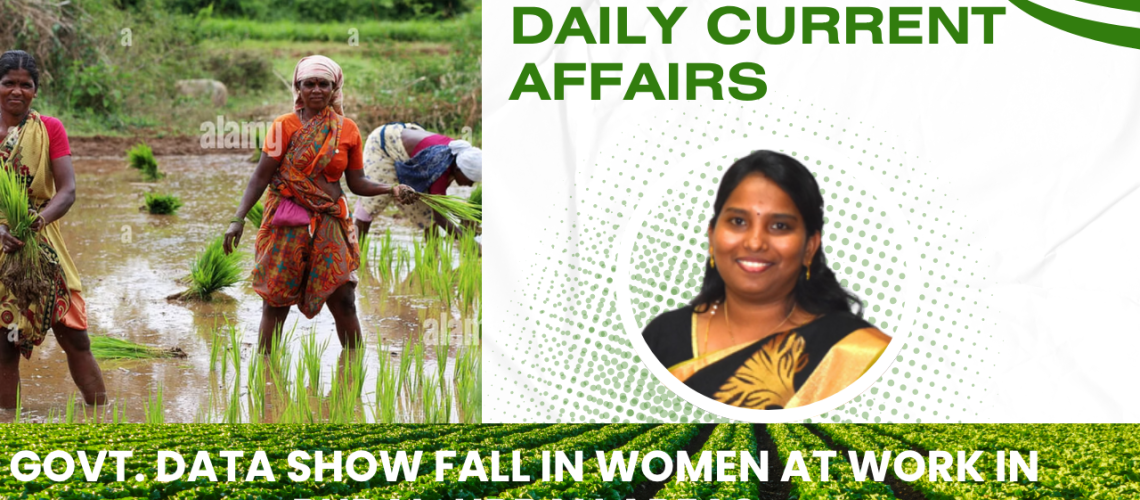
NEWS:Govt data show fall in women at work in rural urban areas
GS-2 governance
The Periodic Labour Force Survey (PLFS) for June 2025 shows a decline in female labour force participation rate (LFPR) in both rural and urban areas, while unemployment remained stagnant at 5.6% for those aged 15 and above.
DATAS
- Female LFPR (15+ age group) dropped from 36.9% in May to 35.2% in June in rural areas and from 25.3% to 25% in urban areas.
- Combined LFPR for all females across age groups fell to 24.5% in June from 25.5% in May.
- Male LFPR declined slightly to 78.1% (rural) and 75% (urban) in June.
- Worker Population Ratio (WPR) and LFPR declined due to seasonal agricultural shifts and intense summer heat.
- The share of rural women in agriculture fell to 69.8% in June from 70.2% in May.
- Unemployment rate stayed constant at 5.6%, with a minor 0.1% decline for females
- Labour Force Participation Rate (LFPR): Percentage of people aged 15+ who are either employed or actively looking for work.
- Worker Population Ratio (WPR): Proportion of employed persons in the population.
- Periodic Labour Force Survey (PLFS): Conducted by NSO to assess employment-unemployment indicators on a monthly, quarterly, and annual basis
MAINS MOCK QUESTION
Critical provisions of POCSO act 2012 .recent SC rulings are contradict with it discuss

