
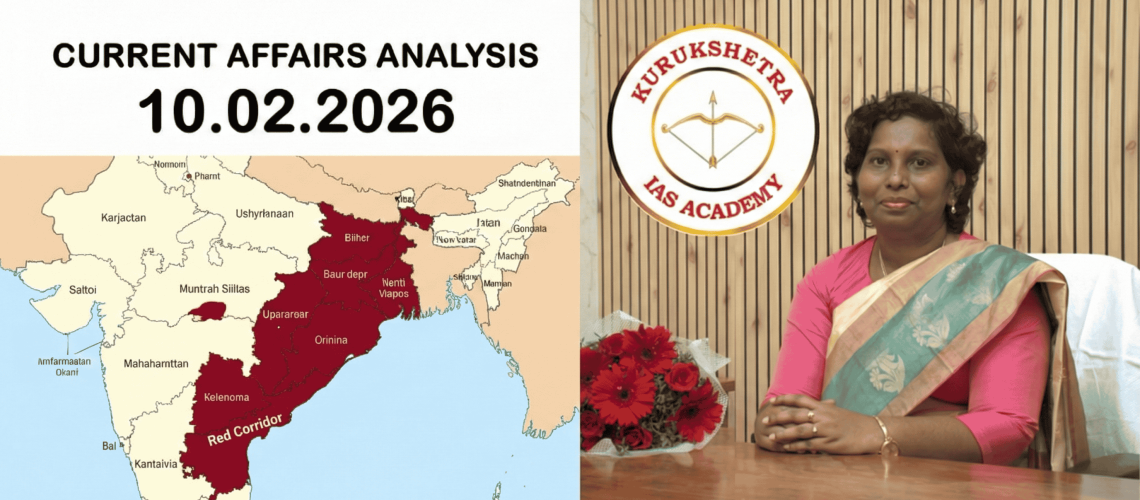
News 1: Amit Shah in Bastar Reclaims Cultural Identity Sets March 31 Deadline for Maoist Eradication
At the Bastar Pandum cultural festival, Union Home Minister Amit Shah reframed the region’s identity from conflict to its rich heritage, while reiterating the government’s dual strategy: a firm security response to armed Maoists and a March 31 deadline for eradication, coupled with appeals for surrender and promises of development.
1. Preliminary Facts
- Event & Venue: Union Home Minister Amit Shah addressed the closing ceremony of ‘Bastar Pandum 2026’, a three-day cultural festival in Jagdalpur, Bastar.
- Core Message on Identity: Shah asserted that “Barood (explosives) cannot be Bastar’s identity”; its true identity is its rich culture and heritage. He committed to preserving and globalizing Bastar’s culture.
- Security & Deadline: Reiterated that Maoism would be completely uprooted by March 31, 2026. Warned of a “firm response” to armed violence while assuring safety for surrendered cadres.
- Appeal & Concern: Made a special appeal for young tribal girls among Maoist cadres to surrender for rehabilitation. Criticized Maoists for closing schools for decades, depriving generations of literacy.
- Development Promise: Vowed that Bastar would become the most developed tribal area in five years through tourism, and that all closed schools, PHCs, and hospitals would be reopened.
2. Syllabus Mapping
- GS Paper III (Internal Security): Linkages between development and spread of extremism; Security challenges in internal security.
- GS Paper I (Society): Salient features of Indian Society, Diversity of India; Role of women.
- GS Paper II (Governance): Government policies and interventions for development in various sectors; Issues relating to poverty and hunger.
3. Deep Dive: Core Issues & Analysis
A. The Battle of Narratives: Reclaiming Identity from Conflict
- From ‘Red Corridor’ to ‘Cultural Corridor’: Shah’s speech is a sophisticated psychological and narrative operation. By stating “explosives cannot be Bastar’s identity,” he directly challenges the dominant media and security discourse that defines Bastar through the prism of conflict. This aims to rebuild local pride and self-perception around indigenous culture (Dokra art, music, festivals), undermining the Maoist narrative of the state as a destructive, alien force.
- Cultural Soft Power as a Counter-Insurgency Tool: Promoting ‘Bastar Pandum’ and vowing to take its culture global uses soft power to foster mainstream integration. It signals that the state values and wants to celebrate tribal identity, not suppress it—a counter to Maoist claims of fighting for tribal rights. This can help win the trust of the local population, a critical element in counter-insurgency.
- The Symbolism of Reopened Schools and Hoisted Flags: Highlighting schools reopened after 40 years and the Tricolour hoisted after decades is potent symbolism. It frames the conflict as one between Maoist obscurantism (closing schools) and the state as a bearer of enlightenment and national integration. This narrative seeks to isolate Maoists ideologically from the very communities they claim to represent.
B. The Dual-Track Strategy: Coercion and Compassion
- The Stick: “Firm Response” and the March 31 Deadline: The reiteration of the deadline maintains operational pressure and demonstrates political resolve. The warning that “armed violence will be met with a firm response” aims to deter remaining cadres and bolster the morale of security forces. It also publicly sets a benchmark for accountability.
- The Carrot: Surrender, Rehabilitation, and Development Focus: The appeal for surrender, especially to young tribal girls, and the promise of no harm is a crucial confidence-building measure. Coupling this with concrete development promises (tourism, schools, hospitals) addresses the root causes of alienation—poverty, lack of services, and unemployment. This is the “hearts and minds” component essential for lasting peace.
- The Gender-Sensitive Appeal: Expressing specific concern for “young tribal girls” in cadres is significant. It recognizes their potential dual vulnerability—as combatants and as victims of exploitation within the movement. This tailored appeal can be more effective and aligns with a more nuanced, humane counter-insurgency approach.
C. The Development Promise and Implementation Challenges
- Tourism as an Economic Engine: Promoting tourism in Bastar is a double-edged sword. While it can create jobs and showcase culture, it risks exploitative commercialization, ecological damage, and disrupting tribal ways of life if not managed with extreme sensitivity and community ownership. It must be sustainable and tribal-led.
- Rebuilding the Social Infrastructure: The pledge to reopen all schools and health centers is foundational. However, the challenge is not just opening buildings but ensuring qualified teachers who speak local languages, culturally relevant curriculum, reliable medical staff, and medicine supply. Past failures in this regard fueled discontent.
- From Promise to Perception: For locals, the gap between promises and on-ground delivery has often been wide. The government’s credibility hinges on visible, tangible improvements in daily life—electricity, roads, fair price for forest produce—before the next election cycle. The “most developed tribal area in 5 years” claim sets a high bar that will be closely watched.
4. Key Terms
- Bastar Pandum: A traditional tribal festival of Bastar, now promoted as a state-sponsored cultural event.
- IED (Improvised Explosive Device): A homemade bomb, commonly used by Maoists in ambushes.
- Rehabilitation Policy: Government schemes for surrendered militants, offering financial aid, vocational training, and sometimes land.
- Narrative Warfare: The use of information and symbolism to influence perceptions, morale, and identity during a conflict.
- Hearts and Minds (Strategy): A military and political strategy aimed at winning the popular support of the local population.
5. Mains Question Framing
- GS Paper III (Internal Security): “The government’s approach to Left-Wing Extremism has evolved to include a strong narrative and developmental component alongside security operations. Critically examine this integrated strategy with reference to recent statements.”
- GS Paper I (Society)/GS Paper II (Governance): “Sustainable development in tribal regions like Bastar requires a balance between cultural preservation, economic growth, and ecological conservation. Discuss the challenges and opportunities.”
- GS Paper III (Internal Security): “Appealing for the surrender of young tribal women in Maoist cadres represents a gendered dimension of counter-insurgency. Analyze its significance and the required rehabilitation framework.”
6. Linkage to Broader Policies & Dynamics
- PM-VIKAS (Virasat Ka Samvardhan) & Vibrant Villages Programme: The cultural promotion aligns with broader schemes for heritage conservation and border village development.
- National Education Policy (NEP) 2020: Reopening schools must incorporate NEP’s focus on mother-tongue instruction and vocational training to be meaningful.
- Pradhan Mantri Janjatiya Vikas Mission: Bastar’s development is central to this mission for tribal welfare. Convergence with schemes for habitat rights (FRA), livelihood (TRIFED), and health (Ayushman Bharat) is crucial.
- International Examples: Citing Colombia, Peru, and Cambodia serves to internationalize the Maoist problem and learn from other nations’ transitions from conflict, highlighting that peace is possible.
Text and Context – 1: Gravity and Motion: Reflecting on Earth’s Extraordinary Celestial Journey as a Metaphor for Life
A science communication piece uses the physics of gravity, Earth’s orbital speed (1,07,000 km/h), and the historical search for ‘aether’ to offer a perspective-shifting reflection on human existence, framing our annual journey around the sun as a shared, remarkable achievement.
1. Preliminary Facts
- Core Theme: An essay blending physics and philosophy, explaining how gravity governs Earth’s existence and its rapid journey through space at approximately 1,07,000 km/h, completing a 1-billion-km orbit yearly.
- Key Scientific Concepts Covered:
- Newtonian Gravity: As an attractive force binding life to Earth and governing celestial orbits (Earth-Moon, Earth-Sun).
- Centripetal Force: Gravity acts as the centripetal force keeping Earth in orbit.
- Motion in Vacuum & The ‘Aether’ Concept: Explains Earth’s sustained speed due to the absence of friction in space, debunking the historical concept of ‘luminiferous aether’ via the Michelson-Morley experiment (1887).
- Human & Historical Context: Connects to Isaac Newton’s discovery, commemorates Indian astrophysicist Jayant Narlikar, and references the TV series ‘Brahmand’ for public science education.
- Purpose: To provide a cosmic perspective, encouraging readers to see their lives as part of an extraordinary, shared space voyage, regardless of earthly mundanity.
2. Syllabus Mapping
- GS Paper III (Science & Tech): Developments in Science and Technology; Awareness in the fields of IT, Space.
- GS Paper I (Society): Salient features of Indian Society; Role of women and women’s organization.
- GS Paper IV (Ethics): Human Values—lessons from the lives and teachings of great leaders.
3. Deep Dive: Core Issues & Analysis
A. The Physics of Stability and Motion: A Foundational Primer
- Gravity as the Architect of Life’s Stage: The article correctly simplifies gravity as the force that not only makes us fall but structures our entire environment—holding the atmosphere, oceans, and all terrestrial life to Earth. This “cohabitation by gravity” is the fundamental precondition for human civilization, politics, and conflict, a profound point often overlooked.
- Orbital Mechanics and the Scale of Existence: By comparing Earth’s orbit (1 billion km/year) to a Delhi-Chennai road trip, the article effectively communicates astronomical scale. The speed of 1,07,000 km/h underscores the dynamic, not static, nature of our planetary home. This challenges the human perception of stability and reinforces our connection to a vast, dynamic cosmos.
- The Significance of the Vacuum and the ‘Failed’ Experiment: The explanation of why Earth doesn’t slow down—absence of friction in the vacuum of space—is crucial. The mention of the Michelson-Morley experiment is key science history. Its “failure” to detect aether was a foundational triumph for modern physics, paving the way for Einstein’s theory of Special Relativity. This teaches that negative results are as important as positive ones in science.
B. Science Communication and Cultural Context in India
- Bridging Abstract Science and Daily Life: The article exemplifies effective science communication. It uses relatable analogies (pulling a child on a bicycle, car friction) to explain complex concepts (centripetal force, motion in vacuum). Its core aim is to foster scientific temper—encouraging wonder about natural phenomena rooted in rational understanding, not superstition.
- Honoring Indian Scientific Heritage: The tribute to Prof. Jayant Narlikar (Padma Vibhushan, founding director of IUCAA) and the reference to his Doordarshan series ‘Brahmand’ serves multiple purposes:
- It indigenizes the narrative of astrophysics.
- It highlights a model scientist who was also a public communicator, fighting superstition.
- It points the public towards accessible, quality Indian educational content (now on YouTube).
- The Institute as a Lighthouse: The casual mention of IIT Kanpur and its physics programs is subtle institutional branding, positioning premier tech institutes as custodians of fundamental science and curiosity-driven inquiry, not just engineering.
C. The Philosophical Undertone: Cosmic Perspective as an Antidote to Insignificance
- Reframing the “Unremarkable” Year: The essay’s central thrust is perspective-shifting. It argues that even if one’s personal year felt ordinary, participation in Earth’s grand orbital journey is itself extraordinary. This is an exercise in cosmic humility and connectedness—all life on Earth is on this “rollercoaster” together.
- Science as a Source of Wonder and Unity: In an era of divisive narratives, the piece suggests that scientific reality—our shared planetary ride—can be a unifying truth. It implicitly argues for science as a source of meaning and awe, complementing (or challenging) traditional spiritual or philosophical frameworks.
- The Call for Curiosity and Lifelong Learning: The concluding invitation to learn more physics, and the open admission that “there are many things we still don’t understand,” models intellectual humility. It promotes a mindset of continuous curiosity, essential for both scientific advancement and an engaged citizenry.
4. Key Terms
- Gravity: A fundamental force of attraction between all objects with mass.
- Centripetal Force: A force that acts on a body moving in a circular path and is directed toward the center.
- Aether (Luminiferous Aether): A hypothetical medium once thought to fill all space and transmit light waves, disproven by the Michelson-Morley experiment.
- Astrophysics: The branch of astronomy dealing with the physics of the universe, including the physical properties of celestial objects.
- Michelson-Morley Experiment (1887): A pivotal experiment that failed to detect the motion of Earth through the aether, supporting the constancy of the speed of light.
5. Mains Question Framing
- GS Paper III (Science & Tech): “Effective science communication is vital for fostering a scientific temper in society. Discuss the methods and importance of making complex scientific concepts, like orbital mechanics or fundamental physics, accessible to the public.”
6. Linkage to Broader Policies & Dynamics
- Science, Technology, and Innovation (STI) Policy: The article’s spirit aligns with the STI Policy’s goal of making science a part of everyday culture and inspiring youth to pursue STEM.
- Scientific Social Responsibility (SSR): It models SSR—scientists (like the author, a professor) communicating their knowledge to the wider public in an engaging manner.
- Digital India & Archival of Knowledge: The availability of ‘Brahmand’ on DD National’s YouTube exemplifies using digital platforms to preserve and disseminate legacy educational content, making it accessible to new generations.
- Climate Change and Planetary Awareness: Understanding Earth as a fast-moving, isolated spaceship reinforces the concept of “Spaceship Earth,” a powerful metaphor for environmental fragility and the need for sustainable stewardship of our limited resources.
News 2: Scheduled Commercial Banks’ Gross NPAs Hit Historic Low of 2.15% as of September 2025
The Finance Ministry announced that Gross Non-Performing Assets (NPAs) of Scheduled Commercial Banks have fallen to a historic low of 2.15% as of September 2025, crediting the sustained decline over eight years to the 4R strategy initiated post the RBI’s 2015 Asset Quality Review.
1. Preliminary Facts
- Key Data Point: The Gross Non-Performing Asset (NPA) ratio for Scheduled Commercial Banks (SCBs) hit a historic low of 2.15% as of September 30, 2025 (provisional).
- Historical Context: This ratio is now lower than the 2010-11 level, marking the culmination of an eight-year continuous decline in gross NPAs.
- Impact: The decline has led to reduced provisioning by banks, improved profitability, and a positive impact on business growth. It reflects improved asset quality and underwriting standards, particularly in Public Sector Banks (PSBs).
- Attributed Cause: The improvement is credited to the Reserve Bank of India’s Asset Quality Review (AQR) in 2015, followed by the government’s 4R strategy: Recognizing NPAs transparently, Resolving and Recovering value, Recapitalizing PSBs, and implementing Reforms in the financial ecosystem.
2. Syllabus Mapping
- GS Paper III (Economy): Indian Economy and issues relating to planning, mobilization of resources, growth, development and employment; Banking sector.
- GS Paper III (Economy): Effects of liberalization on the economy, changes in industrial policy and their effects on industrial growth.
3. Deep Dive: Core Issues & Analysis
A. Decoding the 4R Strategy: A Multi-Pronged Clean-Up
- Recognition (The First ‘R’ – Triggered by AQR): The Asset Quality Review (AQR) of 2015 was a watershed moment. It forced banks, especially PSBs, to stop evergreening loans and recognize stressed assets as NPAs transparently. This caused a spike in reported NPAs initially (the “bad bank” phase) but laid the foundation for an honest balance sheet, which is the first step towards resolution.
- Resolution & Recovery (The Second & Third ‘R’): This phase involved using new legal and institutional tools:
- Insolvency and Bankruptcy Code (IBC), 2016: The most significant reform, creating a time-bound resolution process. It shifted the balance of power from debtor to creditor, forcing promoters to either pay up or lose control.
- Securitisation and Reconstruction of Financial Assets and Enforcement of Security Interest (SARFAESI) Act, 2002: Its provisions were used more effectively.
- Debt Recovery Tribunals (DRTs): Efforts were made to improve their efficiency.
- National Asset Reconstruction Company Ltd. (NARCL) / ‘Bad Bank’: Established to aggregate and resolve stressed legacy assets, taking them off banks’ books.
- Recapitalization (The Fourth ‘R’): The government infused over ₹3 lakh crore into PSBs between 2016-2021. This was not a bailout but a necessary step to shore up their capital adequacy ratios (CRAR) after massive NPA provisioning, enabling them to resume lending and support economic growth.
- Reforms (The Overarching ‘R’): These included:
- Reforms in PSB governance: Instituting the Bank Board Bureau (BBB) for top-level appointments, promoting risk-based audits, and consolidation of PSBs to create stronger, more efficient entities.
- EASE Reforms: Enhanced Access and Service Excellence reforms aimed at tech-enabled banking.
B. Broader Economic and Systemic Implications
- From Crisis to Confidence: The low NPA ratio signifies a robust and resilient banking system. It enhances investor confidence, both domestic and foreign, in the Indian financial sector. A healthy banking system is critical for efficient credit intermediation, which fuels private investment and economic growth.
- Profitability and Lending Capacity: Reduced NPAs mean lower provisioning requirements. This directly boosts net profit, allowing banks to accumulate capital internally and expand their lending capacity. It creates a virtuous cycle of growth.
- Credit Discipline and Risk Management: The entire episode has instilled stricter credit assessment and monitoring disciplines within banks. The fear of IBC has improved borrower discipline. This leads to a more efficient allocation of capital in the economy, directing it to more credible projects and entrepreneurs.
C. Persistent Challenges and the Road Ahead
- Sectoral and Hidden Stress: While aggregate numbers are positive, sectoral concentrations (e.g., agriculture, MSMEs) and restructured accounts under pandemic-era measures (like the Emergency Credit Line Guarantee Scheme – ECLGS) need monitoring to prevent a new wave of stress.
- Implementation Gaps in IBC: Challenges remain, including delays beyond the 330-day timeline, liquidation vs. resolution outcomes, and judicial capacity. The effectiveness of NARCL is yet to be fully proven on a large scale.
- Ensuring Sustainable Credit Growth: Banks, now risk-averse, might over-tighten lending standards, potentially starving viable sectors, especially MSMEs, of credit. The challenge is to maintain prudent lending without stifling growth.
- Global Macroeconomic Risks: A potential global slowdown, high interest rates, and geopolitical instability could impact corporate profitability and, in turn, loan repayment capabilities, testing the resilience of the current low NPA levels.
4. Key Terms
- Gross Non-Performing Asset (NPA): A loan where interest or principal payments are overdue for more than 90 days.
- Scheduled Commercial Banks (SCBs): Banks included in the Second Schedule of the RBI Act, 1934, encompassing public, private, and foreign banks.
- Asset Quality Review (AQR): An RBI-mandated audit to force banks to recognize NPAs accurately.
- 4R Strategy: Recognize, Resolve, Recover, Recapitalize, and Reforms.
- Insolvency and Bankruptcy Code (IBC), 2016: A comprehensive law to resolve insolvency in a time-bound manner.
5. Mains Question Framing
- GS Paper III (Economy): “The decline in Gross NPAs of Indian banks to a historic low is attributed to the 4R strategy post the AQR. Evaluate the effectiveness of this strategy and discuss the remaining challenges in sustaining a healthy banking sector.”
- GS Paper III (Economy): “A robust banking sector is pivotal for economic growth. Analyze how the Insolvency and Bankruptcy Code (IBC) has transformed the credit recovery ecosystem in India.”
- GS Paper III (Economy): “Recapitalization of Public Sector Banks was a key component of banking sector reforms. Critically examine its necessity and its impact on the financial health of PSBs.”
6. Linkage to Broader Policies & Dynamics
- Financial Inclusion & Credit Flow: A healthy banking system is better positioned to support financial inclusion (PMJDY) and provide credit to priority sectors (agriculture, MSMEs) without jeopardizing its stability.
- Monetary Policy Transmission: A clean balance sheet allows banks to transmit RBI’s repo rate cuts more effectively to borrowers, as they are not burdened with provisioning for past losses.
- Atmanirbhar Bharat & Infrastructure Financing: Strong banks are essential to finance the large infrastructure projects crucial for Atmanirbhar Bharat and to support the PLI scheme beneficiaries.
- Global Benchmarks: India’s NPA ratio now compares favorably with many global peers, enhancing its attractiveness for foreign portfolio investment (FPI) in the banking sector.

