
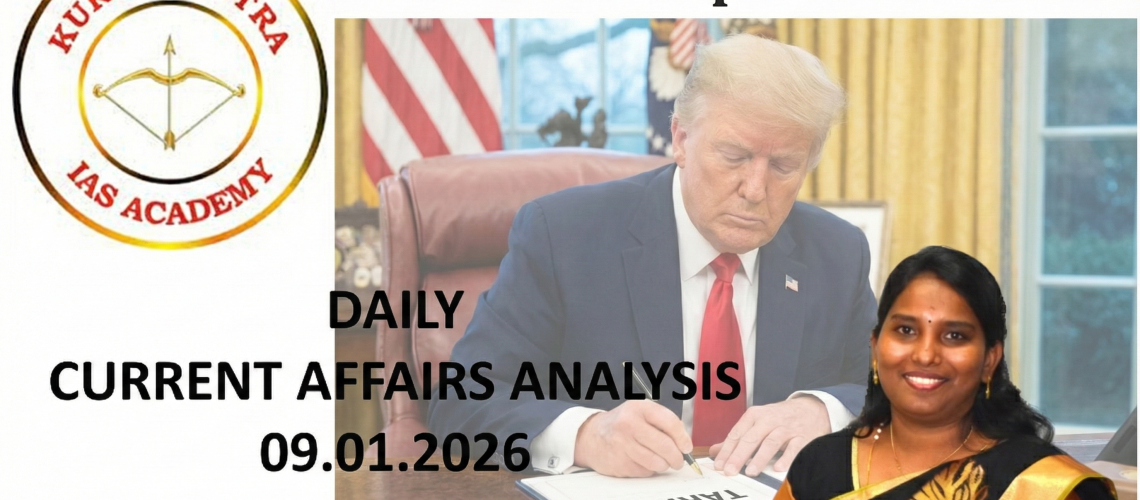
News 1: Trump clears Bill to impose 500% tariffs
New US legislation grants President discretion for steep tariffs; India faces intensified diplomatic pressure to completely cease, not just reduce, Russian oil imports.
1. Preliminary Facts (For Mains Answer Introduction)
- US Legislative Action: The Trump administration has cleared a bill granting the US President discretion to impose tariffs exceeding 500% on targeted countries, beyond existing penalty tariffs.
- Primary Target: The legislation is aimed squarely at compelling India to stop all oil imports from Russia. US Ambassador-Designate Eric Gor has been explicit, stating the demand is for a complete halt.
- On-Ground Impact: Early signs of pressure are visible. Reliance Industries has reportedly stopped Russian oil shipments to its Jamnagar refinery (Dec 2025-Jan 2026). Nayara Energy is constrained by Western sanctions.
- International Endorsement: Poland’s Foreign Minister publicly expressed satisfaction at India’s reduced imports, framing it as cutting finance for Russia’s “war machine.”
- Historical Precedent: In 2018, under similar US pressure, India “zeroed out” oil imports from Iran and Venezuela.
2. Syllabus Mapping (Relevance)
- GS Paper II: International Relations – India and its relations with major powers (USA, Russia); Effect of policies of developed countries on India’s interests.
- GS Paper III: Economy – Energy Security; Effects of globalization on Indian economy.
- GS Paper II: Polity – Government policies and interventions.
3. Deep Dive: Core Issues & Analysis (For Mains Answer Body)
A. The US Strategy: Coercive Diplomacy and “Friend-Shoring”
- Weaponizing Trade via “National Security” Tariffs: The proposed 500% tariff is an instrument of coercive economic statecraft, using the US market as leverage. It represents a move from multilateral trade rules (WTO) to unilateral, punitive measures to enforce foreign policy objectives.
- Aligning India with Western Sanctions Regime: The US objective is to fully integrate India into the Western sanctions coalition against Russia, thereby shrinking Russia’s economic lifeline and enhancing the sanctions’ effectiveness. This is part of a broader “friend-shoring” or “de-risking” strategy to reshape global supply chains along geopolitical lines.
- Leveraging Diplomatic Channels: The pressure is multi-pronged—legislative action (tariff bill), diplomatic statements (Ambassador Gor, Polish FM), and creating a coalition of persuasion (EU partners). This isolates India and raises the cost of non-compliance.
B. India’s Strategic Dilemma: Balancing Interests Amid Great Power Rivalry
- The Energy Security Imperative: India imports over 85% of its crude oil. Russian crude (Urals), offered at a significant discount, has been crucial for managing inflation, fiscal deficit, and foreign exchange reserves. A complete halt would force a costly shift to more expensive alternatives, impacting the economy.
- The Strategic Autonomy Conundrum: This pressure tests the core of India’s strategic autonomy. Acceding fully would signal alignment with the US bloc and could damage the time-tested, defense-centric partnership with Russia (e.g., S-400, spare parts, joint technology). Resisting could trigger severe trade penalties and strain the burgeoning Indo-US strategic partnership.
- Navigating a Multi-Polar World Order: India’s response will signal its approach to an increasingly bipolar world order. It must balance its “Comprehensive Global Strategic Partnership” with the US and its “Special and Privileged Strategic Partnership” with Russia, while pursuing its own national interest.
C. Potential Pathways and Implications for India
- Seeking Negotiations and Exemptions: India’s immediate response will likely involve intense diplomacy to secure exemptions or a phased reduction timeline, citing its developmental needs and history of responsible global engagement. It may highlight its continued purchases cushioning global oil prices.
- Diversification and Accelerated Transition: This crisis will accelerate India’s push for energy diversification—increasing imports from the Middle East, Africa, and the Americas, fast-tracking domestic exploration (e.g., ONGC) and strategic petroleum reserve filling. It also adds urgency to the green energy transition under the National Green Hydrogen Mission.
- Exploring Alternative Financial Mechanisms: India may explore, with Russian cooperation, strengthening non-dollar payment mechanisms (Rupee-Ruble trade, INR settlements) to insulate trade from secondary sanctions, though this presents major challenges of currency convertibility and trade balance.
4. Key Terms (For Prelims & Mains)
- Coercive Diplomacy: Use of threats or limited force to persuade an opponent to act in a certain way.
- Strategic Autonomy: A nation’s ability to pursue its national interests and adopt its preferred foreign policy without being overly dependent on any other country.
- Friend-Shoring: Moving supply chains to countries regarded as political and economic allies.
- Secondary Sanctions: Restrictions that threaten to punish foreign companies and countries for doing business with a primarily sanctioned entity (e.g., Russia).
- Discounted Urals Crude: The Russian crude oil blend that India has been purchasing at prices below the global benchmark (Brent).
5. Mains Question Framing
- GS Paper II (IR): “The US threat of extreme tariffs to force India to halt Russian oil imports represents a critical challenge to India’s policy of strategic autonomy. Analyze the implications and suggest a diplomatic way forward.”
- GS Paper III (Economy): “Examine the impact of a potential complete cessation of Russian oil imports on India’s energy security and macroeconomic stability. What alternative strategies should India pursue?”
- GS Paper II (IR): “The evolving US stance on India’s energy imports highlights the complexities of India’s relationships in a multipolar world. Discuss.”
6. Linkage to Broader Policy & Initiatives
- India’s Integrated Energy Policy: The pressure underscores the need to revisit and aggressively implement this policy for true energy independence.
- International North-South Transport Corridor (INSTC): This route gains importance for accessing Russian and Central Asian resources via Iran, albeit with sanctions complications.
- Make in India for Defense: Heavy reliance on Russian defense hardware makes an immediate, total energy divorce geopolitically risky, highlighting the need for Atmanirbharta in defence.
- PM-UJJWALA Yojana & Energy Access: Sudden fuel price spikes due to altered import patterns could impact schemes aimed at providing affordable energy access to the poor.
Headline: Madhav Gadgil’s Enduring Legacy in the Nilgiris Biosphere Reserve
Ecologist’s pioneering work on landscape conservation, the UNESCO Biosphere Reserve concept, and community-centric ecology leaves a lasting impact on Western Ghats conservation.
1. Preliminary Facts (For Mains Answer Introduction)
- Personality: Renowned ecologist Madhav Gadgil, founder of the Centre for Ecological Sciences (CES) at the Indian Institute of Science (IISc), Bangalore.
- Core Contribution: Authored the foundational concept document for India’s first UNESCO Biosphere Reserve—the Nilgiris Biosphere Reserve (NBR)—under the Man and the Biosphere (MAB) Programme.
- Key Roles: Served as the chairman of the Western Ghats Ecology Expert Panel (WGEEP), whose 2011 report (the Gadgil Committee Report) remains a landmark, though controversial, document for conservation.
- Philosophy: Championed an “all-inclusive, people-centric, nature conservation regime” that integrated ecological science with local community livelihoods.
- Legacy: Mentored generations of ecologists through initiatives like the Western Ghats Network Programme, connecting researchers across six states.
2. Syllabus Mapping (Relevance)
- GS Paper III: Environment – Conservation, Biodiversity; Environmental impact assessment.
- GS Paper III: Disaster Management – Man-made disasters (environmental degradation).
- GS Paper II: Governance – Government policies and interventions; Role of civil society.
- GS Paper I: Geography – Natural resources (forests); World biomes.
3. Deep Dive: Core Issues & Analysis (For Mains Answer Body)
A. Conceptual Foundations: From Species to Landscape Conservation
- Pioneering Landscape Ecology: Gadgil’s work, inspired by his students’ research on elephants, recognized that conservation cannot be limited to isolated protected areas. He advocated for a “landscape-level conservation framework” essential for wide-ranging species like the Asian elephant, which require interconnected habitats.
- The Biosphere Reserve Model: His conceptualization of the Nilgiris Biosphere Reserve introduced India to the UNESCO MAB model, which seeks to reconcile biodiversity conservation with sustainable human use through core, buffer, and transition zones. This was a radical shift from purely exclusionary protection models.
- Scientific Basis for Policy: Gadgil insisted that environmental policy must be rooted in rigorous, long-term ecological research. The CES under his leadership became a hub for generating this critical baseline data on the Western Ghats’ ecosystems.
B. The Gadgil Committee Report (WGEEP): A Paradigm of People-Centric Conservation
- Holistic and Radical Recommendations: The 2011 WGEEP report proposed classifying the entire Western Ghats into Ecologically Sensitive Zones (ESZ 1, 2, 3) with graded restrictions on development. Its most debated aspect was the call for decentralized, community-led governance through a Western Ghats Ecology Authority.
- Clash of Visions: The report faced fierce opposition from state governments, industry, and sections of local communities who saw it as a threat to development and livelihood projects. Its rejection and the subsequent, diluted Kasturirangan Committee Report highlighted the classic conflict between environmental conservation and economic growth.
- Enduring Relevance: Despite non-implementation, the Gadgil Report remains a gold standard for precautionary, science-driven environmental planning. Its warnings about unchecked mining, deforestation, and infrastructure projects have been validated by subsequent disasters (e.g., Kerala floods, landslides).
C. Legacy Beyond Reports: Institution Building and Mentorship
- Creating an Ecological Research Ecosystem: Gadgil’s establishment of the CES and the Western Ghats Network Programme institutionalized ecological research in India. He fostered interdisciplinary collaboration and connected academics across the Ghats’ span, creating a lasting community of practitioners.
- Mentoring a Generation: His greatest legacy may be the cohort of scientists, conservationists, and activists he inspired and trained. This “Gadgil school of thought” continues to influence environmental policy, activism, and academia, ensuring his ideas endure beyond his lifetime.
- Public Intellectual and Advocate: Gadgil transcended academia to become a public intellectual, engaging in debates, writing for popular audiences, and steadfastly advocating for ecological wisdom in public policy, thus democratizing environmental knowledge.
4. Key Terms (For Prelims & Mains)
- Nilgiris Biosphere Reserve (NBR): India’s first UNESCO-designated Biosphere Reserve (1986), spanning Tamil Nadu, Kerala, and Karnataka.
- Western Ghats Ecology Expert Panel (WGEEP): The committee chaired by Madhav Gadgil to recommend measures for the protection of the Western Ghats.
- Man and the Biosphere (MAB) Programme: A UNESCO intergovernmental scientific programme aiming to establish a scientific basis for improving relationships between people and their environments.
- Landscape-Level Conservation: An approach that manages large areas of land encompassing multiple ecosystems and human uses to conserve biodiversity and ecological processes.
- Ecologically Sensitive Zone (ESZ): Areas identified as requiring protection from development activities due to their environmental importance.
5. Mains Question Framing
- GS Paper III (Environment): “The Gadgil Committee Report for the Western Ghats remains a seminal yet unimplemented document. Analyze its core recommendations and the reasons for the resistance it faced.”
- GS Paper III (Environment): “Madhav Gadgil’s work emphasized the synergy between landscape conservation and community welfare. Discuss this approach in the context of managing India’s biodiversity hotspots.”
- GS Paper II (Governance): “Critically examine the challenges in implementing ecologically sensitive zoning, as proposed by the Gadgil Committee, in a federal democracy like India.”
6. Linkage to Broader Policy & Initiatives
- National Biodiversity Act, 2002: Gadgil’s philosophy aligns with the Act’s provisions for Biodiversity Management Committees (BMCs) and recognizing community roles in conservation.
- Forest Rights Act, 2006: His people-centric approach resonates with the FRA’s aim of vesting forest rights in communities, though tensions exist between conservation and rights.
- Sustainable Development Goals (SDGs): His work directly contributes to SDG 15 (Life on Land) and SDG 13 (Climate Action) by advocating for ecosystem integrity.
- National Mission for a Green India: His landscape approach is essential for the success of such mission-based ecological restoration.
Conclusion & Way Forward
Madhav Gadgil’s legacy is a powerful reminder that true ecological security is built on a tripod of rigorous science, inclusive governance, and intergenerational mentorship. His passing marks not an end, but a challenge to uphold and evolve his vision.
The Way Forward:
- Revisit and Contextualize the WGEEP Report: Rather than outright rejection, states should adapt its zoning principles to local contexts through participatory micro-planning, creating win-win scenarios for ecology and sustainable livelihoods.
- Strengthen Biosphere Reserve Management: Revitalize the governance of the Nilgiris and other Biosphere Reserves as active models of Gadgil’s vision, making them functional landscapes for conservation, research, and sustainable development.
- Institutionalize Ecological Literacy: Incorporate Gadgil’s landscape and community-centric approaches into the training of forest officials, planners, and engineers to build state capacity for environmentally sound decision-making.
- Support Long-Term Ecological Research: Governments and institutions must fund and protect long-term ecological monitoring networks like those Gadgil championed, as they provide the early warnings essential for preventing ecological crises.
In an era of climate change and biodiversity loss, Gadgil’s call for humility, scientific rigor, and democratic engagement with nature is more relevant than ever. Honoring his legacy means moving beyond symbolic tributes to the difficult but essential work of weaving ecological wisdom into the fabric of India’s development journey.
Headline: India to Continue to Work with ISA, Back Solar Adoption
India reaffirms commitment to the International Solar Alliance as the US withdraws, citing the alliance’s global success and focus on supporting developing nations.
1. Preliminary Facts (For Mains Answer Introduction)
- Event: The United States announced its withdrawal from the International Solar Alliance (ISA) via an executive order on January 7, 2026, labelling it among “wasteful, ineffective or harmful international organisations.”
- India’s Stance: India reaffirmed its commitment to the ISA, stating it will continue to support solar adoption and energy transition goals through the alliance.
- About ISA: Conceptualized by India and France at COP21 (Paris, 2015). A 125-member alliance aiming to mobilize $1 trillion in solar investments by 2030 and reduce costs of solar implementation.
- ISA’s Track Record: According to Indian sources, ISA programmes are operational in over 95 countries, aiding in creating national pipelines, regulatory frameworks, and markets, demonstrating the “feasibility and effectiveness” of solar solutions.
- Future Focus: ISA will continue focusing on Least Developed Countries (LDCs) and Small Island Developing States (SIDS), mobilizing finance, building capacity, and reducing risk perceptions.
2. Syllabus Mapping (Relevance)
- GS Paper II: International Relations – India and its neighborhood; Important International institutions; Bilateral relations (India-France, India-US).
- GS Paper III: Environment – Conservation, Environmental pollution and degradation; Climate Change.
- GS Paper III: Economy – Infrastructure (Energy); Mobilization of resources.
- GS Paper II: Governance – Government policies and interventions.
3. Deep Dive: Core Issues & Analysis (For Mains Answer Body)
A. Geopolitics of Climate Leadership: Divergent Priorities
- US Withdrawal: “America First” vs. Multilateralism: The US exit, framed around rejecting “globalist agendas,” reflects a resurgence of unilateralism and transactional diplomacy. It signals a preference for bilateral deals over multilateral frameworks perceived as constraining sovereignty or not directly serving immediate US strategic interests. This mirrors previous withdrawals from the Paris Agreement and WHO.
- India’s Steadfastness: Strategic Autonomy and Climate Equity: India’s reaffirmation underscores its commitment to South-South cooperation and positioning itself as a reliable leader in the Global South. The ISA is a key pillar of India’s climate diplomacy, allowing it to champion the cause of climate justice and equitable energy access for developing nations, aligning with the principle of “common but differentiated responsibilities.”
- The India-France Axis: The ISA, a brainchild of the India-France strategic partnership, remains a testament to their shared vision for climate action. India’s continued leadership, with French support, reinforces this bilateral axis as a stable counterpoint to volatile US climate policy, ensuring the initiative’s survival and relevance.
B. Assessing the ISA: Achievements and Inherent Challenges
- Tangible Impact: Indian sources highlight operational success in 95+ countries, helping build policy frameworks and market creation. This “soft infrastructure” is critical for attracting private investment. Initiatives like “One Sun One World One Grid” (OSOWOG) aim to address solar intermittency through global grid interconnection.
- The Financing Gap: The core challenge remains mobilizing the promised $1 trillion. While ISA has launched financial instruments like the Solar Risk Mitigation Initiative (SRMI), the scale of investment required for a global energy transition is monumental. The withdrawal of a major financial contributor like the US could impact fund mobilization, testing the alliance’s resourcefulness.
- Technology Transfer and Capacity Building: ISA’s focus on LDCs and SIDS addresses a critical need for technology transfer, skill development, and de-risking investments. This is where its people-centric approach can have the most transformative impact, building long-term partnerships for India.
C. Strategic Implications for India and the Global Energy Transition
- Opportunity for Enhanced Leadership: The US vacuum creates space for India to shape the ISA’s agenda more decisively. It can steer the alliance to focus on affordable solar tech, decentralized solutions (like solar pumps under PM-KUSUM), and climate resilience—areas where India has expertise.
- Test of Multilateral Efficacy: The ISA now faces a test of whether a major plurilateral initiative can thrive without US participation. Its success will depend on consolidating support from EU members, Japan, and institutional investors, proving that climate action can be democratically driven by a coalition of the willing.
- Broader Impact on Global Climate Governance: This move fragments the multilateral climate landscape. It may push other initiatives (like the Global Biofuels Alliance) to ensure they are financially self-sustaining and politically resilient to shifts in major power politics. It underscores that climate alliances must deliver tangible, localized benefits to retain member loyalty.
4. Key Terms (For Prelims & Mains)
- International Solar Alliance (ISA): A treaty-based intergovernmental organization headquartered in India, focused on scaling up solar energy.
- Least Developed Countries (LDCs) & Small Island Developing States (SIDS): UN-classified country groups most vulnerable to climate change, a priority for ISA.
- Common but Differentiated Responsibilities (CBDR): A principle in UNFCCC acknowledging that developed and developing nations have different obligations in combating climate change.
- One Sun One World One Grid (OSOWOG): An ISA initiative to create a global interconnected solar grid.
- Solar Risk Mitigation Initiative (SRMI): An ISA framework to address risks and lower financing costs for solar projects.
5. Mains Question Framing
- GS Paper II (IR): “The US withdrawal from the International Solar Alliance (ISA) highlights the shifting geopolitics of climate action. Discuss its implications for India’s climate leadership and the future of multilateral climate initiatives.”
- GS Paper III (Environment): “Critically evaluate the role of the International Solar Alliance in facilitating the global energy transition, especially for developing countries.”
- GS Paper II (Governance): “India’s continued commitment to the ISA, despite the US exit, reflects a distinct foreign policy approach. Analyze.”
6. Linkage to Broader Policy & Initiatives
- India’s Panchamrit Goals & Net-Zero 2070: The ISA is instrumental in helping India meet its 500 GW non-fossil capacity target by 2030 by fostering global innovation and cost reduction in solar tech.
- LiFE Mission (Lifestyle for Environment): The ISA can be a platform to globalize the LiFE mission’s principles of sustainable consumption and demand-side management.
- Global Biofuels Alliance (GBA): Lessons from ISA’s governance and challenges can inform the newer GBA, ensuring it is structured for resilience.
- India’s G20 Presidency & Voice of Global South: The ISA operationalizes India’s G20 theme of “One Earth, One Family, One Future” and its focus on amplifying the Voice of the Global South.
Conclusion & Way Forward
The US exit from the ISA is a setback but not a crippling blow. It presents India with a moment of strategic reckoning to reinvent the alliance as a more agile, financially innovative, and results-oriented coalition.
The Way Forward:
- Diversify and Deepen Financial Partnerships: Actively court EU, UAE, Japan, and private institutional investors (pension funds, sovereign wealth funds) to create a robust, decentralized funding pool less reliant on any single nation.
- Focus on Project Pipeline and Bankability: Shift from framework creation to curating and de-risking a pipeline of bankable solar projects in member countries, directly linking ISA’s work to grounded investments.
- Leverage Indian Solar Ecosystem: Use ISA to systematically promote Indian solar manufacturing, project developers, and fintech solutions, aligning diplomacy with economic and “Aatmanirbhar Bharat” objectives.
- Strengthen Institutional Governance: Enhance transparency, accelerate project delivery, and demonstrate clear, measurable outcomes to build credibility and insulate the alliance from future political criticisms.
Ultimately, the ISA’s success will be measured by its ability to deliver clean, affordable, and reliable energy to the world’s most vulnerable populations. By steadfastly leading this mission, India can cement its role as a indispensable and principled stakeholder in the defining challenge of our century.

