
News 1: Iran Vows Not to Attack Neighbours; Will Attack Them Only if Triggered, Says Iranian President; Trump Threatens to Intensify Strikes
Preliminary Facts (For Mains Answer Introduction)
- Iran’s Assurance: Iranian President Masoud Pezeshkian announced on Saturday that Tehran would no longer target neighbouring countries in West Asia unless attacks originated from their territory. He emphasized that Iran “has never planned, nor will ever plan, an invasion of any neighbour” and expressed willingness to work with regional countries for “lasting peace and stability” .
- Continuation of War: Despite the assurance, the war with the U.S. and Israel entered its eighth day, with Israel and the U.S. carrying out strikes across Iran (particularly targeting its Air Force) and Iran firing at least eight missile salvos at Israel. Several Arab countries continued to be targeted in drone and missile attacks .
- U.S. Response: President Donald Trump claimed Iran was “being beaten to hell” while threatening to intensify strikes, indicating no immediate de-escalation .
- Red Lines and Legitimate Targets: Iran’s Khatam al-Anbiya Army headquarters clarified that while neighbouring countries’ sovereignty would be respected, “all military bases and interests belonging to the criminal U.S. and the Israeli regime on land, at sea, and in air across the region will be considered legitimate targets” .
- Strategic Shift: The announcement signals a potential narrowing of the conflict’s geography, aiming to prevent a broader regional war that could draw in Gulf Arab states directly .
Syllabus Mapping (Relevance)
- GS Paper II: International Relations – West Asia geopolitics, Effect of major power conflicts on India’s interests, India’s strategic autonomy.
- GS Paper III: Economy – Energy security, Oil imports, Strait of Hormuz.
- GS Paper II: International Relations – India’s diaspora in West Asia, Regional stability.
- GS Paper III: Internal Security – Impact of regional conflict on India’s economic stability.
Deep Dive: Core Issues & Analysis (For Mains Answer Body)
A. Iran’s Strategic Pivot: De-escalation or Tactical Move?
| Aspect | Analysis |
| Public Assurance | Aimed at reassuring Gulf neighbours that they will not be targeted unless they facilitate U.S./Israeli attacks |
| Sovereignty Respect | Underscores Iran’s desire to avoid a wider regional war that could unite Gulf states against it |
| Legitimate Targets | Retains right to strike U.S./Israeli assets anywhere in the region, keeping military pressure alive |
- Strategic Logic: By decoupling the conflict with the U.S./Israel from its relationship with Gulf states, Iran hopes to prevent a unified Gulf front joining the war against it .
B. The Reality: Continued Strikes on Arab Countries
| Target | Significance |
| Dubai International Airport | Smoke reported from attacks on Saturday |
| U.S. Bases in Gulf | Legitimate targets under Iran’s new doctrine |
| Israeli Assets | Eight missile salvos at Israel since midnight |
- Contradiction: Despite assurances, the region remains volatile. Iran’s distinction between “neighbouring countries” (which it won’t attack) and “U.S./Israeli assets in the region” (which it will) is a fine line that may be difficult to maintain in practice .
C. Trump’s Response: Intensification Threat
| Statement | Implication |
| “Iran is being beaten to hell” | U.S. claims military upper hand |
| Threatens to intensify strikes | No immediate de-escalation; war likely to continue |
- U.S. Calculus: Washington aims to degrade Iran’s military capabilities, particularly its Air Force and missile programme, to prevent future retaliation .
D. Implications for Gulf States
| Country | Dilemma |
| UAE, Saudi, Qatar, Kuwait | Host U.S. bases; now face risk of being drawn into conflict |
| Oman | Traditional mediator; may attempt renewed diplomacy |
- Gulf Arab Position: Iran’s assurance gives Gulf states a face-saving way to avoid direct involvement, but U.S. pressure to support its campaign may complicate neutrality .
E. Implications for India
| Dimension | Impact |
| Oil Supplies | Strait of Hormuz remains closed; Iranian assurance does not reopen it |
| Diaspora Safety | Over 10 million Indians in Gulf; continued strikes raise risk |
| Diplomacy | India’s relationships with all parties (Iran, Israel, U.S., Gulf states) enable advocacy for de-escalation |
| Energy Prices | Brent crude remains elevated; India’s import bill under pressure |
- India’s Interest: A narrower conflict (Iran vs. U.S./Israel only) is preferable to a regional war involving Gulf states. Iran’s assurance, if credible, reduces the latter risk .
Key Terms (For Prelims & Mains)
- Khatam al-Anbiya Army Headquarters: Senior Iranian military command .
- Strait of Hormuz: Strategic chokepoint for global oil trade; remains closed .
- Legitimate Targets: Iran’s designation for U.S./Israeli assets across the region .
- Sovereignty: Principle of non-interference in territorial integrity .
- Regional War: Conflict involving multiple West Asian states; Iran seeks to avoid .
Mains Question Framing
- GS Paper II (International Relations): “Iran’s assurance not to attack neighbours, while reserving right to strike U.S./Israeli assets regionally, represents a strategic effort to narrow the conflict. Analyze the implications for West Asian stability and India’s interests.”
- GS Paper III (Economy): “Despite Iran’s assurance, the Strait of Hormuz remains closed and oil prices elevated. Discuss the ongoing risks to India’s energy security and the adequacy of policy responses.”
- GS Paper II (International Relations): “President Trump’s threat to intensify strikes indicates no early end to the U.S.-Israel-Iran war. Examine the challenges this poses for India’s diplomatic and economic interests.”
Linkage to Broader Issues & Debates
- Energy Security: India’s 85% oil import dependence remains a structural vulnerability .
- Strategic Autonomy: India must balance ties with U.S., Israel, Iran, and Gulf states .
- Diaspora Protection: Safety of 10 million Indians in Gulf is paramount .
- Multilateralism: UN’s limited role in preventing/resolving the conflict is evident .
- Regional Order: Iran’s assurance may prevent a wider war, but does not resolve underlying tensions .
News 2: Over Two-Fold Rise in Breast Cancer Incidence in 30 Years
Preliminary Facts (For Mains Answer Introduction)
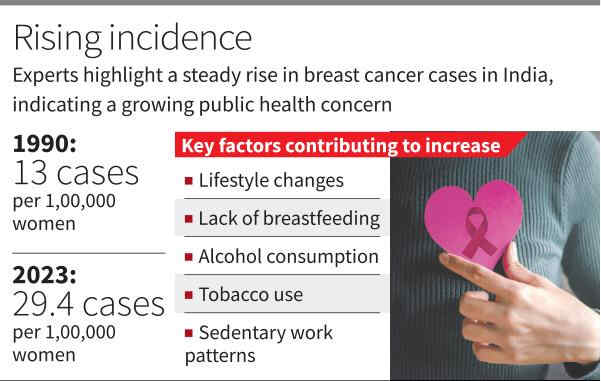
- Alarming Rise: The incidence of breast cancer in India has more than doubled over the past three decades, increasing from 13 per 1,00,000 women in 1990 to 29.4 per 1,00,000 women in 2023, according to estimates shared at the St. Gallen International Breast Cancer Conference (India edition) in Kolkata .
- Contributing Factors: Experts attribute the rise to lifestyle changes, lack of breastfeeding, alcohol consumption, tobacco usage, sedentary work patterns, and increased detection through active screening and awareness .
- Gender Note: While women are at higher risk, men can also develop breast cancer, making regular screening for both genders crucial for early detection .
- Access to Treatment: Despite medical advances, geographical and economic barriers prevent many patients from accessing adequate care. Dr. Soumen Das, Director of the Institute of Breast Diseases, Kolkata, emphasized that cancer drugs available globally must reach the remotest areas .
- Innovative Support: The Institute has launched initiatives to improve treatment completion rates, such as providing temporary employment to relatives or caregivers of patients near the hospital, which has received “immense positive response” .
- Multidisciplinary Approach: Prof. Jens Houber from St. Gallen, Switzerland, stressed the importance of collaboration between surgery, radiation oncology, and systemic therapies, noting that “global dialogue accelerates progress for patients everywhere” .
- New Initiative: The conference launched Project Pink Army, a community-driven volunteer movement aimed at mobilizing communities to drive cancer awareness and build better patient support systems .
Syllabus Mapping (Relevance)
- GS Paper II: Governance – Health policy, Government schemes for healthcare, Issues relating to development and management of social sector/services relating to health.
- GS Paper II: Social Justice – Women’s health, Vulnerable sections, Right to health.
- GS Paper III: Science & Technology – Medical advancements, Cancer research, Drug availability.
- GS Paper I: Society – Changing lifestyle patterns and their impact on health.
- GS Paper II: Polity – Fundamental Rights (Article 21: Right to health).
Deep Dive: Core Issues & Analysis (For Mains Answer Body)
A. The Rising Burden: Statistical Overview
| Year | Incidence (per 1,00,000 women) | Change |
| 1990 | 13 | Baseline |
| 2023 | 29.4 | +126% increase |
- Significance: Breast cancer is now the most common cancer among women in India, accounting for a significant portion of cancer-related morbidity and mortality. The doubling in three decades reflects both better detection and genuine increase in disease burden .
B. Factors Driving the Rise: A Multi-Causal Analysis
| Factor | Explanation |
| Lifestyle Changes | Urbanization, sedentary work, dietary shifts |
| Reproductive Factors | Lack of breastfeeding, delayed childbearing |
| Substance Use | Rising alcohol and tobacco consumption among women |
| Obesity | Increasing BMI due to lifestyle changes |
| Awareness and Detection | Active screening has led to more cases being detected |
- The Awareness Paradox: While increased detection is positive, it also means the healthcare system must handle a larger number of diagnosed cases, requiring expanded treatment infrastructure .
C. The Access Gap: Economic and Geographical Barriers
| Barrier | Impact |
| Geographical | Remote areas lack diagnostic and treatment facilities |
| Economic | High cost of treatment forces many to abandon care |
| Awareness | Late presentation due to lack of knowledge about symptoms |
| Drug Availability | Newer, effective drugs not always available in public health system |
- Dr. Das’s Observation: “Geographical and economic factors should not be a barrier for breast cancer treatment, but unfortunately, till today, many people cannot get adequate care due to lack of resources” .
D. Innovative Solutions: The Kolkata Model
| Initiative | Description | Impact |
| Caregiver Employment | Temporary employment for relatives/caregivers near the hospital | Increased treatment completion rates |
| Government Scheme Utilization | Better use of existing schemes to fund treatment | Improved access |
| Project Pink Army | Community-driven volunteer movement for awareness and patient support | Mobilizing communities |
- Significance: These grassroots innovations address the socio-economic determinants of health outcomes, recognizing that medical treatment alone is insufficient without addressing patient support systems .
E. Multidisciplinary Care: The Global Standard
| Discipline | Role |
| Surgery | Tumor removal, reconstruction |
| Radiation Oncology | Local control of disease |
| Systemic Therapies | Chemotherapy, targeted therapy, immunotherapy |
- Prof. Houber’s Insight: “Advances in breast cancer treatment require close collaboration between surgery, radiation oncology, and systemic therapies. Global dialogue accelerates progress for patients everywhere” .
F. Male Breast Cancer: The Forgotten Dimension
| Aspect | Details |
| Incidence | Rare but possible; accounts for ~1% of all breast cancers |
| Awareness Gap | Men often unaware of risk, leading to late diagnosis |
| Screening | Regular screening for both genders is crucial |
- Implication: Awareness campaigns must be inclusive, targeting both men and women to ensure early detection .
Key Terms (For Prelims & Mains)
- Breast Cancer Incidence: Number of new breast cancer cases per unit population .
- Multidisciplinary Care: Treatment approach involving multiple medical specialties .
- Systemic Therapies: Drugs that travel through bloodstream to treat cancer (chemotherapy, targeted therapy, immunotherapy) .
- Radiation Oncology: Use of radiation to treat cancer .
- Project Pink Army: Community-driven volunteer movement launched at the conference .
- Caregiver Support: Assistance provided to family members caring for patients .
- St. Gallen International Breast Cancer Conference: Prestigious global oncology conference .
Mains Question Framing
- GS Paper II (Governance): “The incidence of breast cancer in India has more than doubled in three decades, yet access to treatment remains unequal. Analyze the challenges in ensuring equitable cancer care and suggest innovative solutions, drawing from the Kolkata model.”
- GS Paper II (Social Justice): “Breast cancer disproportionately affects women, but men are also at risk. Discuss the socio-economic determinants of cancer outcomes and the role of community-driven initiatives like Project Pink Army.”
- GS Paper III (Science & Technology): “Advances in breast cancer treatment require multidisciplinary collaboration and global dialogue. Examine the importance of such approaches in improving outcomes for Indian patients.”
Linkage to Broader Issues & Debates
- Right to Health: Article 21 includes right to health; unequal access violates this right .
- Universal Health Coverage (UHC): India’s Ayushman Bharat scheme aims to provide coverage, but implementation gaps persist .
- Women’s Health: Breast cancer is a gender-specific health crisis requiring targeted policy response .
- Lifestyle Diseases: Rising cancer rates reflect broader epidemiological transition toward non-communicable diseases .
- Innovation in Healthcare: The Kolkata caregiver employment model demonstrates that non-medical interventions can improve medical outcomes .
News 3 : On Backlash, Govt. Pulls Back Revised Earthquake Zoning
Preliminary Facts (For Mains Answer Introduction)
- Notification and Withdrawal: The Bureau of Indian Standards (BIS) issued a Gazette notification on November 6, 2025, introducing revised earthquake hazard zoning under the updated IS 1893 (Part 1): 2025 code, which was meant to replace the existing 2016 framework. However, following major backlash from government departments, the notification was withdrawn through a fresh Gazette notification on March 3, 2026, restoring the earlier code .
- Key Changes Proposed: The revised framework introduced a new highest-risk Zone VI covering parts of Kashmir, the Northeast, and Kutch, while several Himalayan regions were upgraded to Zone V. More than 60% of India’s landmass would have fallen under moderate to high earthquake risk zones under the new classification.
- Stakeholder Concerns: Strong objections came from the Ministry of Housing and Urban Affairs (MoHUA), Metro Rail corporations, the National Dam Safety Authority (NDSA), and developers. MoHUA warned of “materially significant financial implications” for infrastructure projects, with metro project costs potentially rising by 30-50% and construction costs by 20% .
- Technical Objections: The NDSA raised scientific concerns that the revised probabilistic seismic hazard assessment (PSHA) values were “quite high” compared to site investigation findings .
- Uneven Implementation: The rollout created confusion as Ahmedabad enforced the new Zone 4 classification immediately, stalling 15 high-rise projects, while Surat, Vadodara, and Rajkot continued using the 2016 code, awaiting a six-month transition window .
Syllabus Mapping (Relevance)
- GS Paper III: Science & Technology – Standards and codes (BIS), Infrastructure development, Earthquake engineering.
- GS Paper II: Governance – Government policies and interventions, Stakeholder consultation, Regulatory impact assessment.
- GS Paper III: Disaster Management – Earthquake risk mitigation, Hazard mapping, Building codes.
- GS Paper II: Polity – Centre-State coordination, Federal issues in policy implementation.
Deep Dive: Core Issues & Analysis (For Mains Answer Body)
A. The Proposed Changes: A Scientific Rationale
| Aspect | Details |
| Methodology | The revised framework used probabilistic seismic hazard assessment (PSHA) incorporating new hazard parameters and intensity-based modelling . |
| New Zone VI | Introduced for highest-risk areas including parts of Kashmir, Northeast, and Kutch region of Gujarat. |
| Zone Upgrades | Several cities, including Ahmedabad, Surat, Vadodara and Rajkot, were upgraded from Zone 3 to Zone 4 . |
| Coverage | Over 60% of India’s landmass would have fallen under moderate to high earthquake risk zones. |
- Scientific Context: The proposed changes reflected advances in seismic hazard understanding. Studies have highlighted that current code-specified hazard maps may be outdated, with research showing that for cities like Dehradun, the actual hazard is significantly higher than code specifications, while for Delhi it may be lower .
B. Cost Implications: The Core Concern
| Sector | Estimated Cost Impact |
| Metro Rail Projects | 30-50% increase across metro cities |
| High-Rise Construction | ~20% increase in construction costs |
| Stalled Projects | ~15 major high-rise projects in Ahmedabad stalled |
| Infrastructure | Significant impact on dams, bridges, and public works |
- The Stranded Asset Risk: Developers warned that projects in advanced planning stages could not switch standards mid-stream, as “constructing half a building under the old code and the rest under the new code is technically unfeasible” . This raised the specter of under-construction projects turning into stranded assets.
C. Procedural Failure: Lack of Stakeholder Consultation
| Issue | Details |
| Inadequate Consultation | The code was “introduced without structured consultation with metro rail corporations” . |
| Developers Excluded | Credai chairman noted that “the new codes were prepared without consultation with stakeholders” . |
| Scientific Objections | NDSA flagged that hazard values were “quite high” compared to their site investigations when the draft was circulated. |
| Cabinet Intervention | The Cabinet Secretariat advised withdrawal, directing that “all necessary consultations with stakeholders may be held and completed” before any revision . |
- The Governance Failure: The episode highlights the critical importance of regulatory impact assessment and stakeholder consultation before implementing standards with massive financial implications.
D. Uneven Implementation: A Federal Coordination Failure
| City | Status |
| Ahmedabad | Enforced new code from November 3, 2025; 15 high-rises stalled |
| Surat, Vadodara, Rajkot | Continued using 2016 code, awaiting transition window |
- The Transition Window Confusion: The Centre had granted a six-month transition window until May 3, 2026, but Ahmedabad insisted on immediate compliance . This created regulatory uncertainty and highlighted poor centre-state coordination.
E. Technical Debate: PSHA vs. Traditional Approaches
| Aspect | Traditional Approach | Proposed PSHA Approach |
| Basis | Historical intensity data | Probabilistic modelling with multiple parameters |
| Output | Zone factors | Probabilistic hazard curves |
| Certainty | Deterministic | Accounts for epistemic uncertainties |
| Methodology | Peak ground acceleration (PGA) based | Incorporates Modified Mercalli Intensity (MMI) |
- Scientific Perspective: Research suggests that “a rational integration of both PGA- and MMI-based approaches can lead to an improved seismic hazard characterization,” with PGA maps essential for engineering design and MMI maps providing critical insights into spatial damage patterns .
Key Terms (For Prelims & Mains)
- IS 1893 (Part 1): 2025: Indian standard code for earthquake-resistant design of structures (seventh revision) .
- Probabilistic Seismic Hazard Assessment (PSHA): Methodology incorporating probabilistic elements such as earthquake source, magnitude, distance, and spectral distribution .
- Modified Mercalli Intensity (MMI): Intensity scale measuring observed effects of earthquakes .
- Zone Factor (Z): Factor used in design to account for expected peak ground acceleration in different seismic zones .
- Ductile Detailing: Design approach ensuring structures bend rather than collapse during earthquakes .
- Stranded Assets: Projects that cannot be completed economically due to regulatory changes .
- National Dam Safety Authority (NDSA): Regulatory body for dam safety .
Mains Question Framing
- GS Paper II (Governance): “The withdrawal of the revised earthquake zoning framework following backlash from infrastructure agencies highlights the critical importance of stakeholder consultation and regulatory impact assessment. Analyze.”
- GS Paper III (Disaster Management): “India’s seismic hazard mapping must balance scientific accuracy with economic feasibility. Discuss the challenges in updating building codes, with reference to the recent IS 1893 revision episode.”
- GS Paper II (Polity): “The uneven implementation of the new seismic code across Gujarat’s cities and the subsequent central intervention raise important questions about federal coordination in technical standards. Examine.”
Linkage to Broader Issues & Debates
- Disaster Resilience vs. Economic Viability: The episode highlights the tension between enhancing seismic safety and maintaining affordable infrastructure development.
- Regulatory Governance: Standards-setting must follow principles of good governance—transparency, consultation, and impact assessment.
- Federal Coordination: Technical standards require uniform implementation across states to avoid regulatory arbitrage and confusion.
- Scientific Updating: India’s seismic codes need regular updating based on advancing scientific knowledge, but with appropriate transition mechanisms.
- Infrastructure Pipeline: Regulatory uncertainty can stall critical infrastructure projects, affecting economic growth.
Prelims 360
India has released a revised Seismic Zonation Map under the updated Earthquake Design Code (BIS, 2025) based on faults, maximum likely events, attenuation, tectonics, lithology, etc.
Details of New Zonation
- Number of Zones: Earlier, the Indian landmass was demarcated into four earthquake zones, namely Zones II, III, IV, and V.
- Introduces new highest-risk Zone VI, placing the entire Himalayan arc under it for the first time (previously split between Zones IV and V).
- Boundary towns between zones: Now automatically fall in the higher-risk category.
- Hazard mapping: Prioritises geological conditions over administrative boundaries.
India’s Earthquake Vulnerability:
- 61% of India’s land now lies in moderate to high hazard zones (earlier: 59%).
- 75% of India’s population is now in seismically active regions.
- Implications of New Map: Nudges to retrofitting in high-risk regions, halting expansion on soft sediments or near active faults, enforcing uniform building standards in Himalayan states, etc.
- Government strategies:
- National Disaster Management Authority (NDMA) & State Disaster Management Authority (SDMA): NDMA is responsible for setting disaster management policies and SDMAs are in charge of creating and implementing disaster plans
- National Seismological Network: Monitors earthquake activities and conducts research on developing earthquake early warning systems.
Context 1: Why does the Strait of Hormuz’s closure matter?
Where is the Strait of Hormuz and what is its significance? Why have tensions in West Asia affected this passage? What does Iran have to do with the near-complete closure of the strait? How does the situation affect India and what is the government doing about it?
The Strait of Hormuz, one of the world’s most strategically important chokepoints, has been experiencing a near-total collapse in commercial traffic following rising tensions in West Asia. More than 20% of the world’s total oil and gas shipments, and nearly 40% of India’s, pass through the strait.
What is the significance of the strait?
The Strait of Hormuz, only 33 kilometres wide at its narrowest, lies between Iran, Oman, and the UAE. It is a vital route for oil and gas from Saudi Arabia, Qatar, Kuwait, Iraq, and Iran leaving the Persian Gulf to various destinations.
Other important shipping chokepoints in the world include the natural Malacca Strait off Singapore through which almost the entire west-bound Chinese maritime trade takes place; the Bab-al-Mandab at the mouth of the Red Sea, which has come under Houthi influence; the artificial Suez Canal connecting Europe and Africa-Asia; the artificial Panama Canal linking the Pacific and Atlantic Oceans; and the straits of Bosphorus and Dardanelles connecting the Mediterranean and Black Sea via the Sea of Marmara, which are crucial not just for nations such as Romania but also for Russia.
While Egypt and Panama hold sovereignty over the Suez and Panama canals, respectively, Turkey has exclusive sovereign rights over the Bosphorus and Dardanelles straits. Nations such as Malaysia and Singapore, and Iran and Oman play a major role in securing the natural straits (Malacca and Hormuz) while not holding sovereignty over them. India has been building naval presence in the Andaman and Nicobar Islands with the strategic aim of gaining leverage over Chinese trade across the Malacca Strait.
What is the current situation?
Since February 28, when the U.S. and Israel attacked Iran, and Iran retaliated, ship traffic across the strait has reduced by some 95%. Nine ships have faced attacks in or near the strait. Shipping is a high-risk business and even small damages can prove costly to repair. Lloyds List Intelligence, a maritime information provider, estimates that some 600 ships are now stranded in the region. Some 250 are bulk carriers carrying loose cargo such as coal, ores, and grain. Others include some 200 oil tankers and 50 gas carriers.
Can countries just halt shipping lanes?
International law generally treats the seas as commons. Though territorial waters and exclusive economic zones are recognised, in general, laws and practices tend to be favourable towards free usage of all of the seas by merchant ships, and by naval ships for “innocent” passage.
In the past, Egypt has shut down the Suez Canal. Panama has not shut down its canal. No country can order the shutdown of the Straits of Hormuz and Malacca as its sovereign right. However, lack of security, emanating from threats and attacks, can make shippers wary of making the passage due to fears of loss of life and property.
As a result, insurance costs can balloon. In the current situation, insurance premiums have climbed 10-15 times on a case-by-case basis depending, among other factors, on whether a ship is affiliated with any of the belligerent parties. A rough estimate suggests that purchasing insurance for just one week of a ship transiting the strait would cost nearly as much as what the owner would normally pay for a year.
Are there alternatives to this strait?
Saudi Arabia can transport fuels to its western ports on the Red Sea, such as Yanbu, through pipelines. However, ship traffic in the Red Sea plummeted when Houthi attacks started in 2023-24. In October 2023, for instance, there were around 2,300 ship transits across Bab-el-Mandab, the strait at the mouth of the Red Sea. By January, the number had dwindled to less than half of that. Since then, ship transits have only marginally gone up. Any attempt to leverage Red Sea ports may invite attacks from the Houthis, who are aligned to Iran.
How does closing the strait help Iran?
Iran has spoken in multiple voices over allowing ship passage. Currently, about one in five ships passing through the strait are Iranian. While those speaking for the Iranian government have said they would not like ship traffic to halt, agencies such as the Iranian Revolutionary Guards have threatened attacks. Iran hopes that closing the strait will force world opinion to bear upon Israel and the U.S. to end the conflict.
The strait is a leverage that Iran has historically exercised, such as during the Iran-Iraq war in the 1980s. At the time, the U.S. allowed merchant ships registered in other nations to fly its flag. This provided legal sanction for the U.S. to deploy its Navy to escort merchant ship convoys across the strait.
India’s response was unique then. Leveraging its neutrality and positive relationships in the region, the Shipping Corporation of India (SCI) had its ships painted ‘INDIA’ in big, bold white letters against the black hull so that the ships would be visible and stand out as belonging to India. Although there were attacks on SCI ships, the move did succeed to a large extent.
This time too, the U.S. President has vowed to keep ship traffic flowing through the strait. He has talked about escorting ships to provide direct security and also help defray insurance costs. India has been in touch with U.S. authorities for securing maritime insurance cover from the International Development Finance Corporation. The proposal had come from the U.S. government, officials have said.
How does the situation affect India’s economy and oil prices?
Some 40% of India’s oil flows through the strait. Qatar supplies half of India’s liquefied natural gas (LNG) imports, which in turn provide half of the country’s natural gas needs. Qatar shut down its LNG production when the conflict began.
While LNG is regasified to supply city gas uses such as for cooking, power plants and other industrial uses, about 30% of India’s natural gas is directed towards fertilizer production. Though this is the off season for fertilizers, the situation may not recover fast enough when ammonia fertilizer demand picks up later this year. The government is actively pursuing other LNG sources, such as the U.S., Russia, and Australia.
Some 60% of India’s Liquified Petroleum Gas (LPG), which is mostly a mixture of propane and butane, comes from imports largely upstream of the strait. A shortage of LPG, the dominant cooking gas in India, is far more worrying. The government has come up with a series of measures, such as tweaking the oil refining process to produce more of propane-butane and prioritising cooking gas use of propane-butane.
The U.S. has given the green light for India’s purchase of Russian crude for 30 days, which is a relief. India has built supply networks with Russia and these will come in handy. Overall, Brent crude price has been hovering below $90 (it shot past $125 when Russia attacked Ukraine). In a reflection of the turn towards Russian oil, high sulphur Urals oil (from Russia) is now costlier than Brent oil in India. Increase in global crude prices may force the Indian government to increase administered price hikes in petrol and other fuels for transport and other uses, leading to a spiralling effect on the economy.
Context 2: How does Canada’s uranium deal help India?
What uranium ‘stocks’ does India have? Does the latest deal involve the 2010 India-Canada Civil Nuclear Cooperation Agreement? How does India use its uranium? How is the country’s nuclear power programme faring?
In its quest for energy security, on March 2, India signed a Canadian $2.6-billion deal with Cameco. The Canadian company is among the world’s top three largest uranium producers by volume. The deal ensures a supply of around 10,000 tonnes of uranium between 2027 and 2035 to India.
What uranium ‘stocks’ does India have?
India has both domestic reserves and imported stockpiles of uranium. The domestic reserves amount to 4.2-4.3 lakh tonnes of ore, spread across the major mines of Jaduguda and Turamdih in Jharkhand and Tummalapalle in Andhra Pradesh. The quantum of extractable uranium metal from the ore is estimated to be 76,000-92,000 tonnes.
The order of magnitude difference between the ore and the metal is because Indian ore is ‘low grade’ (0.02-0.45% concentration). On the other hand, Canada has high-grade ore (10-100 times richer than Indian ore).
India has increasingly relied on imports, which currently meet nearly three-fourths of the civilian requirement. Aside from the Cameco deal, India also finalised a supply agreement with Kazatomprom of Kazakhstan in February, and has ongoing contracts with Uzbekistan and Russia (both with low-grade ore). The government is also building a reserve intended to hold five years’ supply of fuel to protect against supply chain shocks. While importing uranium ore is cheaper than extracting it, it cannot legally be used in nuclear weapons. This is why India also mines ore domestically.
Does the deal involve the 2010 agreement?
The deal with Cameco comes under the India-Canada Civil Nuclear Cooperation Agreement (NCA). This was signed in 2010, two years after the Nuclear Suppliers Group issued its ‘clean’ waiver for India, allowing it to engage in civil nuclear trade despite not signing the Nuclear Non-Proliferation Treaty. The waiver, in turn, was made possible by the 123 nuclear agreement between India and the U.S.
Unlike the deal with Kazakhstan (which is less intrusive), the NCA requires India to provide “fissionable material accounts” to Canada, which critics have often called a slight against Indian sovereignty. On the flip side, the NCA has also been criticised for tacitly supporting India’s nuclear weapons programme: the more uranium India imports for civilian use, the more domestic uranium it can vouchsafe for military use.
How does India use its uranium?
India currently operates 24 nuclear reactors with a generation capacity of around 9 GW. The 700-MW pressurised heavy water reactors (PHWRs) that currently provide 6-7 GW, or roughly 3%, of India’s total electricity use uranium as fuel. The government is committed to increasing nuclear power capacity to 100 GW by 2047. Previous attempts to up this contribution have been set back by issues with land acquisition and local protests, however.
Significant amounts of uranium are also used in research reactors, such as Dhruva in Trombay, to produce medical isotopes such as technetium-99m and iodine-131 and for advanced materials science research.
In the 2025-26 Union Budget, Finance Minister Nirmala Sitharaman allocated ₹20,000 crore to develop a new generation of small modular reactors, which typically use 3-5% enriched uranium.
Domestic uranium is also used for nuclear warheads (currently estimated to number around 170) and the nuclear-powered INS Arihant class submarines.
How is India’s nuclear power programme faring?
India is currently transitioning from Stage 1 to 2 of the three-stage programme. In Stage 1, PHWRs will use natural uranium-235 to produce electricity and plutonium-239 as a byproduct. In Stage 2, fast breeder reactors will use a mixed oxide fuel of uranium-238 and plutonium-239 to produce electricity, uranium-233, and more plutonium-239. (The reactors are called so because they will produce more fuel than they consume.) The prototype fast breeder reactor (PFBR) in Kalpakkam is currently in an advanced stage of commissioning. Finally, advanced heavy water reactors will use plutonium-239 and thorium-232 as fuel, producing electricity and uranium-233. Homi J. Bhabha envisioned this three-stage programme to take advantage of the fact that India hosts 20-25% of the world’s thorium deposits.
However, the programme has been beset by numerous delays and cost overruns. The fast breeder test reactor was built at Kalpakkam in 1977 but the government did not sign off on the PFBR until the early 2000s, thanks in part to sanctions against India over its nuclear tests. The PFBR’s cost also nearly doubled from ₹3,492 crore at the time it was designed to more than ₹6,800 crore in 2019.
In March 2013, the Department of Atomic Energy had said in a reply in the Lok Sabha, “The time of large-scale thorium deployment is expected to be 3-4 decades after the commercial operation of fast breeder reactors with short doubling time.” Given the PFBR’s own timeline, this period could be in the 2060s, if not later.
Former Department of Atomic Energy Chairman Anil Kakodkar has explained that the doubling time — the time taken for one fast breeder reactor to produce enough fuel to start a second — is 15-20 years. To generate 100 GW, then, India has to go through several doubling cycles, which could explain the multiple deals now to secure the supply of uranium.

