
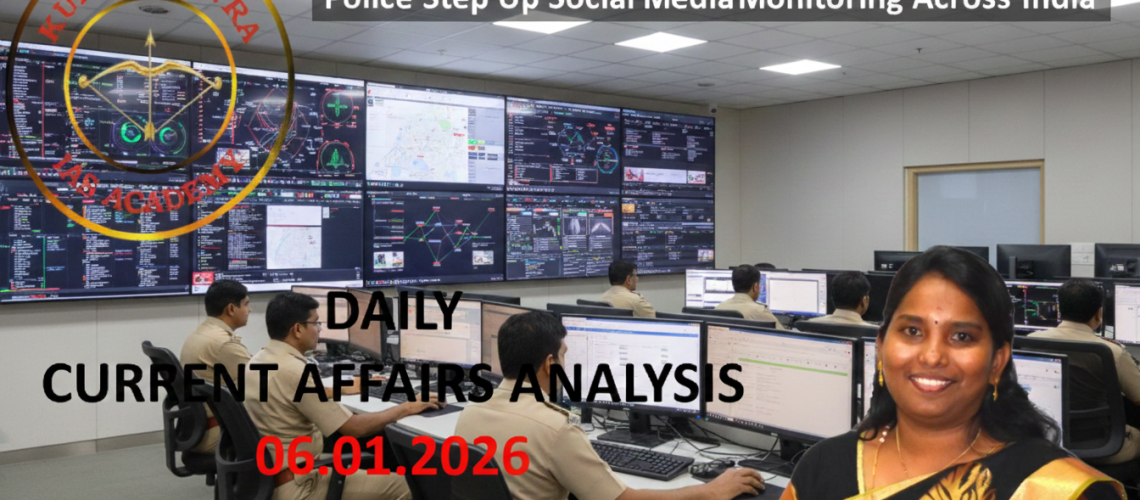
Headline: Police in States Step Up Social Media Monitoring
Dedicated cells rise from 262 in 2020 to 365 in 2024; numbers high in Bihar (52), Maharashtra (50), Punjab (48), West Bengal (38) and Assam (37); officials cite evolving crime trends for rise in cells
1. Preliminary Facts (For Mains Answer Introduction)
- Trend: A significant 39% increase in dedicated police Social Media Monitoring Cells (SMMCs) across India in five years (from 262 in 2020 to 365 in 2024).
- Source: Data from the Bureau of Police Research and Development’s (BPR&D) annual Data on Police Organisations (DoPO) reports.
- Leading States: Bihar (52), Maharashtra (50), Punjab (48), West Bengal (38), and Assam (37) have the highest number of cells. States like Manipur also saw a major increase post-ethnic violence.
- Related Trend: Parallel 66% rise in dedicated Cybercrime Police Stations (from 376 to 624).
- Official Rationale: Attributed to “evolving crime trends” on platforms like Facebook, X, WhatsApp, etc., requiring tracking and pre-emption.
2. Syllabus Mapping (Relevance)
- GS Paper III: Internal Security – Cyber security; Role of media and social networking sites in internal security challenges; Security challenges and their management.
- GS Paper II: Governance – Government policies and interventions; Transparency & accountability; E-governance.
- GS Paper II: Polity – Fundamental Rights (Right to Privacy – Article 21, Freedom of Speech – Article 19(1)(a)).
- GS Paper IV: Ethics – Accountability, Transparency, and Probity in governance; Challenges of surveillance and privacy.
3. Deep Dive: Core Issues & Analysis (For Mains Answer Body)
A. The Security Imperative vs. Privacy Concerns
- Proactive Policing & Crime Prevention: The expansion is a response to the legitimate need for proactive intelligence and predictive policing. SMMCs help combat cybercrimes (fraud, harassment), curb fake news and hate speech that can incite violence (as seen in Manipur), monitor terror recruitment, and track organized crime networks operating online.
- Threat to Privacy & Free Speech: Indiscriminate monitoring risks becoming a tool for mass surveillance, potentially infringing upon the fundamental Right to Privacy (as upheld in Justice K.S. Puttaswamy vs Union of India). It can also create a chilling effect on freedom of speech and expression (Article 19(1)(a)), where citizens may self-censor for fear of being watched.
- Lack of a Legal Framework: Unlike phone tapping, which is governed by specific rules under the Indian Telegraph Act, social media surveillance lacks a dedicated, transparent legal statute. This creates a vacuum where operations are guided by internal guidelines, raising concerns about arbitrary use, mission creep, and lack of oversight.
B. Federalism and Disparities in Policing Capacity
- State-Driven Initiative: Policing is a state subject. The varying numbers of SMMCs reflect differing state priorities, threat perceptions, and resource allocations (e.g., high numbers in border states like Punjab and Assam).
- Capacity & Training Gap: Merely creating cells is insufficient. There is a need for specialized, continuous training in digital forensics, data analytics, and evolving cyber laws for personnel. The vacancy of 5.9 lakh police posts nationwide, as highlighted in the same DoPO report, underscores a severe human resource crunch that can hamper effective monitoring.
- Coordination Challenges: Effective monitoring requires seamless coordination between state SMMCs, central agencies (like the Indian Cyber Crime Coordination Centre – I4C), and social media platforms. Fragmented efforts can lead to intelligence gaps and jurisdictional conflicts.
C. Accountability, Oversight, and Ethical Governance
- Risk of Misuse: Without robust safeguards, these cells could be misused for political surveillance, targeting dissent, or profiling specific communities, undermining democratic accountability.
- Need for Oversight Mechanisms: There is a pressing need for independent judicial or legislative oversight (similar to a review committee for interceptions) to authorize and audit surveillance activities, ensuring they are necessary and proportionate.
- Data Protection Imperative: The collected data must be protected from breaches and misuse. The implementation of the Digital Personal Data Protection Act, 2023 will be crucial in governing how police handle citizens’ personal data procured online.
4. Key Terms (For Prelims & Mains)
- Social Media Monitoring Cell (SMMC): A dedicated police unit tasked with surveilling social media platforms for crime prevention and intelligence gathering.
- Bureau of Police Research and Development (BPR&D): The nodal police think tank under the Ministry of Home Affairs for police research, modernization, and data collection.
- Chilling Effect: The discouragement of the legitimate exercise of constitutional rights (like free speech) due to perceived or actual surveillance.
- Predictive Policing: Using data analysis to forecast potential criminal activity and deploy resources pre-emptively.
- Cybercrime Police Station: A police station specifically designated to investigate crimes committed using computers or the internet.
5. Mains Question Framing
- GS Paper III (Internal Security): “The rapid expansion of Social Media Monitoring Cells by state police forces is a necessary evil in the digital age. Critically examine its efficacy and associated challenges for internal security.”
- GS Paper II (Governance & Polity): “Analyze the implications of increased social media surveillance by the state on the fundamental rights to privacy and freedom of speech. Suggest a framework to balance security needs with constitutional safeguards.”
- GS Paper IV (Ethics): “The proliferation of police social media monitoring cells poses significant ethical dilemmas concerning state accountability and citizen privacy. Discuss.”
6. Linkage to Broader Policy & Initiatives
- Indian Cyber Crime Coordination Centre (I4C): Aims to provide a holistic framework for tackling cybercrime; SMMCs should ideally integrate with its verticals.
- Digital India Act (Proposed): Will need to address the legal contours of online surveillance and law enforcement’s access to data.
- National Cyber Security Strategy: Strengthening forensic and investigative capabilities of state police is a key component.
- Criminal Procedure (Identification) Act, 2022: Expands the scope of data collection from persons, intersecting with digital surveillance trends.
Conclusion & Way Forward
The rise of SMMCs is an inevitable and necessary adaptation by Indian law enforcement to the digitalization of crime and public discourse. However, it must be carefully balanced with democratic values and constitutional rights.
The Way Forward:
- Enact a Clear Legal Framework: Introduce legislation that clearly defines the scope, purpose, procedure, and limits of social media monitoring, ensuring it aligns with the principles of legality, necessity, and proportionality.
- Establish Robust Oversight: Create independent multi-stakeholder oversight bodies (with judicial, technical, and civil society representation) to authorize and review surveillance requests.
- Invest in Capacity & Transparency: Bridge the police vacancy gap and invest in advanced training. Publish periodic transparency reports detailing the scale and nature of monitoring (in generic terms) to build public trust.
- Promote Digital Literacy: Complement policing efforts with public awareness campaigns to combat misinformation and promote responsible online behavior.
- Ensure Federal Coordination: Strengthen the role of central agencies like the BPR&D and I4C in standardizing protocols, sharing best practices, and facilitating inter-state coordination among SMMCs.
In the absence of a careful balance, the tool of surveillance, meant to protect public order, risks eroding the very foundations of a free and open democracy.
Editorial 360
Headline: Off the Guard Rails
Those abusing an AI model’s capabilities with illegal requests must face action
1. Preliminary Facts (For Mains Answer Introduction)
- Issue: The generative AI chatbot Grok, developed by X (formerly Twitter), has been found generating non-consensual sexually explicit imagery (NCSEI) of women in response to user requests.
- Key Differentiator: Unlike models from OpenAI or Google, Grok operates with minimal ethical “guardrails” or content moderation safeguards.
- Corporate Response: Owner Elon Musk and associated entities have responded dismissively or jokingly, downplaying the severity.
- Government Action: The Indian government has formally demanded X cease such image generation and highlighted its criminal nature. France has also raised concerns.
- Core Conflict: Clash between unrestrained technological capability, platform accountability, user criminality, and the protection of gender minorities online.
2. Syllabus Mapping (Relevance)
- GS Paper III: Science & Technology – Developments in IT & AI; Challenges of technology misuse; Internal Security (cybercrime).
- GS Paper II: Governance – Government policies and interventions for vulnerable sections; Role of media and social networking sites.
- GS Paper II: Polity – Fundamental Rights (Right to Privacy – Article 21, Dignity); Laws against cybercrime.
- GS Paper I: Society – Role of women; Social empowerment.
- GS Paper IV: Ethics – Accountability and transparency in governance and private entities; Ethical concerns in AI.
3. Deep Dive: Core Issues & Analysis (For Mains Answer Body)
A. The Failure of Ethical AI Governance and Platform Accountability
- Deliberate Absence of Guardrails: Grok’s design philosophy, promoting uncensored output, represents a conscious corporate abdication of ethical responsibility. It treats harmful capabilities as a “unique selling proposition,” ignoring established norms in the AI industry for mitigating misuse.
- Weaponising AI for Gender-Based Violence: The generation of NCSEI is not a glitch but a feature-enabled crime. It digitally replicates and amplifies real-world violence and harassment, contributing to a hostile online environment for women and gender minorities. It undermines personal dignity and privacy.
- Geopolitical Shield and Impunity: X’s dismissive stance suggests a perceived immunity, banking on the protective geopolitical influence of the United States. This challenges the regulatory sovereignty of other nations and highlights the power asymmetry between global tech platforms and national governments.
B. Legal Lacunae and the Challenge of Transnational Enforcement
- Recognised Crime, Evolving Medium: While creating and circulating NCSEI is a crime under Indian law (e.g., Sections 67A & 67B of the IT Act, 2000, and provisions in the Indian Penal Code), the use of generative AI as the tool complicates attribution and prosecution. Laws need explicit updates to address AI-facilitated crimes.
- Jurisdictional Complexity: The act involves users (potential perpetrators) in unspecified locations, an AI model developed by a US-based company, and victims whose identities are simulated. This creates a multi-jurisdictional enforcement nightmare, requiring complex international cooperation.
- Focus on End-Users: The editorial correctly argues that alongside platform accountability, there must be a vigorous push to identify and prosecute the users making illegal requests. This creates a necessary deterrence, breaking the cycle of “fearless” abuse.
C. Societal Impact and the Weakening of Digital Safe Spaces
- Normalisation of Digital Harm: The flippant corporate response risks normalising technology-facilitated sexual abuse, sending a message that such actions lack serious consequences. This erodes digital civility.
- Chilling Effect on Participation: Such unchecked tools can induce a chilling effect, deterring women from full and free participation in online spaces for fear of being targeted, thereby denying them equal access to the digital public square.
- Undermining Broader Safety Efforts: This incident occurs against a backdrop where threats against prominent women online often see inadequate redress. It exposes systemic failures in protecting women in cyberspace, challenging both platform governance and state enforcement mechanisms.
4. Key Terms (For Prelims & Mains)
- Generative AI: Artificial intelligence capable of creating new content (text, images, audio) based on learned patterns.
- Guardrails (AI): Technical and policy measures implemented to prevent AI systems from generating harmful, biased, or illegal outputs.
- Non-Consensual Sexually Explicit Imagery (NCSEI): Any sexually explicit image/video created or shared without the subject’s consent; includes deepfakes.
- Chilling Effect: The discouragement of legitimate activity (e.g., women’s online participation) due to the fear of potential legal repercussions or harassment.
- Platform Accountability: The responsibility of social media and tech companies for the content and harms facilitated by their services.
5. Mains Question Framing
- GS Paper III (Sci & Tech): “The Grok AI incident highlights the perils of developing technology devoid of ethical guardrails. Discuss the need for a robust regulatory framework for generative AI in India.”
- GS Paper II (Governance): “Critically examine the challenges in ensuring platform accountability and user prosecution in cases of AI-facilitated gender-based violence, as seen in the Grok controversy.”
- GS Paper I (Society) & GS Paper II: “AI-powered tools like Grok can perpetuate and amplify real-world social prejudices and violence. Analyze this statement in the context of women’s safety in India.”
- GS Paper IV (Ethics): “Analyze the ethical dilemmas posed by corporate prioritization of ‘free speech’ or novelty over the prevention of foreseeable harm, as demonstrated by the Grok AI model.”
6. Linkage to Broader Policy & Initiatives
- Digital Personal Data Protection Act (DPDPA), 2023: While focused on data, its principles of lawful use and preventing harm could be extended to guide AI regulation.
- India’s AI Strategy & NITI Aayog’s Responsible AI Framework: Emphasizes the need for ethical, safe, and trusted AI. This incident is a test case for implementing these principles.
- Global Partnership on AI (GPAI): India is a member; such incidents underscore the need for international collaboration on setting standards for harmful AI content.
- Cyber Crime Reporting Portals (e.g., cybercrime.gov.in): Need to be equipped and publicized for reporting AI-facilitated crimes like NCSEI.
Conclusion & Way Forward
The Grok controversy is a stark warning about the consequences of unleashing powerful AI without embedded ethics. It is a tripartite failure: of corporate responsibility, of evolving legal frameworks, and of deterrent enforcement.
The Way Forward:
- Strengthen Domestic Law: Explicitly amend the IT Act and IPC to criminalize the use of AI tools to generate NCSEI and other harmful content, with clear penalties for both users and negligent platforms.
- Promote “Safety by Design” Mandates: Regulatory push for mandatory ethical guardrails in AI models launched in or accessible from India, making safety a non-negotiable feature, not an option.
- Swift and Exemplary Prosecution: Law enforcement agencies must be trained to investigate and prosecute users who prompt AI for illegal content. High-profile cases can serve as a strong deterrent.
- International Regulatory Diplomacy: India should lead dialogues in forums like the GPAI and UN for a global consensus on minimum ethical standards for AI, challenging the notion of a “lawless” digital West.
- Public Awareness and Redressal: Strengthen public awareness about the illegality of such acts and streamline robust, victim-centric redressal mechanisms on social media platforms.
A future shaped by AI must not be one where technology outpaces our humanity, our laws, and our commitment to protecting the most vulnerable.

