
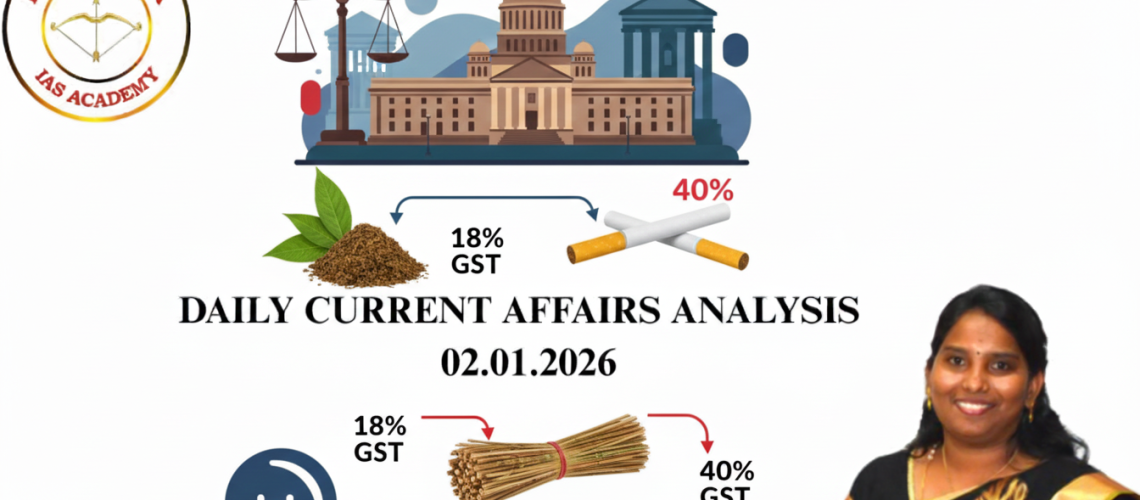
Headline: Centre’s Tobacco Tax Rejig to Take Effect from Feb 1; Beedis at 18% GST Others at 40%
1. Preliminary Facts (For Mains Answer Introduction)
- Effective Date: New tobacco taxation regime effective from February 1, 2026.
- Legislative Basis: Central Excise (Amendment) Act, 2025 and related notifications.
- Key Changes:
- Revamp of Excise Duty: To address the issue where existing excise on cigarettes had become a “fraction of a paisa”, failing to curb affordability.
- New GST Slabs:
- Beedis: Moved to 18% slab (from the now-defunct 28% slab).
- Other Tobacco Products: Placed in the 40% slab.
- End of GST Compensation Cess: The GST compensation cess on all items, including tobacco, will cease from Feb 1, 2026.
- New Valuation for Chewing Tobacco: GST value for products like gutkha, khaini will be based on declared retail sale price on the package.
- New Cess for Security: Health Security se National Security Act, 2025 comes into force, levying a cess on pan masala units to fund national security.
- Objective: To ensure real cigarette prices rise faster than incomes, aligning with global public health guidance.
2. Syllabus Mapping (Relevance)
GS Paper III:
- Economy: Government Budgeting; Taxation (Direct & Indirect); Mobilization of resources.
- Social Issues: Health.
GS Paper II:
- Governance: Government policies and interventions; Federalism (GST compensation).
3. Deep Dive: Core Issues & Analysis (For Mains Answer Body)
A. Public Health vs. Revenue: The Rationale for Tax Reforms
- Correcting a Policy Failure: The government’s admission that cigarette affordability had increased/stagnated over the past decade is a rare acknowledgment of policy inertia. The previous structure, with its negligible specific excise duty, failed as a deterrent. The reform aims to use price elasticity of demand—making tobacco products costlier to reduce consumption, especially among the youth and low-income groups.
- Differential Treatment of Beedis: Placing beedis in the lower 18% GST slab (while other tobacco moves to 40%) is a politically and socio-economically sensitive move. Beedi rolling employs a large number of informal, low-income workers, and a sharp tax hike could have significant livelihood implications. However, this creates a regressive health policy, as beedi smokers (often poorer) face lower financial disincentive despite similar health risks.
- Aligning with Global Best Practices: The move to increase specific excise duties (as opposed to ad valorem duties that depend on price) is in line with WHO’s Framework Convention on Tobacco Control (FCTC) recommendations. Specific duties are harder for the industry to evade and lead to more predictable price increases.
B. The GST Compensation Cess Wind-Down and Fiscal Implications
- End of an Era: The cessation of the GST compensation cess marks the formal end of the five-year transition guarantee given to states during GST implementation. Its extension was necessitated by the COVID-19 revenue shortfall. Its removal simplifies the tax structure.
- Revenue Neutrality or Boost?: While the cess ends, the simultaneous hike in GST rates for non-beedi tobacco (to 40%) and the revised excise duties are aimed at ensuring the government does not lose revenue. The net effect should be higher tax collection from tobacco, serving both health and fiscal objectives.
- New Security Cess – A Novel Fiscal Tool: The Health Security se National Security Act creates a dedicated, non-lapsable fund for security spending, sourced from a sin tax (pan masala cess). This is a creative, albeit controversial, way to ring-fence revenue for a high-priority sector without raising broad-based taxes. It raises questions about “hypothecation” of taxes (earmarking for specific purposes) and whether such cesses should proliferate.
C. Implementation Challenges and Unintended Consequences
- Illicit Trade and Tax Evasion: Historically, sharp tax hikes on cigarettes have fueled the growth of illegal smuggling and counterfeit products. The success of this policy depends on strengthening border controls and supply chain monitoring to prevent the illicit market from undermining public health goals.
- Livelihoods in the Beedi Sector: The protection given to beedis will be scrutinized. The government must have a parallel plan for skilling and transitioning beedi workers to alternative livelihoods, as long-term public health goals cannot permanently exclude this segment.
- Regressive Impact on the Poor: Since tobacco consumption is higher among lower-income groups, the tax increase, while beneficial for health, will disproportionately reduce their disposable income. This highlights the need for complementary smoking cessation programs and public health campaigns targeted at these demographics.
- Legal and Valuation Disputes: The new retail price-based valuation for chewing tobacco could lead to disputes with manufacturers over declared prices and potentially incentivize under-declaration.
4. Key Terms (For Prelims & Mains)
- Specific Excise Duty: A fixed tax amount levied on a per-unit basis (e.g., per cigarette stick), regardless of its price.
- Ad Valorem Tax: A tax based on the assessed value of an item (e.g., a percentage of the price).
- GST Compensation Cess: An additional levy on certain goods (like tobacco, luxury cars) introduced to compensate states for revenue loss for five years after GST implementation.
- Hypothecation of Tax: Earmarking the revenue from a specific tax for a pre-determined purpose.
- Price Elasticity of Demand: The measure of how much the quantity demanded of a good responds to a change in its price.
5. Mains Question Framing
- GS Paper III (Economy): “Taxation is a powerful tool for achieving public health objectives. Critically examine the recent overhaul of tobacco taxation in India in this context.”
- GS Paper III (Economy): “The cessation of the GST compensation cess and its implications for Centre-State fiscal relations marks a significant milestone. Discuss.”
6. Linkage to Broader Policy & Initiatives
- National Health Policy 2017: Aims to reduce premature mortality from non-communicable diseases (NCDs) by 25% by 2025; tobacco tax is a key instrument.
- WHO Framework Convention on Tobacco Control (FCTC): India is a signatory; the tax hike aligns with Article 6 (price and tax measures).
- National Tobacco Control Programme (NTCP): The increased revenue could be partly channeled to strengthen this program for awareness and cessation.
- GST Council: The decision on new slabs and cess removal would have been ratified by the Council, showcasing cooperative federalism.
Conclusion & Way Forward
The tobacco tax overhaul is a bold, dual-purpose reform aiming to salvage public health goals from fiscal irrelevance while adapting to a post-GST-compensation fiscal landscape. Its success hinges on effective implementation and complementary measures.
The Way Forward:
- Strengthen Enforcement Against Illicit Trade: Augment the capacity of agencies like the Directorate of Revenue Intelligence (DRI) and use track-and-trace technology for tobacco products to curb smuggling.
- Invest in Cessation and Rehabilitation: Allocate a portion of the incremental tax revenue to fund robust tobacco cessation clinics, public awareness campaigns, and livelihood transition programs for beedi workers.
- Annual Inflation-Indexed Tax Increases: Institutionalize a policy of annual automatic increases in specific excise duties linked to inflation and income growth, as per WHO guidance, to prevent future erosion of deterrence.
- Transparent Use of Security Cess: Ensure the “Health Security se National Security” cess fund is governed with transparency and accountability, with clear audit trails to maintain public trust in this new fiscal instrument.
- Comprehensive Review: After 2-3 years, conduct an independent impact assessment evaluating the effect on consumption patterns, government revenue, illicit trade, and health outcomes to guide future policy.
By making tobacco less affordable, the government is taking a decisive step towards a healthier India. However, to be truly effective, this fiscal measure must be part of a comprehensive strategy that includes regulation, education, and support for those seeking to quit.

