
Detailed UPSC Civil Services Notes
Border management, labour statistics, rural employment and electoral accountability. Read the complete notes, revise the key distinctions, and test your understanding.

Today’s focus
Read · Revise · PracticeWatch. Understand.
Then revise.
Open the accompanying YouTube video, explore the complete notes below, and complete the 20-question quiz.
Open on YouTubeShowing all 4 topics · Complete notes and 18 study tables.
Topic map
Border management labour statistics rural employment and electoral accountability
Based on the supplied file 24.10.2026 notes(5).docx
| Chapter | Topic | Main examination links |
|---|---|---|
| 1 | India China border management | GS II international relations and GS III border security |
| 2 | PLFS and the changing meaning of work | GS I women and society and GS III employment |
| 3 | AI attendance in rural employment | GS II welfare and governance and GS IV public service ethics |
| 4 | False election affidavits and citizen complaints | GS II elections, fundamental rights and judicial interpretation |
No matching topic. Try a shorter search or select Clear.
1 India China border management
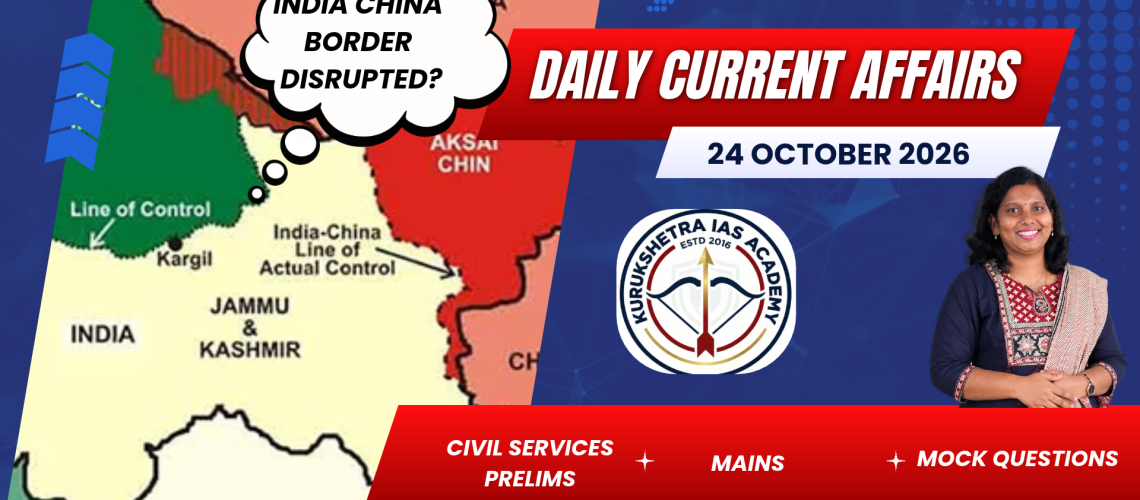
Supplied headline: LAC ‘disturbed’ by PLA’s behaviour, admits MEA
Why in news
The supplied report says that, on 23 October 2026, the Ministry of External Affairs explained that the situation along the Line of Actual Control can be disturbed when Chinese forces depart from established patrolling patterns. It followed reported remarks by the outgoing Indo-Tibetan Border Police Director-General about face-offs in Arunachal Pradesh since July 2026.
The Ministry said that India and China continued to use diplomatic and military channels to address outstanding issues and reduce misunderstanding. Discussions about improving their understanding of the LAC concern border management. They do not, by themselves, establish that the boundary dispute has been settled.
Evidence distinction: Questions raised by opposition leaders about patrolling access and territorial changes remain attributed political claims in the attachment. The report does not establish the precise location, extent or legal status of every alleged incident. Its reference to a four-year standoff concerns the 2020 to 2024 phase; it should not be read as saying that 2020 to October 2026 is four years.
UPSC syllabus linkage
| Paper | Syllabus area | How this topic can be used |
|---|---|---|
| GS II | India and its neighbourhood relations and bilateral agreements | Explain how unresolved boundaries affect wider relations with China. |
| GS III | Security challenges and their management in border areas | Examine surveillance, logistics, interagency coordination and local development. |
| Prelims | Geography, institutions and international agreements | Distinguish the LAC from the LoC and identify the roles of the MEA, Army and ITBP. |
| Essay | Peace, security and national development | Show why diplomacy and credible defence capability must support each other. |
Basic concepts
| Term | Simple meaning | Examination distinction |
|---|---|---|
| Boundary | The legal limit between two states | A final boundary settlement is different from a temporary arrangement for patrols. |
| Line of Actual Control or LAC | The line used to describe actual control in the India China border areas | The two sides do not have an agreed understanding of its alignment everywhere. |
| Line of Control or LoC | The military control line associated with India and Pakistan in Jammu and Kashmir | It is not the India China LAC. |
| Face off | Troops from the two sides confront each other at a location | A confrontation does not automatically mean a full war or a final change in territorial sovereignty. |
| Disengagement | Opposing troops separate at a particular friction point | It can occur without resolving the whole border dispute. |
| De escalation | A wider reduction in military tension and deployments | It must be assessed separately from the separation of troops at one site. |
Geography to remember
The western sector concerns Ladakh, including the Aksai Chin dispute. The middle sector concerns areas adjoining Himachal Pradesh and Uttarakhand. Arunachal Pradesh is central to the eastern dispute. Sikkim also shares a border with China; do not treat every location along that border as having the same history or dispute status.
Mountain terrain, difficult weather, narrow access routes and differing perceptions of the LAC can complicate patrols. A lack of common understanding increases the chance that two patrols regard the same movement differently. This explains the value of local communication and agreed procedures. It does not excuse a breach of agreements.
Historical background
| Year | Development | Why it matters |
|---|---|---|
| 1962 | India China war | It shaped defence planning and the continuing boundary dispute. |
| 1993 | Agreement on maintaining peace and tranquillity along the LAC | It sought stable border management while the boundary question remained unresolved. |
| 1996 | Agreement on military confidence building measures | It added arrangements intended to reduce military risks along the LAC. |
| 2005 | Political Parameters and Guiding Principles agreement | It concerned the framework for a future boundary settlement. |
| 2012 | Working Mechanism for Consultation and Coordination established | It provided a diplomatic mechanism for consultation on border affairs. |
| 2013 | Border Defence Cooperation Agreement | It added a framework for cooperation and avoiding incidents. |
| 2020 | Serious border crisis including the Galwan clash | Trust declined and military deployments increased. |
| October 2024 | Patrolling arrangement followed by disengagement at remaining 2020 friction points | A management breakthrough did not amount to a final boundary settlement. |
The agreements and the 2024 development are documented in the MEA's parliamentary material. The 2026 report should be understood against this longer effort to manage an unresolved dispute.
Constitutional provisions
| Provision | What it provides | Relevance and limit |
|---|---|---|
| Article 73 | Union executive power generally extends to matters on which Parliament can legislate subject to constitutional limits | It supports Union action in defence and foreign affairs. It is not unlimited executive authority. |
| Article 246 and Seventh Schedule Union List Entries 1 and 2 | Parliamentary competence over defence and the Union armed forces | These explain the national responsibility for military security. |
| Union List Entries 10 and 14 | Foreign affairs and entering into and implementing treaties and agreements | They explain the Union role in negotiations. Domestic legal changes may still require legislation. |
| Article 355 | Union duty to protect every State against external aggression and internal disturbance and ensure constitutional government | It supports the duty to protect border States. It does not automatically impose an emergency. |
| Article 51 | Directive Principles concerning international peace, respect for international law and peaceful settlement of disputes | It supports dialogue and peaceful dispute resolution. It does not require India to abandon legitimate security interests. |
Use in an answer: Connect defence and foreign-affairs powers with the need for a coordinated national response. Article 51 supplies a policy principle; it does not decide the alignment of the LAC.
Institutional framework
The Ministry of External Affairs manages diplomatic engagement. The Ministry of Defence and the Indian Army are responsible for military defence. The ITBP is a Central Armed Police Force under the Ministry of Home Affairs, raised on 24 October 1962. It has a border-guarding role along the India China frontier. The ITBP and the Army are distinct organisations with different administrative chains.
The Working Mechanism for Consultation and Coordination, usually called WMCC, addresses border affairs through diplomatic consultation. Military commander meetings and local channels deal with ground-level issues. Political and Special Representatives' discussions address broader relations and the boundary question. A local military meeting cannot be assumed to settle every diplomatic or territorial issue.
Border States, the Union Territory administration in Ladakh, district authorities and local communities matter for roads, communications, disaster response and civilian services. Their participation improves implementation even though foreign affairs and defence are Union subjects.
Prelims facts and traps
- The PLA is China's People's Liberation Army. The ITBP is an Indian Central Armed Police Force.
- The LAC and the LoC refer to different frontiers and different bilateral relationships.
- The LAC is not a mutually settled international boundary throughout its length.
- A patrol arrangement, disengagement and final boundary settlement are three different developments.
- WMCC is a consultation and coordination mechanism; it is not a court deciding sovereignty.
- The 1993 and 1996 agreements concern border peace and confidence building. The 2005 agreement concerns political parameters for settlement.
- Article 355 is a Union duty. It does not automatically trigger Article 352 or Article 356.
- ITBP falls under the Ministry of Home Affairs; the Indian Army falls under the Ministry of Defence.
- The attachment's trade-deficit figures are attributed to a political statement. They are not used here as independently verified statistical facts.
Rapid revision
- Core issue: managing an unresolved boundary while preventing escalation.
- Geography: Ladakh in the west, Himachal Pradesh and Uttarakhand in the middle, Arunachal Pradesh in the east.
- Union role: Articles 73 and 246, Union List defence and foreign-affairs entries, and Article 355.
- Peace principle: Article 51 is a Directive Principle.
- Institutions: MEA, Army, ITBP, WMCC and military dialogue channels perform different functions.
- Answer distinction: disengagement at a point is different from wider de escalation and final settlement.
2 Labour statistics gig work and unpaid care
Supplied headline: Govt. to revise labour survey to track gig, household work
Why in news
The supplied report describes proposed changes to the Periodic Labour Force Survey, or PLFS, from January 2027. A concept note issued for consultation in October 2026 seeks better coverage of digital platform workers and information on unpaid care, domestic activities, volunteer work, unpaid trainee work and labour underutilisation.
The proposal adds a separate household sampling group for digital platform work. It also changes the questionnaire and aspects of sample allocation. The development concerns how work is measured. It is not evidence that the new estimates already exist or that the revision itself has created jobs.
UPSC syllabus linkage
| Paper | Syllabus area | How this topic can be used |
|---|---|---|
| GS I | Role of women and women's organisations and social empowerment | Explain unpaid care burdens and constraints on paid work. |
| GS II | Welfare of vulnerable sections and policy implementation | Link reliable statistics with suitable social protection and public services. |
| GS III | Employment, inclusive growth and the economy | Interpret labour indicators, platform work and hidden underutilisation. |
| Prelims | Economic concepts and government surveys | Learn the denominators of LFPR, WPR and unemployment rate. |
Understanding the main terms
PLFS is a household sample survey conducted under the Ministry of Statistics and Programme Implementation. The official October concept note is issued by the National Statistics Office. The attachment refers to the National Sample Survey Office within MoSPI. For the exam, remember MoSPI's responsibility and do not infer that the proposed survey change creates a new ministry or regulator.
| Term | Simple meaning | Example or caution |
|---|---|---|
| Gig work | Work arrangements outside a traditional employer employee relationship as defined in the Social Security Code | It can include work arranged without a digital platform. |
| Platform work | Work arranged through an online platform outside a traditional employer employee relationship under the Code's definition | An app connecting workers with customers is a common example. |
| Unpaid domestic and care work | Cooking, cleaning and caring for household members without direct payment | Valuable work does not automatically become statistical employment. |
| Unpaid family worker in an enterprise | A person helping in a household farm, shop or other economic enterprise without a separate wage | This can be counted in employment under survey rules. It differs from routine domestic care. |
| Labour underutilisation | A wider lack of suitable work including situations not fully captured by unemployment alone | A worker wanting and available for more hours may face insufficient work. |
| Time poverty | Having little discretionary time because necessary activities occupy much of the day | Long unpaid care duties can restrict access to education, paid work or rest. |
The Code on Social Security, 2020 distinguishes gig workers, platform work and platform workers in Section 2. Section 114 provides for schemes for gig and platform workers. Statistical identification does not automatically establish entitlement to every benefit or settle employment classification in every dispute.
Historical background
| Period | Development | Learning point |
|---|---|---|
| Earlier employment surveys | National sample surveys supplied employment and unemployment data through periodic rounds | India's labour statistics predate the PLFS. |
| 2017 | PLFS began | It became the main regular official household source for labour indicators. |
| 2019 and 2024 | National Time Use Surveys measured participation and time spent in paid and unpaid activities | Unpaid care has already been measured in a separate survey system. |
| 2020 | Code on Social Security enacted | It expressly recognised gig and platform work in the statutory framework. |
| 21 November 2025 | Social Security Code brought into force according to the Labour Ministry's implementation material | Enactment in 2020 and commencement in 2025 are different dates. |
| January 2026 | Experimental platform-worker information collected in PLFS | The 2027 proposal seeks better representation rather than beginning all measurement from zero. |
| January 2027 proposed | New panel sampling and questionnaire changes | Future implementation must be distinguished from current consultation. |
The Time Use Survey supplements employment data by showing how people spend their time. Annual PLFS questions could make some unpaid activities visible more regularly, but they would not replace every detail of a time diary.
What the proposed revision changes
Better representation of platform worker households
The proposal creates four Second Stage Strata in rural areas and five in urban areas, with 14 households surveyed in each selected First Stage Unit. A First Stage Unit is a selected geographical unit such as a village, urban block or relevant subunit. A Second Stage Stratum is a group of households within that unit used for sample selection.
The listing question identifies households with at least one member who engaged in platform work during the relevant period. The concept note specifies the last 365 days for this screening. This is not the same as saying that every such person was employed in platform work during the previous seven days.
Broader questions about work
The revision proposes information on own-use production of goods, unpaid household and care activities, volunteer work and unpaid trainee work. Such activities differ in their purpose and statistical treatment. They should not be combined into one new employment total without clear definitions.
The concept note also proposes experimental questions on labour underutilisation. These can help identify people whose need for work is not captured adequately by a single unemployment rate. Experimental collection does not guarantee that every measure will immediately be published as a final official series.
Protecting comparisons over time
Changes in sampling frames, questions and weights can affect measured results. Statistical agencies must explain how the old and new series relate. A rise in recorded platform work could reflect better coverage, a real increase in work, or both. Analysts should check the method before attributing the entire change to the economy.
Labour indicators in simple language
Use the same age group, geographical coverage and reference period for both numerator and denominator.
| Indicator | Formula in words | What it tells us |
|---|---|---|
| Labour Force Participation Rate or LFPR | Employed plus unemployed persons divided by the relevant population multiplied by 100 | How many people are in the labour force. |
| Worker Population Ratio or WPR | Employed persons divided by the relevant population multiplied by 100 | How many people are employed. |
| Unemployment Rate or UR | Unemployed persons divided by the labour force multiplied by 100 | How many people in the labour force do not have employment. |
| Current Weekly Status or CWS | Status assessed using the previous seven days | It captures a short reference period. |
| Usual status | Status assessed using the preceding 365 days with principal and subsidiary activity rules | It provides a longer view and is not identical to CWS. |
Illustrative calculation: In a population of 1,000 persons aged 15 and above, suppose 540 are employed and 60 are unemployed. The labour force is 600. LFPR is 60%, WPR is 54%, and UR is 10%. The remaining 400 are outside the labour force in this example. The UR is not 6%, because its denominator is 600 rather than 1,000.
A person occupied only in unpaid household care may be outside the labour force under the applicable classification. This does not mean the person contributes nothing to society. A lower unemployment rate can also occur when people cease to meet the survey's seeking or availability criteria, so it should be read with LFPR and WPR.
Constitutional provisions
| Provision | Meaning | Application and limit |
|---|---|---|
| Article 14 | Equality before law and equal protection of laws | Supports fair policy treatment and reasoned classifications. It does not prescribe a survey questionnaire. |
| Article 15(3) | Permits special provisions for women and children | Helps explain measures that reduce barriers to women's participation. It does not itself create an employment quota. |
| Article 39(a) and (d) | Adequate means of livelihood and equal pay for equal work for men and women | These Directive Principles guide labour and gender policy. |
| Article 42 | Just and humane conditions of work and maternity relief | Connects employment policy with worker protection and care needs. |
| Article 43 | Living wage and decent conditions of life for workers | Supports attention to job quality as well as employment counts. |
| Seventh Schedule Concurrent List Entries 23 and 24 | Social security and social insurance and labour welfare | Explains the legislative role of both the Union and States subject to constitutional rules. |
Article 37 states that Directive Principles are not enforceable by courts by themselves but are fundamental in governance. A measured social need must still be addressed through laws, budgets and effective administration. [1]
Why measuring unpaid care matters
Care work makes paid employment possible for other household members. When it is shared unequally, women may have less time for education, training, paid jobs and rest. Better data can identify whether public childcare, water supply, accessible transport or eldercare would reduce the burden.
Measurement is different from valuation. Recording that a person performs unpaid care is not the same as calculating its monetary value. Adding a question to PLFS does not automatically add all unpaid domestic services to GDP. Own-use goods and unpaid domestic services also have different treatment under national-accounting rules. Avoid claiming that all unpaid activities lie outside economic production in exactly the same way.
Rapid revision
- PLFS belongs to MoSPI and began in 2017.
- The new changes are proposed from January 2027; they are not already-published 2027 findings.
- Proposal: four rural and five urban SSSs, with 14 sampled households per selected FSU.
- UR uses the labour force as its denominator; LFPR and WPR use the relevant population.
- CWS refers to seven days; usual status uses a longer 365-day reference period.
- Unpaid care, unpaid enterprise work and platform work require separate definitions.
- Statistical visibility does not automatically create a social-security entitlement or revise GDP.
3 AI attendance and rural employment rights
Supplied headline: AI tools to be used to verify attendance in jobs scheme
Why in news
On 23 October 2026, the Ministry of Rural Development announced an enhanced National Mobile Monitoring System, or NMMS, for recording attendance under VB G RAM G. The supplied report describes protection against app tampering, liveness detection, improved face verification and checks for repeated photographs. The official release confirms support from IIT Madras and provisions for offline attendance and authorised exceptions.
The report says suspicious entries can cause wage lists and Fund Transfer Orders to be withheld pending checks. This makes the issue relevant to both financial accountability and workers' access to timely wages. An AI flag indicates a need for examination; it does not establish fraud by itself.
UPSC syllabus linkage
| Paper | Syllabus area | How this topic can be used |
|---|---|---|
| GS II | Welfare schemes, mechanisms for vulnerable sections and e governance | Examine whether digital procedures help workers receive statutory benefits. |
| GS III | Employment, technology and cyber security | Explain attendance verification and the limits of anti-fraud technology. |
| GS IV | Accountability, empathy, integrity and public service values | Balance prevention of corruption with protection against wrongful exclusion. |
| Essay | Technology and human dignity | Show why public systems must be judged by service outcomes. |
Understand the legal transition first
The current programme in the attachment is the Viksit Bharat Guarantee for Rozgar and Ajeevika Mission Gramin, commonly abbreviated VB G RAM G. Its governing Act is the VB G RAM G Act, 2025, which came into force across rural India on 1 July 2026. The Ministry's commencement release states that MGNREGA, 2005 stood repealed from the same date. The 2025 title year must not be confused with the 2026 commencement date. [10]
The new framework provides 125 days of guaranteed wage employment per financial year to a rural household whose adult members volunteer for unskilled manual work, subject to the Act's provisions. It is a household guarantee, not 125 days separately for every individual member. Section 5 contains the employment guarantee. Section 5(4) permits the Union or a State, within economic capacity and development, to provide work beyond the guaranteed period. The Ministry's August reply explains that States may fund additional days from their own resources.
Section 5(2) entitles a person who has done the assigned work to wages at the applicable rate. Section 5(3) provides for weekly payment, or in any case no later than a fortnight after the work was done, subject to the Act. A technology-related payment hold must therefore be assessed against the wage obligation, rather than treated as a sufficient answer to the worker. Section 6 also provides for State-notified peak agricultural periods aggregating to 60 days in a financial year during which scheme works are not undertaken. This seasonal provision must be read with the annual guarantee; the guarantee is not a promise of work on every chosen date. [11]
Historical distinction: MGNREGA, 2005 used a 100-day household guarantee in its original central framework. Do not carry that old figure into an answer asking about the current 2026 programme. Equally, do not assume that every old funding rule or procedure survives unchanged under the new Act.
Historical background
| Period | Development | Why it matters |
|---|---|---|
| Before the statutory guarantee | Rural public works provided employment support through different schemes | Assistance depended on programme design and implementation capacity. |
| 2005 | National Rural Employment Guarantee Act enacted | It created a statutory employment-guarantee framework later known as MGNREGA. |
| Digital tools | Digital records, attendance systems and electronic payment processes expanded | They improved traceability but also introduced technology-related barriers. |
| March 2026 | Face authentication introduced in NMMS according to the Ministry | This preceded the current enhanced version. |
| 1 July 2026 | VB G RAM G Act commenced and replaced the predecessor framework | Current-law answers must use the new framework. |
| 23 October 2026 | Enhanced NMMS version launched | Focus shifted to stronger security, photo checks and exception handling. |
Technical concepts in simple language
| Term | Meaning | Important limit |
|---|---|---|
| Face verification | Comparing a captured face with an enrolled or reference identity | A mismatch may reflect an error rather than impersonation. |
| Liveness detection | Checking whether the camera sees a live person rather than a photograph or replay | It does not prove the person completed all assigned work. |
| Photo de duplication | Identifying repeated or suspiciously similar images | Similarity is a signal requiring review. |
| App tampering | Unauthorised changes intended to alter the application's behaviour | Stronger security reduces risk but cannot remove every form of corruption. |
| Offline capture | Recording attendance when there is no network connection | Later synchronisation is still needed for server-side processing. |
| False rejection | A genuine worker is wrongly rejected by the system | Error rates matter because a worker may depend on the wage. |
| False acceptance | An ineligible or impersonating entry is wrongly accepted | Lower fraud must be pursued alongside lower wrongful exclusion. |
Example: If the same worksite photograph appears in two attendance records, the software may flag it. An officer should check the original records and hear an explanation. A data-entry error, duplicated upload and deliberate fraud require different responses.
Constitutional provisions
| Provision | What it means | Application and limit |
|---|---|---|
| Article 14 | Equal protection and protection against arbitrary State action | An unexplained technical rejection should not replace a fair and reasoned administrative decision. |
| Article 21 | Protection of life and personal liberty including recognised dimensions of dignity and privacy | Biometric use must respect constitutional safeguards. The Article does not prescribe a particular attendance app. |
| Article 39(a) | Adequate means of livelihood as a Directive Principle | Supports livelihood-oriented public policy. |
| Article 41 | Public assistance and the right to work within the State's economic capacity and development | It is a Directive Principle rather than an unconditional Fundamental Right to any chosen job. |
| Article 43 | Living wage and decent conditions of life for workers | Adds a job-quality and dignity perspective. |
| Article 243G and Eleventh Schedule Entry 16 | State legislatures may endow Panchayats with powers including poverty alleviation programmes | Supports local participation subject to State law. It does not make every programme power automatic. |
The nine-judge privacy decision in Justice K S Puttaswamy Retd v Union of India, 2017 recognised privacy as a Fundamental Right. Biometric attendance should have a lawful basis, a legitimate public purpose and proportionate safeguards. The judgment did not prohibit every biometric system or approve this particular application.
Administrative and institutional framework
The Ministry of Rural Development sets the national programme framework and technology requirements. State governments and local implementing authorities must ensure reliable attendance, work records, payments and grievance handling. Gram Panchayats and Gram Sabhas are important for local planning, public scrutiny and verification under the applicable law and scheme arrangements.
A muster roll records workers and attendance for a worksite. A wage list supports calculation and processing of wages. A Fund Transfer Order, or FTO, is part of the payment instruction process. Creating an FTO is not the same as money reaching the worker's bank account. Attendance, completion of work, authorisation of payment and actual credit must be checked separately.
The Ministry describes an authorised exception mechanism for elderly workers, persons with disabilities and genuine authentication or device problems. Workers need to know who can authorise an exception and how to obtain it. The existence of an exception on paper does not prove that every worksite can use it promptly. [9]
Prelims facts and traps
- NMMS here means National Mobile Monitoring System. It is an attendance application, not the employment-guarantee law itself.
- The relevant ministry is Rural Development. IIT Madras provided technical support for the enhanced version.
- VB G RAM G Act title year: 2025. Nationwide rural commencement: 1 July 2026.
- The statutory guarantee is 125 days per eligible rural household per financial year under the new framework.
- Face verification and liveness detection serve different technical functions.
- Offline capture does not mean immediate online validation or completed bank payment.
- A repeated-photo flag is not a criminal conviction or final proof of wage fraud.
- Article 41 is subject to economic capacity and development and belongs to the Directive Principles.
- A public audit can examine work and payments without publishing workers' raw biometric data.
Rapid revision
- Programme law and attendance application are different layers of governance.
- Current framework: VB G RAM G Act, 2025, effective from 1 July 2026.
- Guarantee: 125 days per eligible rural household per financial year under the statute.
- Liveness checks a live presentation; de duplication checks repeated images.
- An AI alert is not proof of guilt and an FTO is not proof of bank credit.
- Constitutional anchors: equality, dignity, privacy, livelihood and local participation.
- Best policy test: genuine workers receive the correct wages on time while misuse is detected fairly.
4 Voters and false election affidavits
Supplied headline: SC backs voters’ right to prosecute candidates
Why in news
The supplied report discusses the Supreme Court's ruling that a private citizen can bring a criminal complaint alleging an offence under Section 125A of the Representation of the People Act, 1951. The provision concerns specified failures, false information or concealment in nomination papers or the required affidavit with intent to be elected.
The verified case is Sri Rajkumar Madki v Dr Shailendra Beldale, Criminal Appeal 3387 of 2026, 2026 INSC 1138, decided on 16 October 2026 by Justices Dipankar Datta and Sheel Nagu. Justice Datta authored the judgment. The judgment date is different from the compilation date.
Crucial qualification: The Court rejected the High Court's view that only a public authority could make this complaint. It nevertheless left the particular complaint quashed for different reasons, because the allegation concerning the candidate's residential address had been effectively rebutted on the material before it. The Court did not convict the candidate or revive the prosecution.
UPSC syllabus linkage
| Paper | Syllabus area | How this topic can be used |
|---|---|---|
| GS II | Constitution, fundamental rights and the judiciary | Connect informed voting with the right to information and judicial interpretation. |
| GS II | Salient features of the Representation of the People Act | Explain affidavit duties, electoral offences and election petitions. |
| GS IV | Probity, accountability and integrity in public life | Examine truthful disclosure and responsible citizen oversight. |
| Prelims | Constitutional bodies, statutes and legal distinctions | Distinguish Articles 324 and 326 and Sections 33A and 125A. |
Basic concepts
| Term | Simple meaning | Why the distinction matters |
|---|---|---|
| Nomination paper | The formal document through which a person seeks candidature | It is subject to statutory requirements and scrutiny. |
| Affidavit | A statement sworn or affirmed as legally required | Candidate disclosures help voters evaluate a person's background. |
| Locus standi | Legal standing to approach a court | This case recognises that the private-complaint route is available for Section 125A allegations. |
| Cognisance | A court applying its mind to an alleged offence for proceeding under law | It is different from a finding that the accused is guilty. |
| Non cognisable offence | An offence for which police powers are restricted under criminal procedure | It does not mean no complaint or prosecution is possible. |
| Bailable offence | An offence for which bail is available as a matter of right under the applicable conditions | It does not mean that the offence has no punishment. |
| Election petition | The statutory proceeding to challenge an election result | It serves a different purpose from prosecution for an electoral offence. |
Historical background
Constitutional and statutory foundations
India adopted adult suffrage as the foundation of representative elections. The Representation of the People Act, 1950 deals mainly with matters such as allocation of seats and electoral rolls. The 1951 Act addresses the conduct of elections, qualifications and disqualifications, election disputes, corrupt practices and electoral offences. Do not confuse the roles of the two Acts.
In Union of India v Association for Democratic Reforms, 2002, the Supreme Court supported disclosure of candidates' backgrounds as part of informed electoral choice. Parliament inserted Sections 33A and 125A with effect from 24 August 2002. The 2026 judgment discusses that history.
In People's Union for Civil Liberties v Union of India, 2003, the Court rejected Section 33B, which sought to restrict additional disclosure requirements. The Court held that the restriction violated Article 19(1)(a). The voter-information framework therefore rests on constitutional interpretation, statute, rules and ECI instructions together.
The Bharatiya Nagarik Suraksha Sanhita, 2023, or BNSS, came into force on 1 July 2024 and replaced the CrPC subject to savings. The present case originated in a 2023 complaint and discusses the CrPC. Do not copy that procedural label into every fresh case without checking the applicable law.
Constitutional provisions
| Provision | Main role | Application and limit |
|---|---|---|
| Article 19(1)(a) | Freedom of speech and expression | The voter's right to know relevant candidate information has a Fundamental Right dimension. |
| Article 324 | Superintendence, direction and control of elections vested in the ECI for specified elections | ECI administers elections within the constitutional and legal framework. It does not replace a criminal court. |
| Article 326 | Elections to the Lok Sabha and State Assemblies based on adult suffrage subject to stated conditions | Do not describe the entire right to vote as an unrestricted Fundamental Right under Article 19. |
| Article 327 | Parliament may make laws regarding elections subject to the Constitution | It underlies the statutory election framework. |
| Article 329(b) | Election challenges must follow the election-petition route provided by law | It should not be read as abolishing every separate prosecution for an electoral offence. |
| Article 141 | Law declared by the Supreme Court binds all courts in India | Distinguish the Court's legal holding from a party's argument or a news summary. |
The constitutional protection of informed expression and choice must be distinguished from the detailed statutory conditions for registration, voting, candidature and election challenges.
Statutory and procedural framework
Sections 33A and 125A
Section 33A specifically requires information concerning certain criminal cases and convictions and an affidavit in the prescribed manner. Wider disclosures about assets, liabilities, education and other prescribed particulars are associated with Form 26, Rule 4A and the judicial and ECI framework. Do not attribute every field in Form 26 solely to the text of Section 33A.
Section 125A addresses the specified failure to furnish information, knowingly false information or concealment by a candidate, personally or through a proposer, with intent to be elected. The punishment may extend to six months' imprisonment, or a fine, or both. Six months is the maximum term in this provision, not a mandatory sentence in every case.
Under the criminal-procedure classification for offences under other laws carrying such punishment, the offence is non-cognisable and bailable. Those classifications concern procedure and bail; they do not remove the need to prove the ingredients of the offence.
Why Section 195 CrPC did not bar the complaint
Section 195 contains restrictions on a court taking cognisance of specified offences unless the required complaint comes from the relevant public servant or court. It is not a universal rule that only public servants can initiate criminal proceedings.
The Supreme Court held that the relevant statutory restriction did not include Section 125A. Courts could not add that offence to the restriction merely because some facts might resemble another offence. The possibility of frivolous complaints could be addressed through existing judicial powers.
For current-law study, BNSS Section 215 is the corresponding provision on specified complaint requirements, Section 223 concerns examination of a complainant, and Section 531 contains repeal and savings provisions. These provisions are not identical in every procedural detail to the old CrPC; the 2026 judgment did not decide every issue under the new procedure.
Different routes and consequences
| Route or stage | Purpose | What it does not automatically establish |
|---|---|---|
| Criminal complaint under Section 125A | Ask a competent court to proceed against an alleged electoral offence | It does not itself prove guilt or remove an elected member. |
| Election petition under the 1951 Act | Challenge the election on statutory grounds through the prescribed forum | It is not the same proceeding as a criminal trial. |
| Scrutiny by the Returning Officer | Examine nomination requirements within the statutory process | It is not a general criminal conviction for every disputed disclosure. |
| Complaint or information to the ECI | Seek electoral administrative attention within its lawful role | ECI consideration is not a substitute for a court's finding of guilt. |
Sections 80 and 80A of the 1951 Act provide for an election petition and its trial by the High Court. Filing a private criminal complaint is not an automatic disqualification. A disqualification or invalidation requires the relevant legal ground and process. [17]
What the 2026 judgment actually decided
The Court's legal holding made the private complaint maintainable in principle under the statutory framework it considered. Its order in the individual dispute still kept the proceedings closed. These conclusions can coexist: a legal route can be available even when a particular complaint lacks a sufficient factual basis.
The Court also explained that interpretation of statutes is primarily a judicial task. ECI guidelines and press notes can guide election administration but do not bind the Supreme Court's interpretation. This is a useful example of institutional roles rather than a claim that the ECI has no authority.
Prelims facts and traps
- Section 125A belongs to the Representation of the People Act, 1951, not the 1950 Act.
- The section contains a maximum imprisonment term of six months, or fine, or both.
- A non-cognisable offence can still be prosecuted through the lawful complaint process.
- A bailable offence is not the same as a non-punishable act.
- Criminal complaint, cognisance, conviction and disqualification are separate stages or consequences.
- The Court allowed private complaints as a matter of legal principle but did not revive this particular complaint.
- The case was decided on 16 October 2026, although the supplied file is dated 24 October.
- Articles 324 and 326 concern different aspects of elections: administration and adult suffrage respectively.
- A voter's right to know relevant candidate information has a constitutional speech dimension. That does not erase statutory voting conditions.
- The judgment's discussion of the CrPC must be read with the BNSS transition and savings provisions.
Rapid revision
- Main statute: Representation of the People Act, 1951.
- Section 33A requires specified criminal-background information; Form 26 has a wider disclosure framework.
- Section 125A maximum: six months' imprisonment or fine or both.
- Judgment: Rajkumar Madki v Shailendra Beldale, 16 October 2026, 2026 INSC 1138.
- Holding: the relevant Section 195 CrPC restriction did not bar a private Section 125A complaint.
- Outcome: the particular complaint remained quashed on different grounds.
- Constitutional anchors: Articles 19(1)(a), 324, 326, 327, 329(b) and 141.
Today’s quiz
20 questions from the supplied notes. Choose one answer per question, then submit to see your score and explanations. Reset the quiz to try again.
Review the explanations under each question before your next attempt.

