The Tamil Nadu Public Service Commission (TNPSC) is a department of the government of Tamil Nadu that is responsible for governing the recruitment of personnel into the state’s public service. It is the successor of the Madras Service Commission, which came into being under an Act of the Madras Legislature in 1929 and was the first Provincial Public Service Commission in India. It adopted its current name in 1970. TNPSC operates under Articles 315 to 323 of Part XIV of the Constitution of India.
TNPSC Group-2/2A
TNPSC Group 2 Exam is conducted by Tamil Nadu Public Service Commission to shortlist the eligible candidates willing to join the civil services of Tamil Nadu. The candidates will be selected for various Group-II Services Interview & Non-Interview posts.
The selection for Group 2 & Group 2 A will be done through the selection process as discussed below:
Group 2 (Interview Posts): Preliminary exam, main written exam, and Interview/Personality Test.
Group 2A (Non-Interview Posts): Written Test only
AGE LIMIT :
(For both Interview Posts and Non-Interview Posts)
Sl.No.
Name of the Post
Minimum Age limit (For all)
Maximum Age limit“Others”
Maximum Age limit Scheduled Caste / Scheduled Caste (Arunthathiyars), Scheduled Tribes, Most Backward Classes / Denotified Communities, Backward Classes (OBCMs), Backward Classes (Muslims) and Destitute Widows of all categories.
1.
For all posts (Except Probation Officer in the Department of Prisons and Correctional Services)
18 Years
32* Years
No Maximum age limit
2.
Sub-Registrar, Grade-II in Registration Department
20 Years
32* Years
No Maximum age limit
3.
Probation Officer in the Department of Prisons and Correctional Services
22 Years
32* Years
No Maximum age limit
EDUCATIONAL QUALIFICATION (as on 23.02.2022)
Interview-Posts
Sl.No.
Name of the Post
Educational Qualification
Preferential Qualification
1.
Junior Employment Officer (Non-Differently Abled) in Employment and Training Department (Employment Wing)
A degree in Arts or Science or Commerce or B.O.L., of Annamalai University or B.B.A., of Madurai Kamarajar University or B.Litt., of Madras University or B.B.M., or B.Litt., of Bharathiyar University
2.
Probation Officer in the Department of Prisons and Correctional Services
A degree of B.A., or B.Sc., or B.Com., or B.O.L., of Annamalai .University or B.B.A., of Madurai Kamarajar University Or B.Litt., of Madras University or B.B.M., or B.Litt., of Bharathiyar University
Provided that other things being equal preference shall be given to persons Who possess M.A., Degree in Criminology or Sociology or a Degree in Sociology or Psychology Or Who holds a Diploma in Sociology or Psychology in addition to a Degree in any subject other than Sociology or Psychology Or Who has rendered Social Welfare Work for a period of not less than one year Or Who possess a Diploma in Social Work awarded by the Madras School of Social Work
3.
Assistant Inspector of Labour in Labour Department
A degree in Arts or Science or Commerce or Engineering or B.O.L., of Annamalai University or B.B.A., of Madurai Kamarajar University or B.Lit., of Madras University or B.B.M., or B. Litt., of Bharathiyar University
Provided that other things being equal preference shall be given to candidates Who possess the M.A., Degree in Social Work or Who possess the Diploma awarded by the Madras School of Social Work. Or Who possess the M.A., Degree in Applied Psychology of the Sagar University. or Who has undergone the Diploma Course of 2 years duration of the Institute for Labour Welfare Workers, Bombay (or) The Xavier Labour Relation Institute, Bihar or Who has undergone the diploma course of PSG School of Social Work, Coimbatore on Labour Specialisation or the Post Graduate Diploma Course in Social Services conducted by the Institute of Social Science, Loyola College, Madras under the direction of the Indian Institute of Social Order, Pune. or Who possess the Master’s degree in Social Work (MSW) of the University of Baroda. or Who possess a Post Graduate Diploma in Labour Administration awarded by the Tamil Nadu Institute of Labour Studies. or Who possess a Post Graduate Diploma in Personnel Management, Industrial Relations and Labour Welfare awarded by the Madras Productivity Council. or Who possess a P.G. Diploma in Personnel Management and Industrial Relations, conducted by the Madurai Institute of Social Work, Madurai. or Who possess a M.A., Degree in work Education awarded by the University of Madras. or Who are released Short Service, Regular Commissioned Officers or Emergency Commissioned Officers or Other Ex- Servicemen.
4.
Sub-Registrar, Grade-II in Registration Department
A Bachelor’s Degree of any University or Institution recognised by the UGC for the purpose of its Grant.
Provided that other things being equal preference will be given to persons who possess a B.L. degree in addition to the qualification specified.
5.
Junior Employment Officer (Differently Abled) in Employment and Training Department (Employment Wing)
a) A degree in Arts or Science or Commerce or B.O.L., of Annamalai University or B.B.A., of Madurai Kamarajar University or B.Lit., of Madras University or B.B.M., or B.Litt., of Bharathiyar University b) Differently Abled persons whose physical disability shall not be less than 40%. Differently Abled person who applies for appointment to the post of Junior Employment Officer-Differently Abled should produce at the time of certificate verification, a Medical Certificate obtained from a Medical Officer of the rank not lower than that of the Civil Assistant Surgeon showing the nature and degree of his Physical impairment.
6.
Special Assistant in the Vigilance and Anti-Corruption Department
Educational Qualification Any Degree andTechnical Qualification Must have passed the Government Technical Examination in Typewriting both by Higher / Senior Grade in Tamil and English
7.
Special Branch Assistant in Intelligence Section of the Police Department
EducationalQualification Any Degree TechnicalQualification Persons appointed should pass the Government Technical Examination in Typewriting by Higher / Senior Grade within a period of two years from the date of his/her appointment unless he/she has already passed the said examination.
Preference will be given to those who have passed Government Technical Examination in Typewriting and Shorthand atleast by Lower / Junior Grade.
8.
Special Branch Assistant in Criminal Investigation Department
EducationalQualificationAny Degree TechnicalQualification Persons appointed should pass the Government Technical Examination in Typewriting by Higher / Senior Grade within a period of two years from the date of his / her appointment unless he / she has already passed the said examination.
Preference will be given to those who have passed Government Technical Examination in Typewriting and Shorthand atleast by Lower / Junior Grade.
Non Interview Posts
Sl.No.
Name of the post
Educational Qualification
Preferential Qualification
9
Municipal Commissioner, Grade-II in Municipal Administration Department
A Degree of any University or Institution recognised by the University Grants Commission
10
Assistant Section Officer in Secretariat (Other than Law and Finance Department)
A Master’s Degree; orA Bachelor’s Degree and a B.G.L Degree; orA Bachelor’s Degree with First Class in any one of the parts. Provided that in the case of a candidate belonging to SC, SC(A), ST, MBC/DC, BC (Other than BCM) and BCM it shall be sufficient if he / she holds a Bachelor’s Degree.
11
Assistant Section Officer in Secretariat (Law Department)
B.L., Degree awarded by any University recognised by the University Grants Commission.
12
Assistant Section Officer in Secretariat (Finance Department)
A Master’s Degree in Commerce or Economics or Statistics or A Bachelor’s Degree in Commerce or Economics or Statistics with a pass in the final examination of the ICWAI.
13
Assistant Section Officer in Tamil Nadu Public Service Commission
A Master’s Degree; orA Bachelor’s Degree and a BGL Degree; orA Bachelor’s Degree with First Class in any one of the parts. Provided that in the case of a candidate belonging to SC, SC(A), ST, MBC/DC, BC (Other than BCM) and BCM it shall be sufficient if he / she holds a Bachelor’s Degree.
14
Full Time Residential Warden (Men’s Hostel) in Dr. Ambedkar Government Law College, Chennai
A Bachelor’s Degree of any University recognised by the University Grants Commission. Must be an Ex-serviceman who has worked in the Army in the rank of Junior Commissioned Officer.
15
Senior Inspector of Co-operative Societies in Department of Co-operative Societies.
A Degree of any University Or Institution recognised by the University Grants Commission or other Educational Institutions established by an Act of Parliament or declared to be Deemed as University under Section 3 of UGC Act, 1956. or A Diploma in Rural Services awarded by the National Council of Rural Higher Education. or A Diploma of Associate Member of the Institute of Chartered Accountants.
Provided that other things being equal, preference shall be given to the candidates possessing such qualification and in such order as specified below: M.A., Degree in Co-operation; orM.Com., Degree with Co- operation as one of the subjects; orB.A., Degree in Co-operation; orHigher Diploma in Co-operative Management awarded by the Natesan Institute of Co-operative Management, Madras; or Institute of Co-operative Management, Madurai.Diploma in Cooperative Business Management awarded by the Vaikunta Mehta National Institute of Cooperative Management, Pune.
16
Audit Inspector in the Audit Wing of Hindu Religious and Charitable Endowments Department
A Degree of B.A., or B.Sc., or B.Com., or B.O.L., of Annamalai University or B.B.A., of Madurai Kamarajar University or B.Lit., of Madras University or B.B.M., or B.Litt., of Bharathiyar University Note: Persons professing Hindu Religion alone are eligible to apply for this post.
17
Assistant Inspector in Local Fund Audit Department
A Degree of B.A., or B.Sc., or B.Com., or B.O.L., of Annamalai University or B.B.A., of Madurai Kamarajaj University or B.Litt., of Madras University or B.B.M., or B.Litt., of Bharathiyar University
18
Supervisor / JuniorSuperintendentin Agricultural Marketing and Agri Business Department
Any Degree
Provided that other things being equal preference shall be given to persons who have passed the Government Technical Examinations in Book-Keeping by Higher / Senior Grade.
19
Handloom Inspector in Handlooms and Textiles Department
i) Degree in B.A., or B.Sc., or B.Com., of any University recognised by the University Grants Commission or ii) A Diploma in Handloom Technology or Textile Technology or Textile Processing or Manmade Fibre Technology awarded by the State Board of Technical Education and Training in Tamil Nadu
20
Revenue Assistant in the Revenue Department in various Revenue Units
A Degree from any University recognised by the University Grants Commission
21
(i) Personal Clerk in Secretariat (other than Law and Finance Department) (ii) Personal Clerk in Tamil Nadu Public Service Commission (iii) Steno-Typist in Secretariat (Tamil Nadu Legislative Assembly)
Educational Qualification Any Bachelor’s Degree Technical Qualification Must have passed the Government Technical Examination in Typewriting:- both by Higher / Senior Grade in Tamil and English and Must have passed the Government Technical Examination in Shorthand:- both by Higher / Senior Grade in Tamil and English Provided that if candidates with the qualifications referred to in items (i) and (ii) above are not available, candidates who have passed the following examinations in the order of preference indicated below will be considered for selection namely: – Government Technical Examination in Typewriting and Shorthand in Tamil both by the Higher / Senior Grade and Typewriting and Shorthand in English both by the Lower / Junior Grade.Government Technical Examination in Typewriting and Shorthand in English both by the Higher / Senior Grade and Typewriting and Shorthand in Tamil both by the Lower / Junior Grade. (iii) Certificate course in Computer on Office Automation awarded by the Technical Education Department. Note:Candidates who do not possess the qualification in “Computer on Office Automation” conducted by the Technical Education Department may also apply. If selected they should acquire such qualification within the period of their probation.
22
Personal Clerk in Secretariat (Finance Department)
Educational Qalification A Bachelor’s Degree in Commerce or Economics or Statistics Technical Qalification Must have passed the Government Technical Examination in Typewriting:- both by Higher / Senior Grade in Tamil and English and Must have passed the Government Technical Examination in Shorthand:- both by Higher / Senior Grade in Tamil and English Provided that if candidates with the qualifications referred to in items (i) and (ii) above are not available, candidates who have passed the following examinations in the order of preference indicated below will be considered for selection namely: – a. Government Technical Examination in Typewriting and Shorthand in Tamil both by the Higher / Senior Grade and Typewriting and Shorthand in English both by the Lower / Junior Grade. b. Government Technical Examination in Typewriting and Shorthand in English both by the Higher / Senior Grade and Typewriting and Shorthand in Tamil both by the Lower/ Junior Grade. (iii) Certificate course in Computer on Office Automation awarded by the Technical Education Department. Note: Candidates who do not possess the qualification in “Computer on Office Automation” conducted by the Technical Education Department may also apply. If selected they should acquire such qualification within the period of their probation.
23
Assistant in the following departmental units:- Civil Supplies and Consumer Protection, Industries and Commerce, Land Administration, Land Reforms, Prisons and Correctional Services, Police, Medical and Rural Health, Transport, Registration, Rural Development and Panchayat Raj, Divisions of Commercial Taxes, Backward Classes Welfare, Fisheries and Fishermen Welfare, Labour, Highways, Archives and Historical Research, Hindu Religious and Charitable Endowments, NCC, School Education, Social Defence, Directorate of Vigilance and Anti- Corruption, Forest, Urban and Land Ceiling, Stationery and Printing, Survey and Settlement, Technical Education, TNPSC, Secretariat, (other than Law and Finance Department), in Secretariat Tamil Nadu Legislative Assembly, Director General of Training (Civil Services Training Institute, Bhavani sagar), Sugar and Revenue Administration.
Any Bachelor’s Degree Note:Persons professing Hindu Religion alone are eligible to apply for the post of Assistant in Hindu Religious and Charitable Endowments Department
24
Accountant in Treasuries and Accounts Department
Any Bachelor’s Degree Other things being equal preference shall be given to persons who holds a degree in Commerce
25
Assistant / Accountant / Store Keeper in Employment and Training Department (Training Wing)
Any Degree from any University recognised by the University Grants Commission
26
Assistant / Accountant in Sericulture Department
A Degree from any University recognised by the University Grants Commission
27
Executive Officer, Grade- II in Town Panchayat Department
A Degree of any University or Institution recognised by the University Grants Commission
28
Planning Junior Assistant in Tamil Nadu State Planning Commission
A Degree of B.A., or B.Sc., or B.Com., of any University
29
Audit Assistant in Accounts Branch of Highways Department
Degree in B.A. / B.Sc. / B.Com., preferably B.com
30
Junior Co-operative Auditor in Co-operative Audit Department
A Degree of B.B.M., or B.Com., or B.Com. (Computer Application) or B.A. (Co-operation) or B.A. (Economics) or B.A. (Corporate Secretaryship) or B.B.E. awarded by any University.
31
Assistantin Secretariat (Finance Department)
A Bachelor’s Degree in Commerce or Economics or Statistics of any University or Institution recognised by the University Grants Commission
32
Assistantin Secretariat, (Law Department)
B.L., Degree awarded by any University recognised by the University Grants Commission.
33
Lower Division Clerk in Tamil Nadu Legislative Assembly Secretariat
B.A., B.Sc., or B.Com., of any University recognised by the University Grants Commission
Note:
(A) KNOWLEDGE IN TAMIL:-
Applicants should possess adequate knowledge in Tamil. [For further details refer para 14(I) of `Instructions to Applicants’]
(B) CERTIFICATE OF PHYSICAL FITNESS:-
Applicants selected for appointment to this post will be required to produce a certificate of physical fitness in the form prescribed below. The model format is enclosed with Annexure-IV of this Notification. The said Certificate should be submitted by the selected candidates to the appointing authority at the time of joining to the said post:-
1. SCHEME OF THE PRELIMINARY EXAMINATION, MAIN WRITTEN EXAMINATION AND ORAL TEST:-
FORBOTHINTERVIEWANDNON-INTERVIEWPOSTS
PRELIMINARY EXAMINATION (OBJECTIVE TYPE)
Subject
Duration
Maximum Marks
Minimum Qualifying Marks for AllCommunities
Preliminary Examination(Objective Type) General Tamil (S.S.L.C. Standard) (100 questions) + General Studies (Degree Standard) (75 questions) Aptitude and Mental Ability Test (S.S.L.C. Standard) (25 questions) Total – 200 Questions(or) General English (S.S.L.C. Standard) (100 questions) + General Studies (Degree Standard) (75 questions) Aptitude and Mental Ability Test (S.S.L.C. Standard) (25 questions) Total – 200 Questions
3 Hours
300
90
Note:
Two types of question papers will be set. One type of paper will contain questions on General Tamil (100 items) and General Studies (75 items), Aptitude and Mental Ability Test (25 items). The other will contain General English (100 items) General Studies (75 items), Aptitude and Mental Ability Test (25 items). Candidates are given the option to choose either General Tamil or General English for answering the first 100 items apart from answering the second (75+25) 100 items on General Studies, Aptitude and Mental Ability Test.
The questions on General Studies will be set both in English and Tamil and the questions on General Tamil / General English will be set in the respective languages.
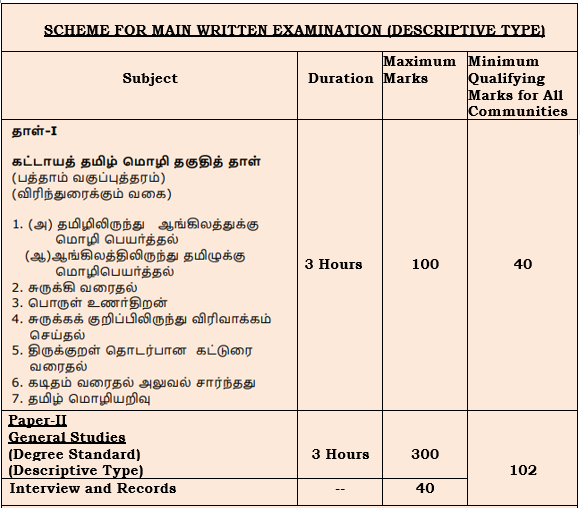
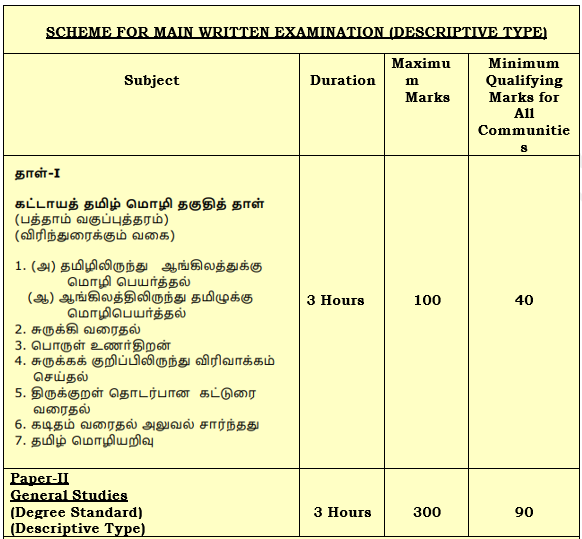
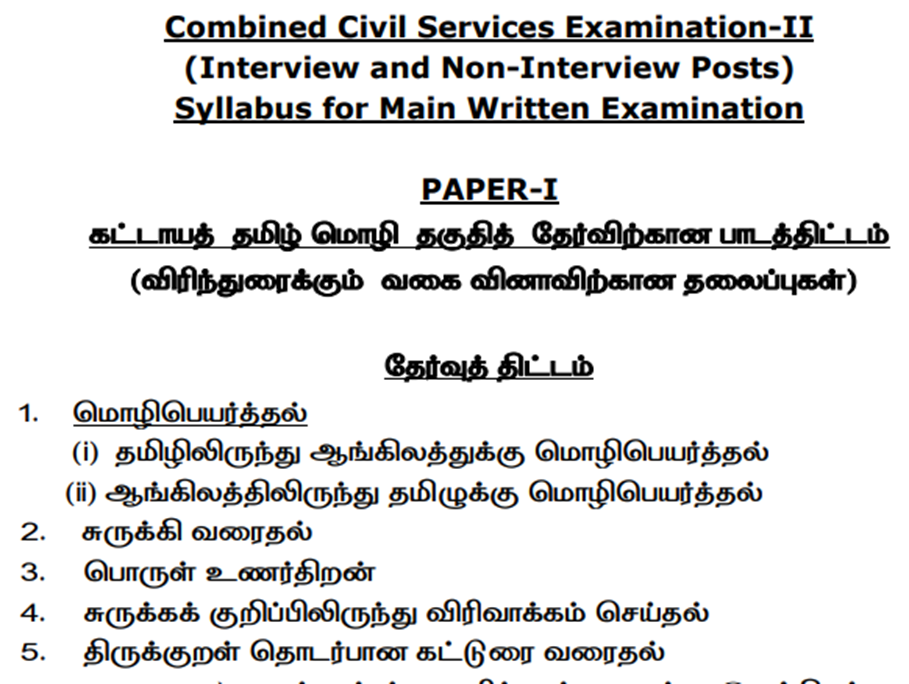
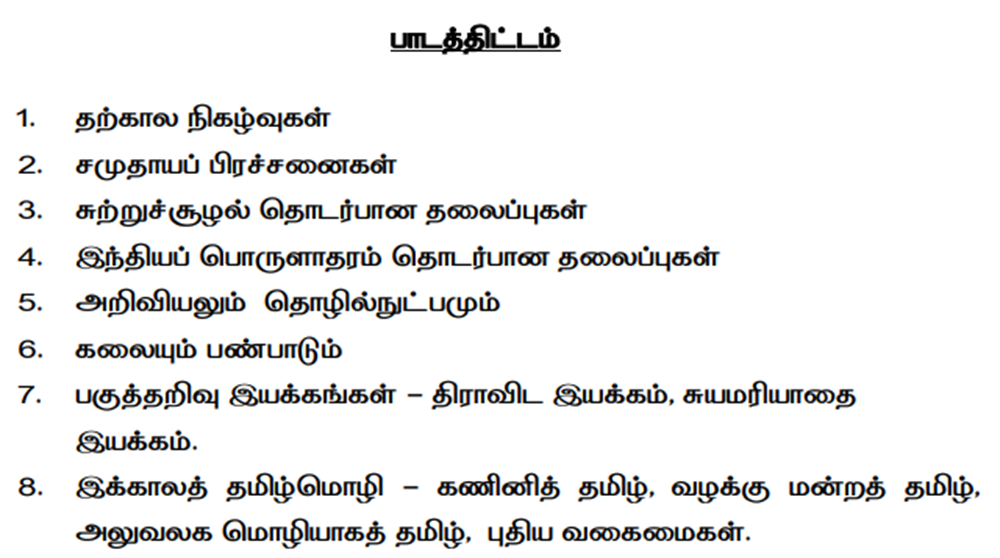
(B) SCHEME OF MAIN WRITTEN EXAMINATION AND ORAL TEST FOR INTERVIEW POSTS:Note: Paper-II will be evaluated only if the candidate secures minimum qualifying marks in Paper-I. Except the questions on “Tamil to English translation” all the questions in Paper-I should be answered in Tamil only. Paper-II has to be answered fully in Tamil or fully in English. Marks secured in Paper-II alone will be considered for selection to Interview
(c) SCHEME OF MAIN WRITTEN EXAMINATION FOR NON-INTERVIEW POSTS:-
Note: Paper-II will be evaluated only if the candidate secures minimum qualifying marks in Paper-I. Except the questions on “Tamil to English translation” all the questions in Paper-I should be answered in Tamil only. Paper-II has to be answered fully in Tamil or fully in English. Marks secured in Paper-II alone will be considered for selection.SELECTION PROCEDURE:
(A) Interview Post:
The selection of candidates for appointment to the posts mentioned in Table-I will be made in three stages viz., (i) Preliminary Examination for selection of candidates for admission to the Main Written Examination (ii) Main Written Examination and (iii) an Oral Test in the shape of an Interview and Counselling.
The Preliminary Examination is meant to serve as a screening test only. The marks obtained in the Preliminary Examination by the candidates who are declared qualified for admission to the Main Written Examination will not be counted for determining their final order of merit. The number of candidates to be admitted to the Main Written Examination will be 10 times the number of candidates to be recruited having regard to the rule of reservation of appointments. However, in each reservation group, all the candidates who secure the same marks as that of cut off marks of their reservation groups shall also be admitted to the Main Written Examination, though the number of candidates to be admitted to the Main Written Examination may exceed 1:10 ratio.
The final selection will be made based on the total marks obtained by the candidates in the Main Written Examination Paper-II and Oral Test taken together, subject to Rule of Reservation of Appointments.
(B) Non-Interview Post:
The selection of candidates for appointment to the posts mentioned in Table-II will be made in two stages viz., (i) Preliminary Examination for selection of candidates for admission to the Main Written Examination (ii) Main Written Examination and Counselling.
The Preliminary Examination is meant to serve as a screening test only. The marks obtained in the Preliminary Examination by the candidates who are declared qualified for admission to the Main Written Examination will not be counted for determining their final order of merit. The number of candidates to be admitted to the Main Written Examination will be 10 times the number of candidates to be recruited having regard to the rule of reservation of appointments. However, in each reservation group, all the candidates who secure the same marks as that of cut off marks of their reservation groups shall also be admitted to the Main Written Examination, though the number of candidates to be admitted to the Main Written Examination may exceed 1:10 ratio. Final selection will be made based on the marks obtained in Main Written Examination Paper-II, subject to Rule of Reservation of Appointments.
SYLLABUS
COMBINED CIVIL SERVICES EXAMINATION—II
(Interview Posts and Non-Interview Posts)
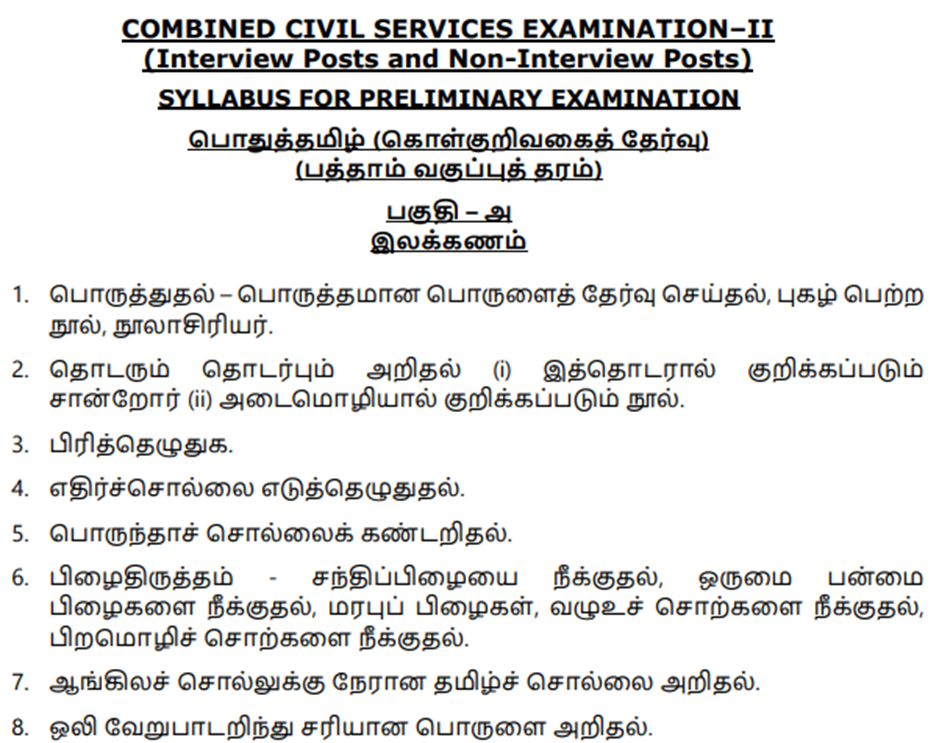
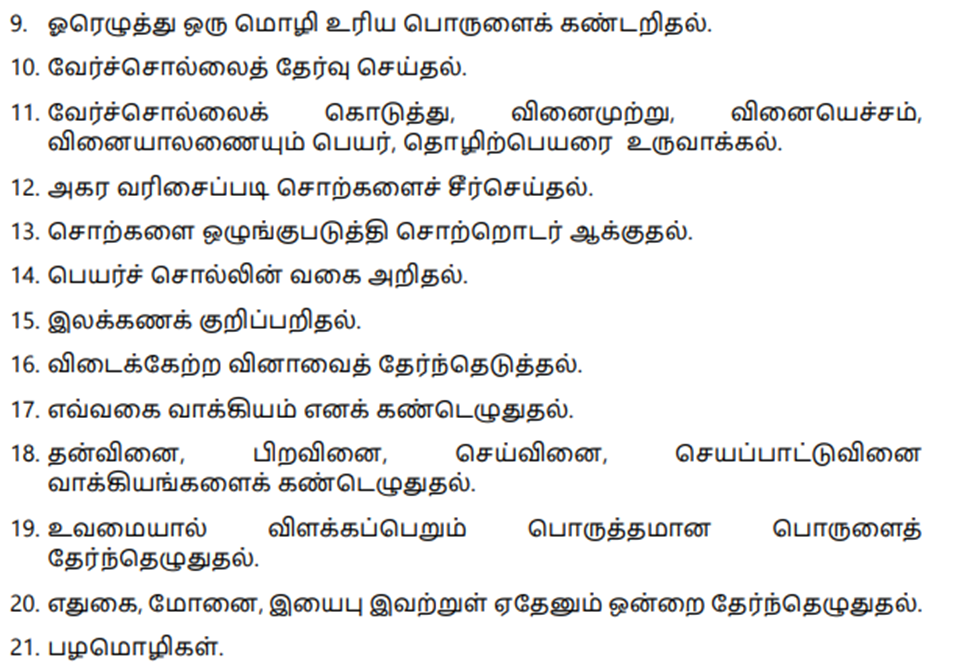
SYLLABUS FOR PRELIMINARY EXAMINATION
GENERAL ENGLISH
SSLC Standard (Objective Type Examination)Part A
Grammar
Match the following words and phrases given in Column A with their meanings in Column B.
Choose the correct ‘Synonym’ for the underlined word from the options given.
Choose the correct ‘Antonym’ for the underlined word from the options given.
Select the correct word (Prefix, Suffix).
Fill in the blanks with suitable Article.
Fill in the blanks with suitable Preposition.
Select the correct Question Tag.
Select the correct Tense.
Select the correct Voice.
Fill in the blanks (Infinitive, Gerund, Participle).
Identify the sentence pattern of the following sentence (Subject, Verb, Object…).
Fill in the blanks with correct Homophones.
Find out the Error (Articles, Preposition, Noun, Verb, Adjective, Adverb).
Select the correct sentence.
Find out the odd words (Verb, Noun, Adjective, Adverb).
Select the correct Plural forms.
Identify the sentence (Simple, Compound, Complex Sentence).
Identify the correct Degree.
Form a new word by blending the words.
Form compound words (eg.: Noun+Verb, Gerund+Noun).
– Rhyme Scheme – Rhyming Words – Repetition, etc.)
Poetry Appreciation
Important Lines
LIST OF POEMS
Life – Henry Van Dyke
I am Every Woman – Rakhi Nariani Shirke
The Secret of the Machines – Rudyard Kipling
The Ant and The Cricket – Adapted from Aesop’s fables
No Men are Foreign – James Falconer Kirkup
The House on Elm Street – Nadia Bush
Stopping by Woods on a Snowy Evening – Robert Frost
A Poison Tree – William Blake
On Killing a Tree – Gieve Patel
The Spider and the Fly – Mary Botham Howitt
The River – Caroline Ann Bowles
The Comet – Norman Littleford
The Stick-together Families – Edgar Albert Guest
Special Hero – Christina M. Kerschen
Making Life Worth While – George Elliot
A Thing of Beauty – John Keats
Lessons in Life – Brigette Bryant & Daniel Ho
My Computer Needs a Break – Shanthini Govindan
Your Space – David Bates
Sea Fever – John Masefield
Courage – Edgar Albert Guest
Team Work – Edgar Albert Guest
From a Railway Carriage – Robert Louis Stevenson
Indian Seasons – Nisha Dyrene
A Tragic Story – William Makepeace Thackeray
Part-C Literary Works
LIST OF PROSE
His First Flight – Liam O’Flaherty
The Tempest – Tales From Shakespeare
The Last Lesson – Alphonse Daudet
The Little Hero of Holland – Mary Mapes Dodge
The Dying Detective – Arthur Conan Doyle
Learning the Game (Book Extract) – Sachin Tendulkar
The Cat and the Painkiller (An Extract from The Adventures of Tom Sawyer)
– Mark Twain
Water – The Elixir of Life – Sir C.V.Raman
The Story of a Grizzly Cub – William Temple Hornaday
Sir Isaac Newton – Nathaniel Hawthorne
My Reminiscence – Rabindranath Tagore
The Woman on Platform 8 – Ruskin Bond
The Nose Jewel – C.Rajagopalachari
A Birthday Letter – Jawaharlal Nehru
II. Biographies of –
Mahatma Gandhi – Jawaharlal Nehru – Subash Chandra Bose – Helen Keller – Kalpana Chawala – Dr.Salim Ali – Rani of Jhansi – Nelson Mandela – Abraham Lincoln
III. General Comprehension
Combined Civil Services Examination—II (Interview Posts and Non-Interview Posts)
General Studies (Preliminary Examination)(Degree Standard)
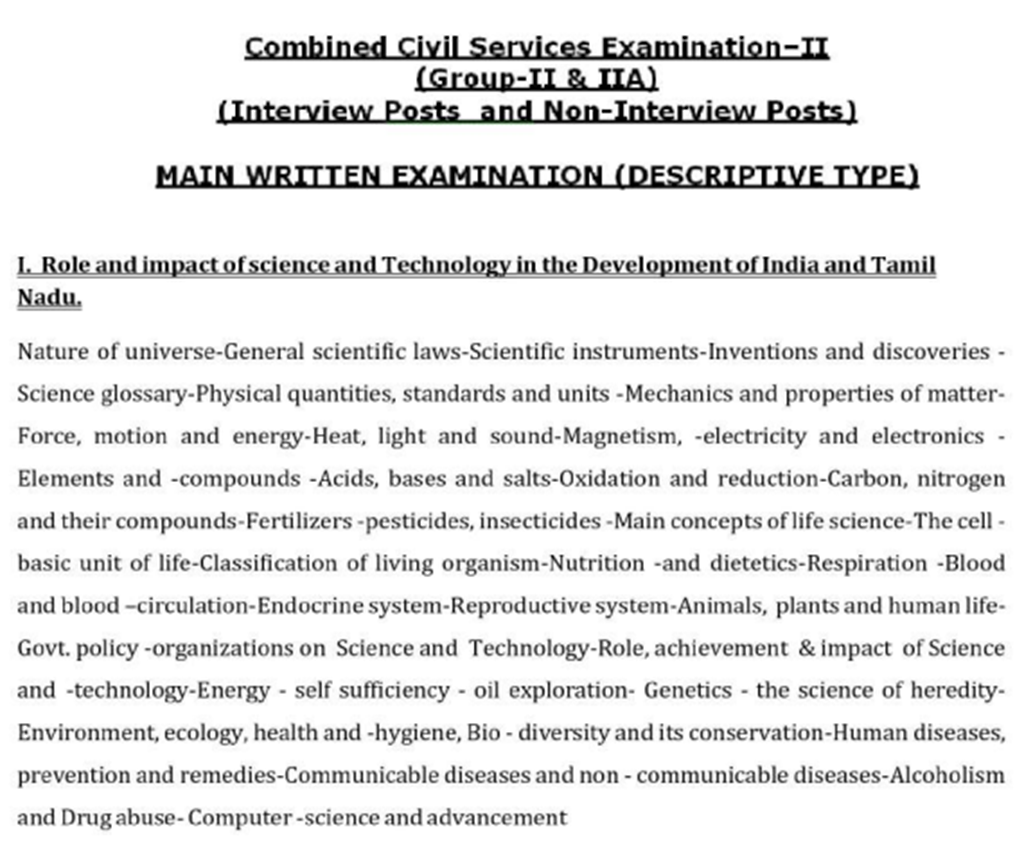
Topics for Objective Type UNIT-I: GENERAL SCIENCE
Scientific Knowledge and Scientific Temper – Power of Reasoning
– Rote Learning vs Conceptual Learning – Science as a tool to understand the past, present and future.
Nature of Universe – General Scientific Laws – Mechanics – Properties of Matter, Force, Motion and Energy – Everyday application of the Basic Principles of Mechanics, Electricity and Magnetism, Light, Sound, Heat, Nuclear Physics, Laser, Electronics and Communications.
Elements and Compounds, Acids, Bases, Salts, Petroleum Products, Fertilisers, Pesticides.
Main concepts of Life Science, Classification of Living Organisms, Evolution, Genetics, Physiology, Nutrition, Health and Hygiene, Human Diseases.
Environment and Ecology.
UNIT-II: CURRENT EVENTS
History – Latest diary of events – National symbols – Profile of States – Eminent personalities and places in news – Sports – Books and authors.
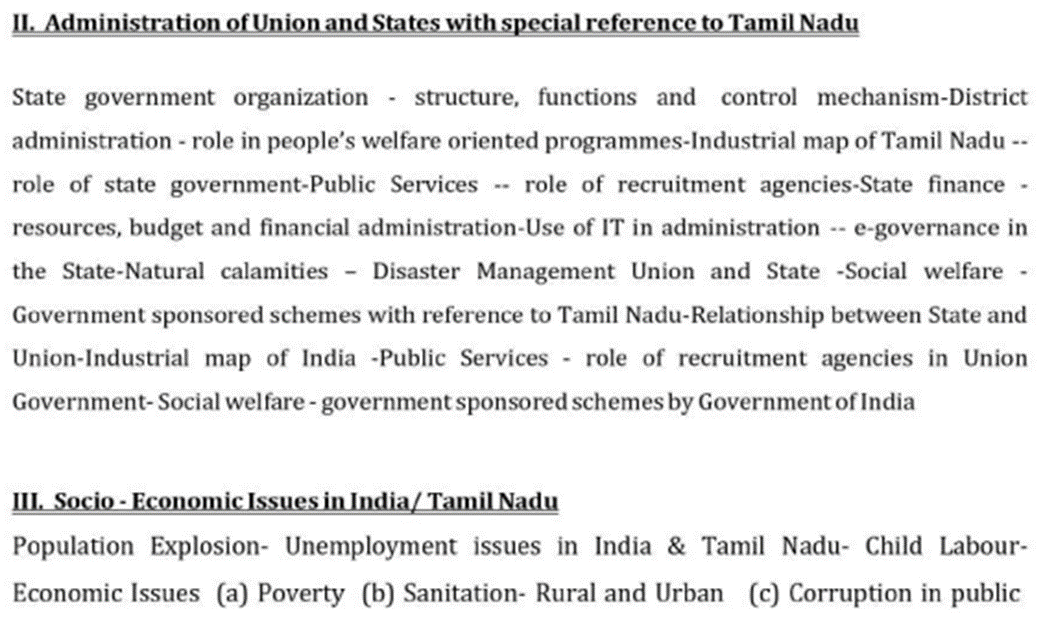
Polity – Political parties and political system in India – Public awareness and General administration – Welfare oriented Government schemes and their utility, Problems in Public Delivery Systems.
Geography – Geographical landmarks.
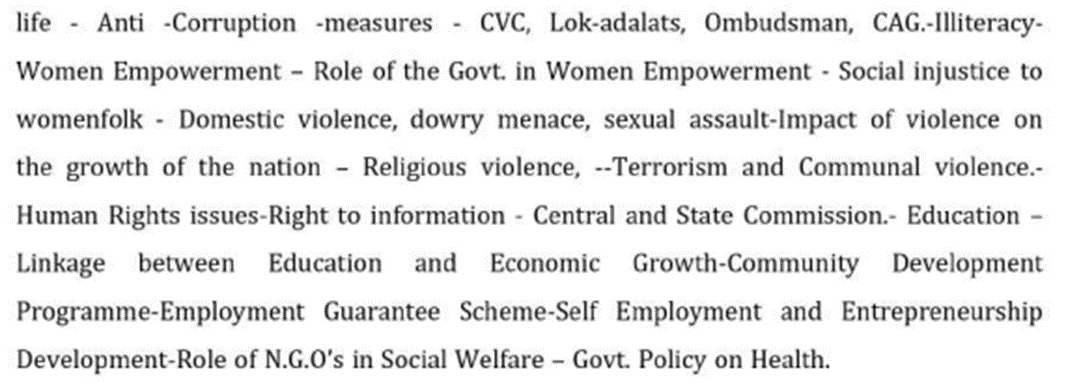
Economics – Current socio – economic issues.
Science – Latest inventions in Science and Technology.
Prominent Personalities in various spheres – Arts, Science, Literature and Philosophy.
UNIT-III: GEOGRAPHY OF INDIA
Location – Physical features – Monsoon, Rainfall, Weather and Climate – Water Resources – Rivers in India – Soil, Minerals and Natural Resources – Forest and Wildlife – Agricultural pattern.
Transport – Communication.
Social Geography – Population density and distribution – Racial, Linguistic Groups and Major Tribes.
Indus Valley Civilization – Guptas, Delhi Sultans, Mughals and Marathas – Age of Vijayanagaram and Bahmani Kingdoms – South Indian History.
Change and Continuity in the Socio-Cultural History of India.
Characteristics of Indian Culture, Unity in Diversity – Race, Language, Custom.
India as a Secular State, Social Harmony.
UNIT-V: INDIAN POLITY
Constitution of India – Preamble to the Constitution – Salient features of the Constitution – Union, State and Union Territory.
Citizenship, Fundamental Rights, Fundamental Duties, Directive Principles of State Policy.
Union Executive, Union Legislature – State Executive, State Legislature – Local Governments, Panchayat Raj.
Spirit of Federalism: Centre – State Relationships.
Election – Judiciary in India – Rule of Law.
Corruption in Public Life – Anti-corruption measures – Lokpal and Lok Ayukta – Right to Information – Empowerment of Women – Consumer Protection Forums, Human Rights Charter.
UNIT-VI: INDIAN ECONOMY
Nature of Indian Economy – Five year plan models – an assessment – Planning Commission and Niti Ayog.
Sources of revenue – Reserve Bank of India – Fiscal Policy and Monetary Policy – Finance Commission – Resource sharing between Union and State Governments – Goods and Services Tax.
Structure of Indian Economy and Employment Generation, Land Reforms and Agriculture – Application of Science and Technology in Agriculture – Industrial growth – Rural Welfare Oriented Programmes – Social Problems – Population, Education, Health, Employment, Poverty.
UNIT-VII: INDIAN NATIONAL MOVEMENT
National Renaissance – Early uprising against British rule – Indian National Congress – Emergence of leaders – B.R.Ambedkar, Bhagat Singh, Bharathiar, V.O.Chidambaranar Jawaharlal Nehru, Kamarajar, Mahatma Gandhi, Maulana Abul Kalam Azad, Thanthai Periyar, Rajaji, Subash Chandra Bose, Rabindranath Tagore and others.
Different modes of Agitation: Growth of Satyagraha and Militant Movements.
Communalism and Partition.
UNIT-VIII: History, Culture, Heritage and Socio – Political Movements in Tamil Nadu
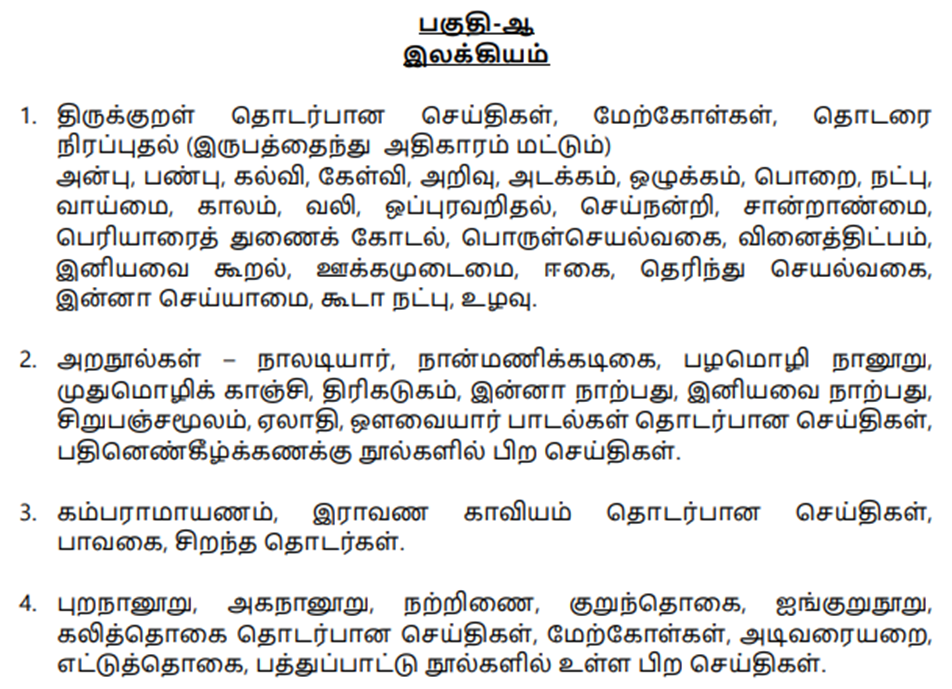
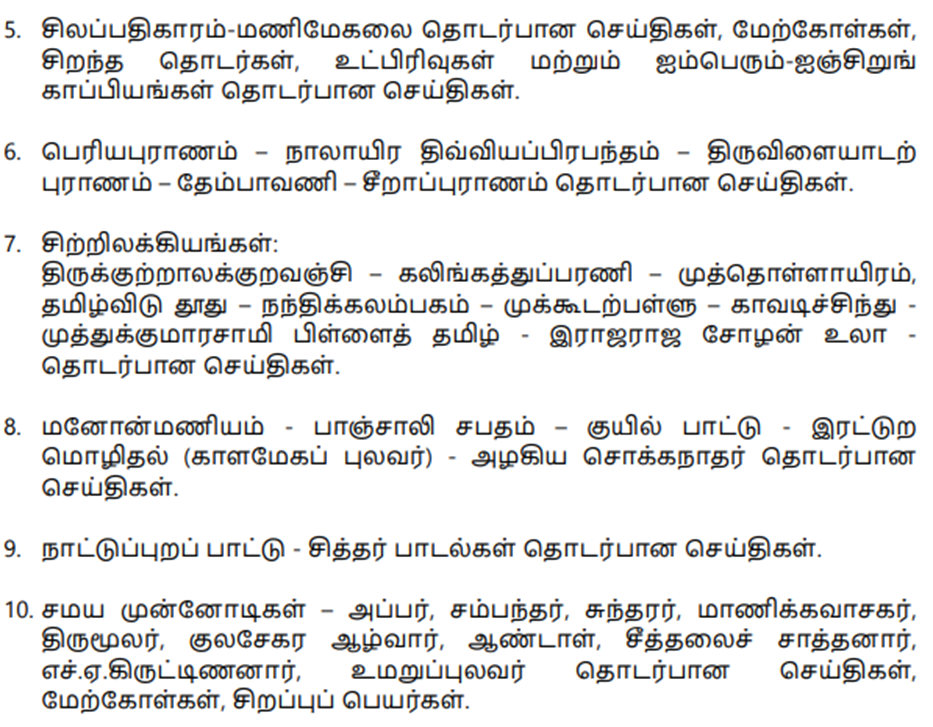
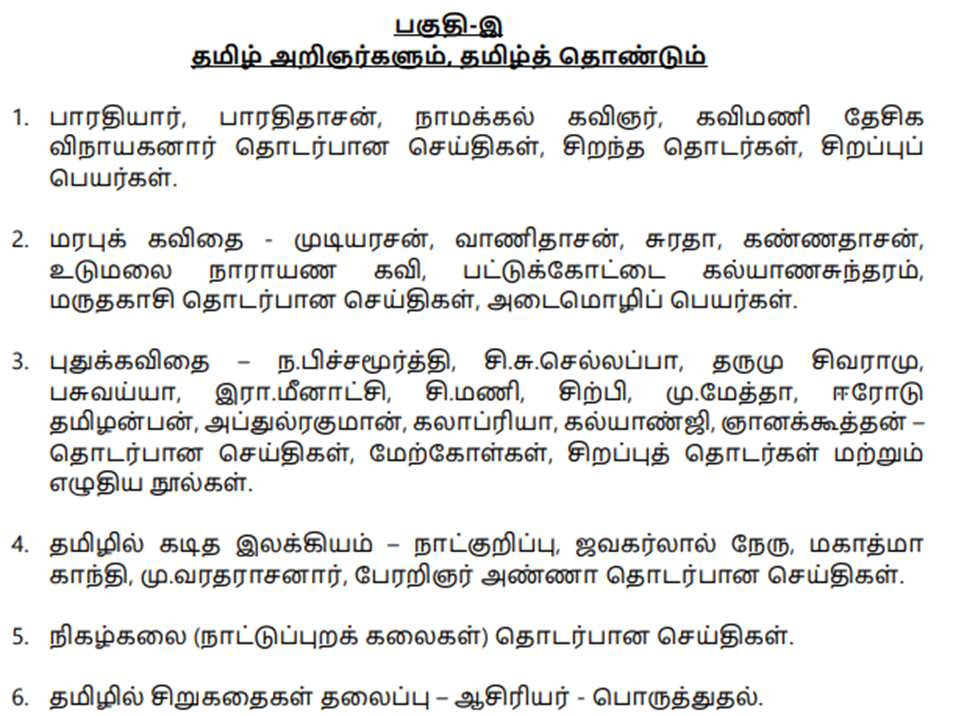
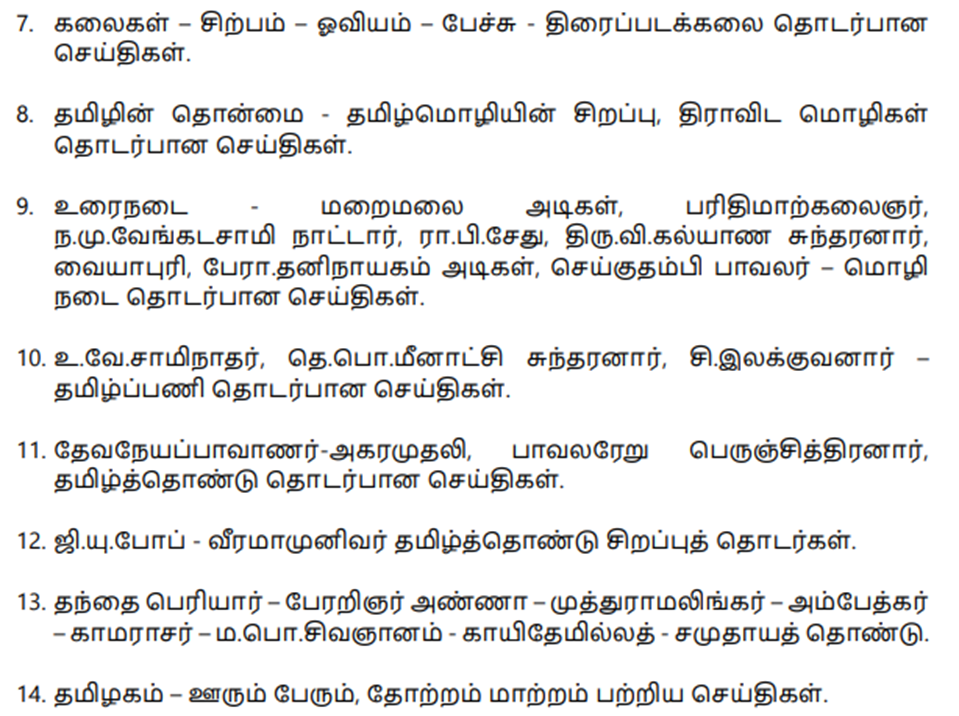
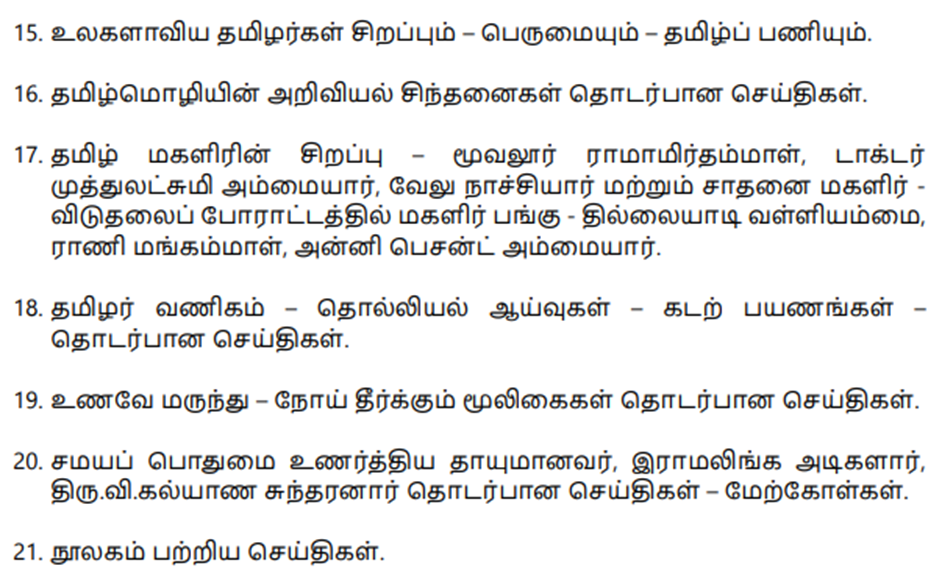
History of Tamil Society, related Archaeological discoveries, Tamil Literature from Sangam Age till contemporary times.
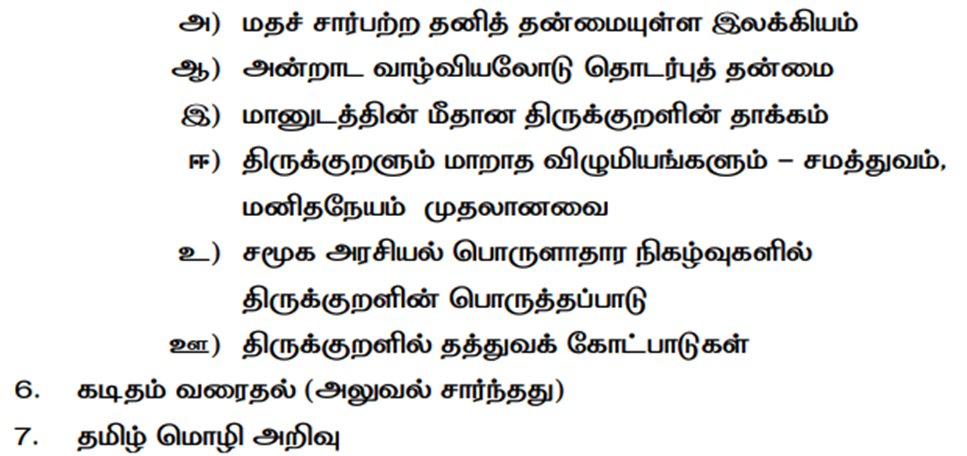
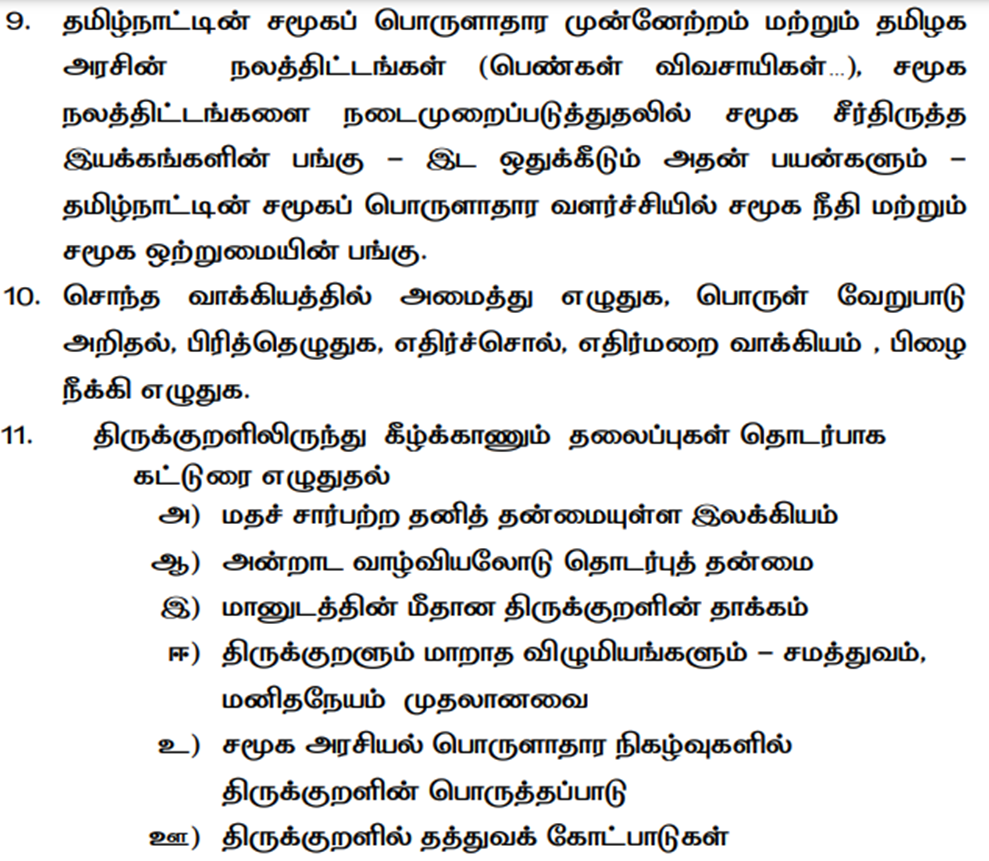
Thirukkural : (a) Significance as a Secular Literature
Relevance to Everyday Life
Impact of Thirukkural on Humanity
Thirukkural and Universal Values – Equality,
Humanism, etc
Relevance to Socio – Politico – Economic affairs
Philosophical content in Thirukkural
Role of Tamil Nadu in freedom struggle – Early agitations against British Rule – Role of women in freedom struggle.
Evolution of 19th and 20th Century Socio-Political Movements in Tamil Nadu – Justice Party, Growth of Rationalism – Self Respect Movement, Dravidian Movement and Principles underlying both these Movements, Contributions of Thanthai Periyar and Perarignar Anna.
UNIT—IX: Development Administration in Tamil Nadu
Human Development Indicators in Tamil Nadu and a comparative assessment across the Country – Impact of Social Reform Movements in the Socio – Economic Development of Tamil Nadu.
Political parties and Welfare schemes for various sections of people – Rationale behind Reservation Policy and access to Social Resources – Economic trends in Tamil Nadu – Role and impact of social welfare schemes in the Socio – Economic Development of Tamil Nadu.
Social Justice and Social Harmony as the Cornerstones of Socio- Economic Development.
Education and Health Systems in Tamil Nadu.
Geography of Tamil Nadu and its impact on Economic growth.
Achievements of Tamil Nadu in various fields.
e-Governance in Tamil Nadu.
UNIT-X: APTITUDE AND MENTAL ABILITY
Simplification – Percentage – Highest Common Factor (HCF) – Lowest Common Multiple (LCM).
Ratio and Proportion.
Simple interest – Compound interest – Area – Volume – Time and Work.
Our complete 18-month programme for the UPSC Civil Services Exam: Prelims with CSAT, Mains, Optional, Personality Test, both test series, current affairs and complete material.
Duration
18 months
Classroom (Anna Nagar, Chennai) · Hybrid · Live onlineView course

 UPSC


